
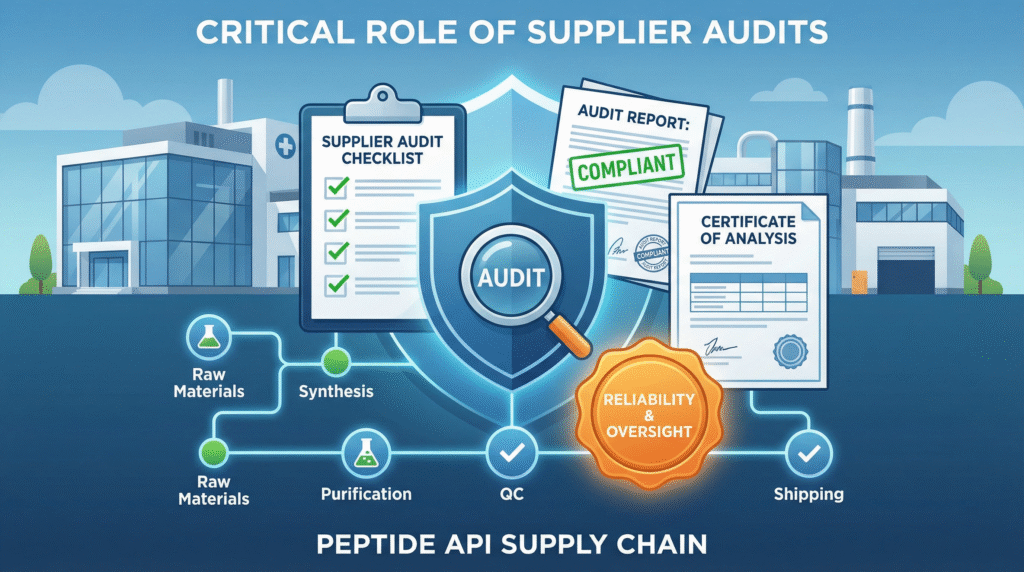
The global peptide API market, projected to reach $75 billion by 2028, faces unprecedented quality and security challenges, with industry surveys revealing that 35% of pharmaceutical companies have experienced a significant quality event linked to a peptide supplier in the past three years. In this high-stakes environment, where a single audit oversight can result in multi-million dollar recalls, clinical trial delays, and irrevocable brand damage, a systematic and comprehensive supplier auditing framework is not a regulatory formality—it is the fundamental cornerstone of supply chain resilience and patient safety.
This definitive guide provides a detailed, actionable checklist for qualifying peptide API manufacturers, synthesizing current Good Manufacturing Practice (cGMP) requirements, ICH Q7 and Q9 principles, and industry best practices to enable auditors to conduct assessments that reduce quality risk by 60-80%, accelerate onboarding timelines by 30-50%, and build a foundation of trust with partners capable of delivering the consistent, high-quality materials essential for the next generation of peptide therapeutics.
The Critical Role of Supplier Auditing in Peptide API Supply Chains
Effective auditing transforms supplier relationships from transactional engagements to strategic partnerships built on demonstrated quality and shared responsibility.
The Evolving Risk Landscape for Peptide APIs
Multiple factors increase the complexity and criticality of peptide supplier audits:
- Synthetic Complexity: Multi-step solid-phase peptide synthesis (SPPS) introduces numerous critical process parameters.
- Supply Chain Fragility: 40% of peptide starting materials face single-source dependency risks.
- Regulatory Scrutiny: FDA and EMA increasing inspections of API manufacturers, with 25% citing data integrity issues.
- Therapeutic Criticality: Peptides often target chronic, high-unmet-need indications where interruptions are unacceptable.
Beyond Compliance: The Business Case for Rigorous Auditing
Strategic benefits of a robust supplier qualification program:
- Risk Mitigation: Proactive identification and correction of issues before they impact your supply.
- Cost Avoidance: Prevention of batch failures, recalls, and regulatory actions costing 10-100x the audit investment.
- Operational Efficiency: Streamlined tech transfer and reliable supply from qualified partners.
- Innovation Enablement: Confidence to pursue complex molecules knowing manufacturing partners are capable.
“Auditing a peptide API manufacturer is not about checking boxes on a form. It’s a deep forensic investigation into an organization’s quality culture, technical capability, and commitment to doing the right thing—even when no one is watching. The most significant risks are often found not in the equipment, but in the mindset of the people operating it.” — Elena Rodriguez, VP of Global Quality & Compliance, Major Pharma Corporation.
Foundational Framework: Principles of an Effective Peptide API Audit

Successful audits are built on a structured approach that balances thorough investigation with objective evaluation.
Pre-Audit Preparation and Planning
Critical activities before setting foot on site:
- Document Request List (DRL): Secure key documents (Quality Manual, Org Charts, List of Equipment, recent CAPAs, Change Controls) for review.
- Risk-Based Scope Definition: Focus audit intensity based on molecule complexity, past performance, and therapeutic criticality.
- Team Assembly: Include experts in peptide chemistry, analytics, quality systems, and engineering as needed.
- Agenda Development: Detailed schedule allowing time for document review, facility walkthrough, and interviews.
The Audit Lifecycle: From Planning to Closure
A phased approach ensures comprehensive coverage:
- Phase 1: Desktop Assessment – Review of submitted quality system documents and stability data.
- Phase 2: On-Site Audit – In-depth evaluation of facilities, processes, and personnel (3-5 days typical).
- Phase 3: Report & Response – Formal audit report issuance, supplier response with corrective actions.
- Phase 4: Closure & Monitoring – Verification of corrective actions and establishment of ongoing quality metrics.
Comprehensive Peptide API Supplier Audit Checklist
This detailed checklist is organized by system and can be adapted based on the specific audit scope and risk assessment.
1. Quality Management System (QMS)
Evaluation of the foundational quality system and its effectiveness.
| Check Area | Key Questions / Evidence to Review | Acceptable State / Observations |
|---|---|---|
| Quality Manual & Policies | Is there a current, approved Quality Manual? Does it align with ICH Q7 and cGMP? Are quality policies (e.g., data integrity) clearly defined and communicated? | Manual is comprehensive, accessible, and implemented. Policies are evidenced in practice. |
| Management Responsibility | Is there evidence of senior management review of the QMS (management reviews)? Is there a designated, independent Quality Unit with adequate authority? Are sufficient resources allocated to quality functions? | Regular management reviews with actionable outputs. Quality Unit has clear authority to reject materials and stop operations. Staffing levels are adequate. |
| Document Control | Are documents (SOPs, specifications, batch records) controlled? Is there a robust change control procedure? Observe document issuance, use, and retrieval on the manufacturing floor. | No uncontrolled documents in use. Changes are properly reviewed and approved. Batch records are completed in real-time with ink. |
| Deviation, CAPA, & Change Control | Review recent deviations, OOS results, and CAPAs. Are root causes investigated adequately? Are CAPAs effective? Is change control rigorous, especially for critical process/analytical changes? | Trends are analyzed. CAPAs address root cause and are verified for effectiveness. Changes are assessed for impact prior to implementation. |
| Internal Audits & Supplier Management | Does the site conduct internal audits? Are their own critical suppliers (e.g., Fmoc-amino acids) qualified? Review their supplier qualification program. | Schedule of internal audits exists and is followed. Their supplier audits are robust. Critical raw materials have certified CoAs. |
2. Facilities, Equipment, and Utilities
Assessment of the physical plant and its suitability for peptide API manufacturing.
- Facility Design & Flow: Is there adequate segregation to prevent cross-contamination (e.g., dedicated suites for highly potent peptides)? Is the flow of personnel, materials, and waste logical?
- Cleanroom Classification & Monitoring: For aseptic processing or sterile API handling, verify classification (ISO 7/8) and ongoing particulate/microbial monitoring data.
- Equipment Qualification: Review DQ/IQ/OQ/PQ documentation for critical equipment (synthesizers, chromatography systems, lyophilizers). Is calibration status current and visible?
- Computerized System Validation: For systems controlling processes or managing quality data (LIMS, Chromatography Data Systems), assess validation status and data integrity controls (access, audit trail, backups).
- Utilities: Review qualification for WFI, clean steam, HVAC, and compressed gases. Are monitoring limits appropriate and adhered to?
3. Materials Management
Control over incoming starting materials, reagents, and solvents.
- Supplier Qualification: Are amino acid and other building block suppliers qualified? Are certificates of analysis (CoAs) verified by the QC lab?
- Receipt & Quarantine: Is there a clear process for receiving, labeling, and quarantining incoming materials?
- Storage Conditions: Are temperature and humidity-sensitive materials (e.g., Fmoc-amino acids) stored appropriately with monitoring. Verify freezer/refrigerator logs.
- Solvent Management: How are high-purity solvents (DMF, DCM, ACN) stored, handled, and tested? Is there a solvent recovery program, and if so, is it validated?
4. Manufacturing & Process Controls
The heart of the audit: evaluating the synthesis, purification, and isolation processes.
| Process Stage | Critical Audit Points |
|---|---|
| Peptide Synthesis (SPPS/LPS) | Review master and batch production records. Verify critical parameters (coupling times, deprotection, wash volumes) are defined and controlled. Observe charging of amino acids and reagents (weight verification). Assess handling of resin and in-process intermediates. |
| Cleavage & Deprotection | This is a high-risk step. Verify scavenger systems, cleavage time/temperature, and safety controls for handling strong acids (TFA, HF). |
| Purification (Chromatography) | Assay column packing and qualification records. Review purification methods and acceptance criteria for collected fractions. Evaluate how pooling decisions are made and documented. |
| Isolation & Lyophilization | Review freeze-drying cycles and validation. Check filter integrity testing (bubble point/diffusive flow) for sterile filtration. Assess aseptic handling techniques if applicable. |
| Process Validation | For commercial products, is there a Process Validation protocol/report per ICH Q7? For clinical stage, is there a development report justifying the process? |
5. Laboratory Controls (QC & Stability)
Ensuring the API is correctly tested and characterized.
- Analytical Method Validation/Verification: Review validation reports for critical methods (HPLC for purity/assay, peptide mapping, residual solvent analysis). Are methods stability-indicating?
- Specifications & Testing: Are release specifications appropriate and inclusive of critical quality attributes (CQA) like purity, chiral purity, related substances, and residual solvents? Review CoA against specifications.
- Reference Standards: How are primary (e.g., USP) and working standards qualified and stored?
- Stability Program: Is there an ongoing stability program per ICH Q1A? Review stability protocols, storage conditions, and data trends. Are stability chambers monitored and qualified?
- Out-of-Specification (OOS) Investigation: Interview analysts and review recent OOS investigations. Is the procedure compliant and robust, preventing “testing into compliance”?
6. Packaging, Labeling, and Warehousing
Controls to protect the finished API until delivery.
- Packaging Materials: Are primary packaging materials (vials, stoppers) suitable and tested for compatibility?
- Label Control: Are labels printed, checked, and reconciled to prevent mix-ups? Verify critical information (product name, batch number, purity, storage conditions).
- Storage & Distribution: Are quarantine and release statuses clearly marked? How is temperature control maintained during storage and shipping (qualified shippers, data loggers)?
7. Personnel, Training, and Hygiene
The human element of quality.
- Organizational Charts & Job Descriptions: Are roles, responsibilities, and reporting lines clear, particularly for the Quality Unit?
- Training Program: Review training records for key personnel (operators, analysts). Is training effective (beyond just attendance)? Is GMP and safety training current?
- Personal Hygiene & Gowning: Observe gowning procedures for clean areas. Are health checks performed for personnel entering aseptic areas?
Risk Management and Continuous Improvement
Evaluating the supplier’s proactive approach to identifying and mitigating risks.
- Formal Risk Management: Is there a system for risk assessment per ICH Q9? Are risks to product quality (e.g., single-source raw material) formally identified and managed?
- Quality Metrics & Trend Reporting: Does the supplier track and report key performance indicators (e.g., batch success rate, deviation rate, CAPA timeliness) to customers?
- Business Continuity Planning: Are there plans for dealing with equipment failure, utility loss, or other disruptions? Are backup systems or alternate sites identified?
Technology Transfer and Partnership Considerations
For audits related to a specific product transfer or development.
- Transfer Protocol/Report: Review the plan for transferring analytical methods and manufacturing processes. Is responsibility clear?
- Development & Scale-Up Capability: Assess the site’s experience and success in scaling processes from lab to clinic to commercial volumes.
- Intellectual Property (IP) Protection: How does the site ensure confidentiality of client processes and data?
- Communication & Project Management: Evaluate the responsiveness and structure of the project team.
Audit Reporting, Response, and Closure
The critical follow-through to ensure audit findings are addressed.
- Audit Report: Findings should be clear, specific, and referenced to regulations/guidelines. They should be categorized by criticality (Critical, Major, Minor).
- Supplier Response: The supplier should provide a formal response with proposed corrective and preventive actions (CAPA) for each finding, with realistic due dates.
- CAPA Effectiveness Check: The auditor must verify that CAPAs have been implemented and are effective, often requiring evidence (updated SOPs, training records, data) or even a follow-up audit for major issues.
- Qualification Status Decision: Based on the audit outcome and CAPA verification, a decision is made: Approved, Approved with Conditions, or Not Approved.
Future Trends: Evolving Audit Practices
The landscape of supplier auditing is changing with technology and regulation.
- Remote Auditing & Hybrid Models: The use of live video streams, document sharing platforms, and continuous data monitoring to supplement or, in some cases, replace on-site visits for lower-risk assessments.
- Data Integrity Focus: Increased scrutiny on data lifecycle management, from electronic systems validation to audit trail review, driven by regulatory emphasis.
- Environmental, Social, and Governance (ESG) Factors: Audits beginning to incorporate assessments of sustainable practices, ethical sourcing, and supply chain transparency.
- Artificial Intelligence in Audit Preparation: Using AI to analyze a supplier’s historical regulatory inspection reports, quality metrics, and news to identify potential risk areas before the audit.
FAQs: Peptide API Supplier Auditing
Q: How long does a typical on-site audit of a peptide API manufacturer take, and what size should the audit team be?
A: The duration of an on-site audit typically ranges from 2 to 5 days, depending on the scope, complexity of the processes, and the size of the facility. A routine, full-scope cGMP audit of a established peptide manufacturer often requires 3-4 days. The audit team usually consists of 2-3 members, including a lead auditor with strong QMS knowledge, a subject matter expert in peptide chemistry/manufacturing, and potentially an analytical specialist. For smaller or more focused audits (e.g., a follow-up or a for-cause audit), a single experienced auditor might suffice over 1-2 days.
Q: What is the single most critical finding that would cause an auditor to immediately recommend disqualification of a peptide supplier?
A: While any critical finding is serious, a systemic failure in data integrity is often considered a disqualifying event. This includes evidence of data falsification, back-dating records, deleting original data without justification, disabling audit trails, or a culture where “testing into compliance” (repeatedly testing a sample until it passes) is tolerated. Data integrity is the foundation of trust.
If you cannot trust the data on the certificate of analysis, you cannot trust the product. Other critical findings like a complete lack of sterility assurance for an aseptically processed API or evidence of willful non-compliance with critical GMPs would also lead to immediate disqualification.
Q: How often should a qualified peptide API supplier be re-audited?
A: The standard re-audit frequency is every 2-3 years for a routine, full-scope surveillance audit. However, this should be risk-based. A supplier with an excellent quality record, strong KPIs, and no significant changes may be audited every 3 years. A supplier with a history of issues, one manufacturing a highly complex or high-risk molecule, or one that has undergone significant changes (new facility, new key personnel, major process changes) should be re-audited more frequently, potentially every 12-24 months. Additionally, “remote” or “desktop” assessments reviewing quality metrics, change notifications, and annual product reviews should be conducted annually between on-site audits.
Q: For an audit in a non-English speaking country, how should language and document translation be handled?
A: This requires careful planning. Key audit documents (Quality Manual, high-level SOPs, batch records for the product in question, recent audit reports) should be requested in English or with certified translations in advance. For the on-site audit, having a professional, independent interpreter who is familiar with technical and GMP terminology is essential—never rely on the supplier’s staff to interpret.
The audit report should be issued in English. For critical findings, ensure the supplier’s CAPA response is clearly understood; it may be necessary to have key sections of their response translated to verify appropriateness. Clear communication is paramount to avoid misunderstandings that could mask significant issues.
Core Takeaways
- Systematic & Risk-Based: Effective auditing is a structured, phased process driven by risk assessment, not a random inspection.
- Beyond the Checklist: While a checklist is vital, the audit must assess the underlying quality culture, data integrity, and management commitment.
- Depth in Critical Areas: For peptide APIs, pay particular attention to synthetic process controls, purification strategy, analytical method validity, and raw material (especially amino acid) quality.
- Follow-Through is Key: The audit’s value is realized only through rigorous evaluation of CAPA responses and verification of their effectiveness.
- Partnership Mindset: The goal is not to “catch” the supplier but to build a transparent, collaborative relationship that ensures a reliable supply of high-quality material.
Conclusion: Building a Foundation of Trust and Quality
The qualification of a peptide API manufacturer through comprehensive auditing is one of the most consequential activities in the pharmaceutical supply chain. In an era of increasing complexity and regulatory expectation, a thorough, evidence-based audit provides the confidence needed to advance life-saving therapies. By applying a rigorous, systematic framework and focusing on both technical capability and quality culture, organizations can secure a supply chain that is not only compliant but resilient, innovative, and capable of supporting the future of peptide medicine. The investment in a world-class audit program pays dividends in risk reduction, operational efficiency, and, ultimately, in the assurance that patients receive medicines of the highest possible quality.
Disclaimer:
This article contains information, data, and references that have been sourced from various publicly available resources on the internet. The purpose of this article is to provide educational and informational content. All trademarks, registered trademarks, product names, company names, or logos mentioned within this article are the property of their respective owners. The use of these names and logos is for identification purposes only and does not imply any endorsement or affiliation with the original holders of such marks. The author and publisher have made every effort to ensure the accuracy and reliability of the information provided.
However, no warranty or guarantee is given that the information is correct, complete, or up-to-date. The views expressed in this article are those of the author and do not necessarily reflect the views of any third-party sources cited.