
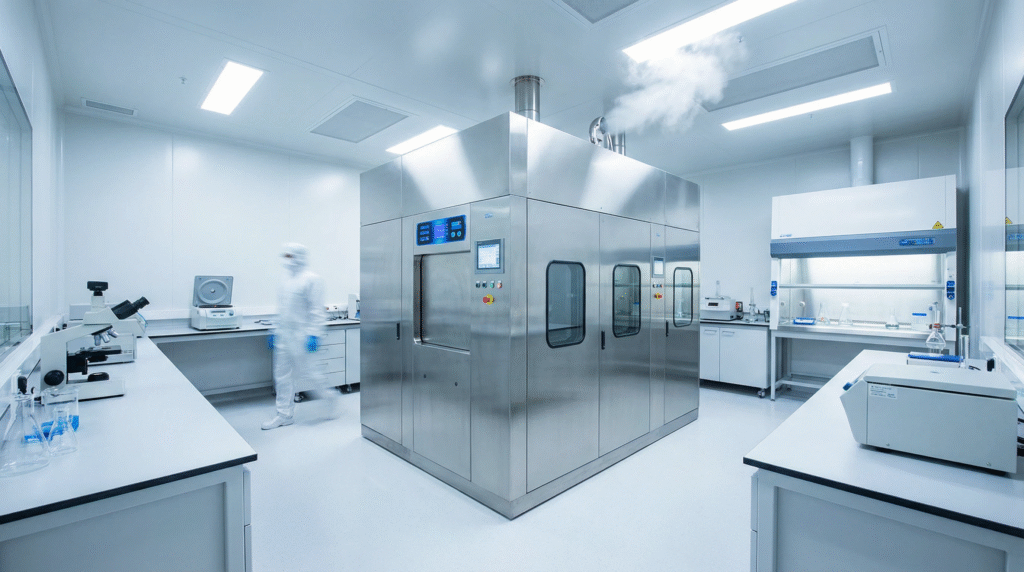
The global injectable peptide therapeutics market, projected to exceed $50 billion by 2028, is fundamentally dependent on one non-negotiable requirement: sterility. With regulatory agencies reporting that sterility failures account for over 20% of drug recalls and the stakes of patient safety being absolute, the selection and validation of an appropriate sterilization method is a critical determinant of product viability and regulatory approval. For peptide drugs—notoriously sensitive to heat, radiation, and chemical stress—this decision crystallizes into a strategic choice between the robust assurance of terminal sterilization and the gentle complexity of aseptic processing.
This comprehensive analysis delves into the scientific principles, validation paradigms, and regulatory imperatives governing these two pathways, providing a framework for achieving the mandated Sterility Assurance Level (SAL) of 10⁻⁶ while preserving the delicate structure and efficacy of life-saving peptide molecules.
The Sterility Imperative in Peptide Parenteral Products
Ensuring the absence of viable microorganisms is a cornerstone of patient safety for all injectable drugs, presenting unique challenges for biologically derived peptides.
Why Sterility is Non-Negotiable
The consequences of non-sterile injectables are severe and direct:
- Patient Safety Risks: Microbial contamination can lead to sepsis, endotoxic shock, and death.
- Regulatory Mandate: All compendia (USP, EP, JP) require sterile products for injection, with a defined Sterility Assurance Level (SAL).
- Product Recall & Liability: A single sterility failure can trigger global recalls, costing hundreds of millions and irrevocably damaging brand trust.
- Clinical Trial Integrity: Sterility failures in clinical supply can invalidate trial results and delay development by years.
The Unique Vulnerability of Peptides
Peptide molecules present specific challenges that constrain sterilization options:
- Thermal Lability: Many peptides denature, aggregate, or hydrolyze at standard autoclave temperatures (121°C).
- Radiation Sensitivity: Gamma and e-beam radiation can cause cleavage of peptide bonds and generation of radiolytic by-products.
- Chemical Reactivity: Peptides can react with sterilizing agents like ethylene oxide or vaporized hydrogen peroxide, leading to covalent modifications.
- Formulation Complexity: Presence of stabilizers, buffers, and other excipients must also withstand the chosen sterilization method.
“The sterilization decision for a peptide is not a mere technical selection; it is a fundamental product definition. Choosing terminal sterilization commits you to a molecule and formulation robust enough to survive it. Choosing aseptic processing commits you to building an immutable culture of absolute environmental control. Both paths demand rigorous validation, but they validate fundamentally different things: the process’s lethality versus the process’s exclusionary capability.” — Dr. Anya Sharma, Head of Sterile Product Development, Global CMO.
Terminal Sterilization: The Gold Standard When Feasible
Terminal sterilization involves processing the sealed, final drug product in its final container to achieve sterility.
Common Terminal Sterilization Modalities
Methods applicable to peptide products, listed in order of preference per regulatory guidelines:
| Method | Mechanism | Typical Conditions | Peptide Compatibility Considerations |
|---|---|---|---|
| Moist Heat (Autoclaving) | Denaturation of microbial proteins and enzymes by saturated steam under pressure. | 121°C for 15 minutes (overkill). Various cycles (e.g., 115°C for longer) can be validated. | Rarely feasible for most therapeutic peptides due to heat lability. May be possible for short, stable peptides or with extreme formulation optimization. |
| Dry Heat | Oxidative destruction of microbes by high-temperature air. | 160-180°C for 120+ minutes. | Generally not suitable for peptides due to extreme thermal degradation. Used for depyrogenation of glassware and tools. |
| Radiation (Gamma, E-beam) | Ionizing radiation damages microbial DNA. | 25 kGy standard dose; dose-setting studies can justify lower levels. | Can cause peptide fragmentation and generation of unique radiolytic impurities. Requires extensive compatibility and stability studies. |
| Gas (Ethylene Oxide) | Alkylation of microbial proteins and DNA. | Combination of EtO concentration, humidity, temperature, and exposure time. | Risk of alkylating the peptide itself. Significant residue concerns (EtO, ECH) require exhaustive aeration and testing. Rarely used for pharmaceuticals today. |
Validation of Terminal Sterilization Processes
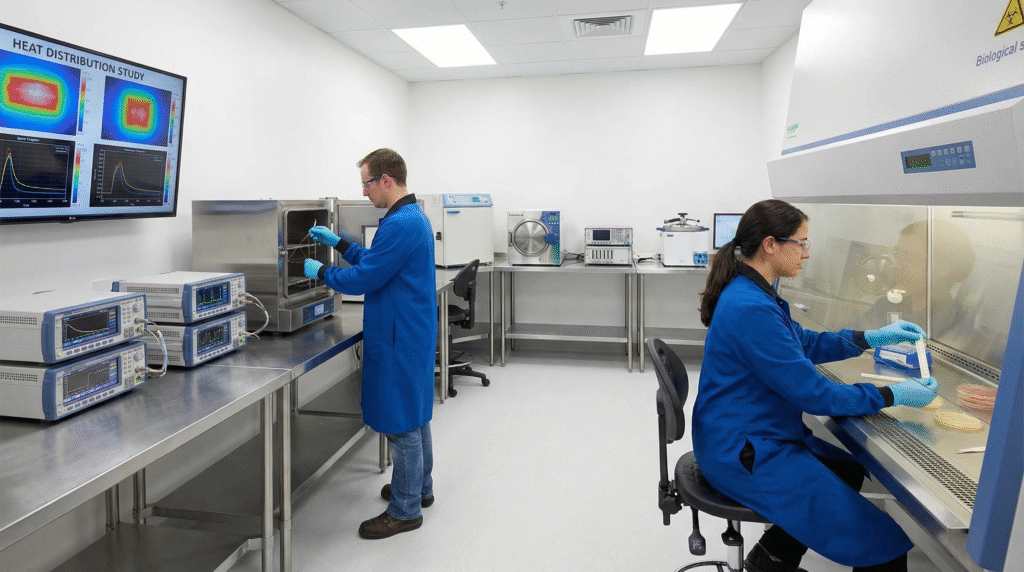
Terminal sterilization validation is a direct, quantitative exercise focused on demonstrating microbial kill.
- Cycle Development & Qualification (IQ/OQ): Establishing equipment functionality and reproducible physical parameters (temperature, pressure, radiation dose).
- Performance Qualification (PQ) – Physical:
- Heat Distribution Studies: Mapping temperature uniformity within the empty chamber.
- Heat Penetration Studies: Measuring temperature at the coldest point within the product (or a simulated product) during a cycle.
- Dose Mapping (for radiation): Determining the minimum and maximum dose received within a product load.
- Performance Qualification (PQ) – Microbiological:
- Biological Indicators (BIs): Using standardized, high-population spores (e.g., Geobacillus stearothermophilus for moist heat) placed at defined, worst-case locations.
- Demonstration of SAL 10⁻⁶: The cycle must reproducibly achieve a minimum log reduction (e.g., 12-log for an overkill cycle) of the BI, proving the SAL.
- Lethality Calculations (F0 Value): For moist heat, calculating the equivalent sterilization time at 121°C. An F0 > 12 minutes typically supports an overkill approach.
Aseptic Processing: The Predominant Pathway for Peptides
Aseptic processing involves sterilizing the peptide drug substance, container, and closure separately, then combining them under sterile conditions.
Core Components of an Aseptic Process
A chain of controlled steps where sterility is assembled, not terminally achieved:
- Sterilization of Drug Product: Peptide solution is filtered through a sterilizing-grade membrane (0.22 µm or 0.2 µm pore size).
- Sterilization of Components: Vials, stoppers, and seals are sterilized (typically by moist/dry heat or radiation).
- Aseptic Assembly: The filtered solution is filled into sterile vials and stoppered in an ISO 5 (Class A) cleanroom environment.
- Integral Systems: Use of closed systems, isolators, or RABS (Restricted Access Barrier Systems) to minimize human intervention.
Validation of Aseptic Processes: Process Simulation (Media Fill)
Validation is indirect, proving the capability of the process to prevent contamination.
- The Concept: Replacing the peptide solution with a sterile, growth-promoting microbial culture medium (e.g., TSB) and running the entire aseptic process at production scale and speed.
- Interventions & Worst-Case Conditions: The simulation must include all standard and unusual interventions (e.g., line stoppages, component additions, operator adjustments) that occur during normal production.
- Incubation & Evaluation: Filled units are incubated for 14 days and inspected for microbial growth. Any contaminated unit is investigated to identify the root cause.
- Acceptance Criteria: Regulatory expectation is zero growth from units incubated. A statistically valid number of units must be produced (typically 5,000-10,000+ for commercial batches). The process is validated initially and re-validated at regular intervals (e.g., twice per year per line).
Supporting Validation for Aseptic Processing
The media fill is supported by a foundation of other critical validations:
| Validation Area | Purpose | Key Requirements |
|---|---|---|
| Sterilizing Filtration Validation | Prove the filter removes all microorganisms from the product stream. | Bacterial Retention Test (ASTM F838), compatibility, extractables/leachables, adsorption, integrity test correlations (bubble point/diffusive flow). |
| Environmental Monitoring (EM) Program | Demonstrate ongoing control of the aseptic processing environment. | Viable (air, surface, personnel) and non-viable particle monitoring in ISO 5/7/8 areas. Strict action and alert limits. |
| Container-Closure Integrity Testing (CCIT) | Prove the final sealed container maintains a microbial barrier. | Performed post-process and throughout shelf-life. Methods include dye ingress, high voltage leak detection, or helium mass spectrometry. |
| Gowning & Personnel Qualification | Ensure operators are a controlled part of the process, not a contamination source. | Initial and periodic gowning qualification, including microbiological assessment of gloved fingers. |
Strategic Decision Framework: Terminal vs. Aseptic
The choice is guided by product stability, regulatory expectation, and risk management.
Comparative Analysis
| Aspect | Terminal Sterilization | Aseptic Processing |
|---|---|---|
| Sterility Assurance | Inherently higher. Provides a direct, measurable kill of contaminants. | Inherently lower. Relies on prevention of contamination; no in-process microbial kill. |
| Product Impact | High risk of degrading the peptide API. Limits formulation options. | Low product impact. Filtration is gentle, preserving peptide integrity. |
| Regulatory Preference | Strongly preferred (e.g., EMA Annex 1, FDA guidance). If feasible, it must be used. | Acceptable only when terminal sterilization is not feasible due to product instability. |
| Validation Focus | Quantitative (microbial kill, lethality). | Qualitative/Probabilistic (absence of contamination during simulation). |
| Operational Complexity & Cost | Lower operational complexity. Higher validation cost upfront, but lower routine control burden. | Extremely high operational complexity and ongoing control/monitoring costs. |
| Primary Risk | Product degradation/failure due to sterilization stress. | Microbial contamination due to process failure or breach. |
Decision Tree for Peptide Products
- Stability Assessment: Can the peptide drug product (formulation and container) withstand a terminal sterilization method (e.g., moist heat at a lower F0, radiation) without unacceptable degradation?
- If YES: Develop and validate a terminal sterilization process. This is the mandated route.
- If NO: Document the scientific justification for instability (e.g., HPLC showing >10% degradation, loss of biological activity).
- Proceed to Aseptic Processing: Design, qualify, and validate a full aseptic process with robust controls, acknowledging the higher inherent risk.
Future Trends and Advanced Modalities
Innovation is driven by the need for gentler terminal methods and smarter aseptic controls.
Advanced Terminal Methods
- Low-Temperature Moist Heat: Advanced cycles (e.g., 105-115°C) with precise control, combined with novel, heat-stable peptide formulations.
- Pulsed Light & UV-C: For surface sterilization of containers or possibly in-line treatment of certain solutions, though peptide UV sensitivity is a major constraint.
- Supercritical CO2: Explored for its microbial inactivation potential with minimal thermal stress, though scalability and compatibility are challenges.
Advanced Aseptic Technologies
- Isolators & Closed System Processing: Becoming the standard for new facilities, virtually eliminating personnel-based contamination risk.
- Single-Use Systems (SUS): Pre-sterilized, closed fluid paths that reduce set-up interventions and cleaning validation burdens.
- Real-Time Viable Particle Counters: Moving from off-line settle plates to instantaneous detection of airborne microbes, enabling rapid intervention.
- Robotics & Automation: Removing human operators from the critical zone entirely for high-volume products.
FAQs: Peptide Sterilization and Validation
Q: If my peptide solution can be filtered through a 0.22 µm sterilizing-grade filter, why isn’t that considered terminal sterilization?
A: Filtration alone is not considered terminal sterilization because it is not applied to the product in its final, sealed container. The subsequent steps of filling, stoppering, and capping are open to the environment, however controlled, and introduce a risk of post-filtration contamination. Terminal sterilization, by definition, is the last manufacturing step and treats the sealed final product, thereby sterilizing any potential contamination introduced during prior aseptic assembly. Filtered product is “sterile” but the process to get it into its final package is “aseptic.”
Q: What is the most critical aspect of designing a successful media fill (Process Simulation) for an aseptic peptide fill?
A: The most critical aspect is accurately simulating production realism, including all interventions. The media fill must be an exact mimic of a production run in duration, number of personnel, manipulations, stoppages, and component changes. If a routine production intervention is to stop the line and manually clear a jammed stopper, that exact intervention must be performed during the media fill. Omitting interventions because they are “risky” invalidates the simulation. The goal is to stress the system to its realistic limits to prove that even under challenging conditions, contamination does not occur.
Q: For a lyophilized (freeze-dried) peptide product, how does the sterilization strategy change?
A: Lyophilization adds a layer of complexity. The peptide solution is filter-sterilized and aseptically filled into vials. The open vials are then loaded into a (non-sterile) lyophilizer. The freezing and drying process itself is not a sterilization step. Therefore, the entire lyophilization cycle (often 24-72+ hours) becomes a critical aseptic “hold” period. The sterilizer/lyophilizer must be capable of maintaining an aseptic environment (through HEPA-filtered sterile air breaks, sterilizable condensers, etc.), and this extended exposure must be accurately simulated in the media fill. Terminal sterilization after lyophilization is not possible, firmly locking lyophilized products into the aseptic processing pathway.
Core Takeaways
- Hierarchy of Methods: Terminal sterilization is regulatorily mandated where feasible due to its higher inherent sterility assurance. Aseptic processing is a necessary alternative for labile peptides like most therapeutics.
- Validation Divergence: Terminal sterilization validation quantifies microbial destruction (kill). Aseptic process validation qualifies contamination prevention (exclusion) through media fills and supporting systems.
- Product Stability is King: The decision between the two paths is primarily driven by the peptide’s stability under sterilizing conditions. Robust stability data is required to justify aseptic processing.
- Holistic Control for Aseptic: Aseptic assurance is not just a media fill; it is an ecosystem of validated filtration, relentless environmental monitoring, and impeccable personnel training and gowning.
- Zero-Tolerance Endpoint: Regardless of the path, the endpoint is the same: a sterile product with a statistical Sterility Assurance Level (SAL) of 10⁻⁶ or better, guaranteed by a validated, controlled process.
Conclusion: Ensuring Absolute Safety for Peptide Injectables
The path to a sterile peptide drug product is a demanding exercise in applied microbiology, process engineering, and quality by design. The strategic choice between terminal sterilization and aseptic processing defines the entire development and manufacturing lifecycle of the product. While the gentle nature of peptides often leads to the aseptic pathway, this must not be seen as an easier option; it demands an even greater commitment to building an unshakeable culture of absolute environmental and procedural control. The rigorous validation frameworks for both methods exist to transform the abstract goal of “sterility” into a demonstrable, reproducible, and defendable scientific reality.
As peptide modalities grow more complex and potent, the imperative for sterility only intensifies. Embracing these rigorous principles and validation methodologies is not merely a regulatory hurdle; it is the fundamental promise of safety made to every patient who will receive a life-sustaining injection. In the world of sterile peptides, there is no room for compromise, only for validated, controlled, and assured quality.
Disclaimer
This article contains information, data, and references that have been sourced from various publicly available resources on the internet. The purpose of this article is to provide educational and informational content. All trademarks, registered trademarks, product names, company names, or logos mentioned within this article are the property of their respective owners. The use of these names and logos is for identification purposes only and does not imply any endorsement or affiliation with the original holders of such marks. The author and publisher have made every effort to ensure the accuracy and reliability of the information provided.
However, no warranty or guarantee is given that the information is correct, complete, or up-to-date. The views expressed in this article are those of the author and do not necessarily reflect the views of any third-party sources cited.