

The landscape of medical diagnostics is undergoing a paradigm shift, moving beyond anatomical visualization towards the precise molecular profiling of disease. At the forefront of this revolution are peptide-based diagnostic imaging agents—sophisticated molecules engineered to seek out and illuminate specific biological targets with unparalleled accuracy. By harnessing the natural targeting prowess of peptides and coupling it with powerful radionuclides, these agents enable the non-invasive visualization of disease processes at the cellular and molecular level, long before structural changes occur. This capability is revolutionizing oncology, cardiology, and neurology, offering hope for earlier detection, personalized treatment planning, and real-time therapeutic monitoring.
This article provides a comprehensive exploration of the science behind radiolabeled peptides, delving into the critical radiolabeling techniques, pivotal clinical applications, and the strategic considerations that separate a promising concept from a clinically transformative diagnostic tool.
The Rationale for Peptides in Molecular Imaging: Precision and Versatility
Peptides offer a unique and powerful platform for diagnostic imaging, bridging the gap between small molecules and larger biologics like antibodies.
Inherent Advantages of Peptide-Based Imaging Agents
- High Target Affinity and Specificity: Engineered to mimic natural ligands, peptides can bind with high affinity to receptors overexpressed on target cells (e.g., somatostatin receptors on neuroendocrine tumors, PSMA on prostate cancer cells).
- Excellent Tissue Penetration and Rapid Blood Clearance: Their small size (typically 5-50 amino acids) allows for rapid diffusion into tissues and fast renal clearance, leading to high target-to-background ratios within hours, not days.
- Low Immunogenicity: Compared to antibodies, peptides are far less likely to provoke an immune response, allowing for repeat imaging studies.
- Facile Chemical Synthesis and Modification: Solid-phase peptide synthesis (SPPS) enables the reliable, scalable production of highly pure peptides. Their structure can be easily modified to incorporate radiolabeling sites, linkers, and other functional groups without compromising biological activity.
- Dual Diagnostic and Therapeutic Potential (Theranostics): The same targeting peptide can often be labeled with different radionuclides—one for imaging (e.g., Ga-68) and another for therapy (e.g., Lu-177)—enabling a “see-and-treat” paradigm.
Key Components of a Radiolabeled Peptide Imaging Agent
Every agent is a precisely engineered construct consisting of three core elements:
- The Targeting Vector: The peptide sequence responsible for specific binding to the disease-associated target (e.g., a receptor).
- The Radiolabel: The radioactive atom (radionuclide) that emits detectable signals (gamma rays for SPECT, positrons for PET).
- The Bifunctional Chelator/Linker: The chemical bridge that stably and efficiently attaches the radionuclide to the peptide, often without interfering with its binding properties.
“Peptide-based imaging agents represent the perfect marriage of molecular biology and nuclear chemistry. They are not just ‘radioactive dyes’; they are exquisitely designed molecular probes that report on specific biological processes. The choice of radiolabel and the method of its attachment are as critical to success as the peptide sequence itself.” — Professor Sarah Chen, Director, Center for Molecular Imaging Sciences.
The Radiochemical Toolkit: Key Radionuclides for Peptide Imaging
The selection of the radionuclide dictates the imaging modality (PET vs. SPECT), image quality, logistical feasibility, and clinical utility.
Positron Emission Tomography (PET) Radionuclides
PET offers superior sensitivity, resolution, and quantification compared to SPECT.
| Radionuclide | Half-life | Key Advantages | Clinical Peptide Examples |
|---|---|---|---|
| Gallium-68 (⁶⁸Ga) | 68 min | Generator-produced (on-demand), ideal for DOTA-chelation, perfect match for fast-clearing peptides. | ⁶⁸Ga-DOTATATE (NETSPOT®), ⁶⁸Ga-PSMA-11 |
| Fluorine-18 (¹⁸F) | 110 min | Excellent image quality, widespread availability via cyclotron, allows for centralized production. | ¹⁸F-DCFPyL (Pylarify®), Al¹⁸F-PSMA-11 |
| Copper-64 (⁶⁴Cu) | 12.7 h | Longer half-life suits slower-kinetic peptides (e.g., antibodies, minibodies) and allows for delayed imaging. | ⁶⁴Cu-DOTA-TATE (under investigation) |
Single Photon Emission Computed Tomography (SPECT) Radionuclides
SPECT is more widely available and often more cost-effective, though with lower resolution.
| Radionuclide | Half-life | Key Advantages | Clinical Peptide Examples |
|---|---|---|---|
| Technetium-99m (⁹⁹ᵐTc) | 6 h | Ideal physical properties, generator-produced, low cost, kit-based labeling possible. | ⁹⁹ᵐTc-Depreotide, ⁹⁹ᵐTc-MIP-1404 (PSMA-targeted) |
| Indium-111 (¹¹¹In) | 2.8 d | Long half-life allows for delayed imaging (24-48h) and pairs with DTPA/DOTA chelators. | ¹¹¹In-Pentetreotide (OctreoScan®) |
Core Radiolabeling Techniques: Building the Stable Link
The method of attaching the radionuclide to the peptide must be robust, efficient, and must preserve biological activity.
Direct Labeling
The radionuclide is incorporated directly into the peptide’s structure.
- Mechanism: For ⁹⁹ᵐTc and ¹⁸⁸Re, the radionetal binds directly to donor atoms (N, S, O) within the peptide sequence (e.g., via a cysteine thiol or histidine imidazole).
- Advantages: Simple, one-step, minimal modification to the peptide.
- Disadvantages: Risk of instability (transchelation in vivo), potential loss of receptor affinity, less control over radiochemical yield.
- Example: ⁹⁹ᵐTc binds to the -N₃S- core in some peptide kits.
Indirect Labeling via Bifunctional Chelators (BFCs)
This is the predominant and more controlled strategy, especially for metallic radionuclides.
- Mechanism: A bifunctional chelator is first conjugated to the peptide. One functional group (the chelate) tightly binds the radiometal; the other (often an activated ester) forms a stable covalent bond (e.g., amide) with the peptide.
- Common Chelator-Radionuclide Pairs:
- DOTA/DOTAGA: For trivalent radiometals (⁶⁸Ga³⁺, ¹¹¹In³⁺, ⁹⁰Y³⁺, ¹⁷⁷Lu³⁺). The gold standard for many applications.
- NOTA/NODAGA: Faster kinetics and higher stability for Ga-68 compared to DOTA.
- DTPA: Used for ¹¹¹In labeling, though largely superseded by DOTA.
- HYNIC: Used with co-ligands (e.g., tricine) for ⁹⁹ᵐTc labeling, offering high specific activity.
- Advantages: High stability (kinetically and thermodynamically inert complexes), high specific activity, well-defined chemistry, suitable for a wide range of radionuclides.
- Disadvantages: Adds molecular weight and hydrophilicity, which can affect pharmacokinetics; requires multi-step synthesis.
Recent Innovations in Radiolabeling
- Click Chemistry for Fluorine-18: Using strain-promoted azide-alkyne cycloaddition (SPAAC) or tetrazine ligation for rapid, late-stage fluorination under mild conditions, preserving peptide integrity.
- Aluminum Fluoride (Al¹⁸F) Method: Creates an ¹⁸F-labeled mimic of a radiometal complex, using NOTA derivatives to bind [¹⁸F]AlF²⁺. Combines the favorable half-life of ¹⁸F with simple, one-step kit-like labeling.
- Peptide Backbone Modification: Incorporating non-natural amino acids (e.g., 4-fluorobenzylamine derivatives) for direct nucleophilic aromatic substitution with ¹⁸F.
From Bench to Bedside: The Clinical Development Pathway
Translating a radiolabeled peptide from concept to clinic is a rigorous, multi-stage process.
- Target Identification and Peptide Design: Select a target (receptor) with high differential expression in disease vs. normal tissue. Design or discover a high-affinity, selective peptide ligand.
- Chemical Synthesis and Conjugation: The peptide-chelator conjugate (often called the “precursor” or “cold peptide”) is synthesized under GMP conditions with exceptional purity and full characterization. This is the critical starting material.
- Radiolabeling and Formulation Development: Develop a robust, reproducible radiolabeling procedure (kit or automated module) and a stable final drug product formulation.
- Preclinical Evaluation:
- In Vitro: Binding affinity, specificity, and internalization assays.
- In Vivo: Biodistribution, pharmacokinetics, dosimetry, and efficacy studies in relevant animal models.
- Toxicology: Safety assessment of the unlabeled (“cold”) peptide conjugate.
- Regulatory Submission (IND/IMPD): Compile data on chemistry, manufacturing, controls (CMC), preclinical pharmacology/toxicology, and proposed clinical protocol.
- Clinical Trials:
- Phase I: Safety, dosimetry, and optimal imaging timepoint in a small group.
- Phase II: Diagnostic performance (sensitivity, specificity) in the target patient population.
- Phase III: Large-scale, multi-center trials to confirm efficacy for regulatory approval.
Transformative Clinical Applications: Illuminating Disease
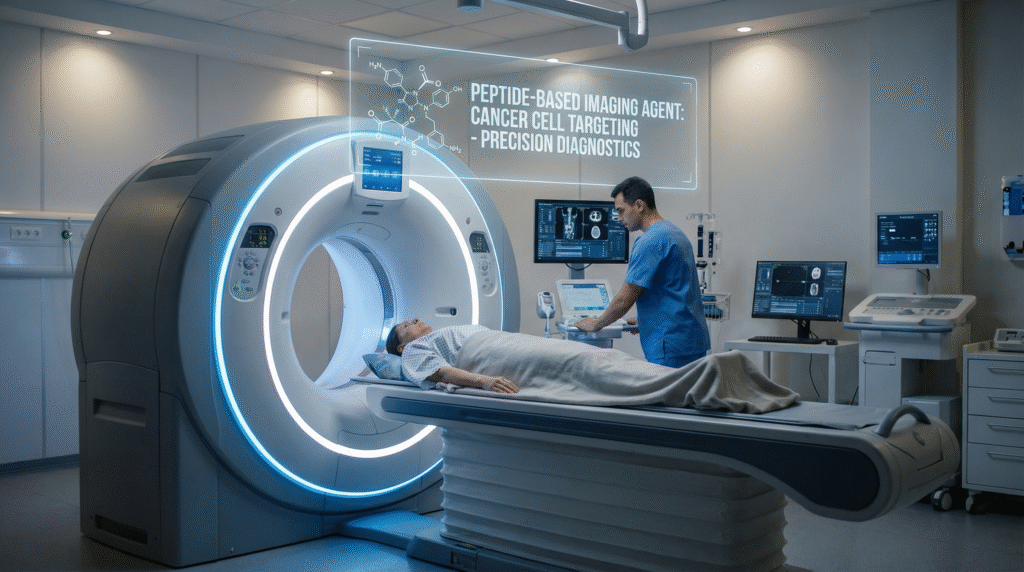
Radiolabeled peptides are delivering on their promise across multiple disease areas.
Oncology: The Primary Driver
- Neuroendocrine Tumors (NETs): ⁶⁸Ga-DOTATATE/-DOTATOC PET/CT is the gold standard for staging, restaging, and selecting patients for peptide receptor radionuclide therapy (PRRT). It has dramatically improved detection sensitivity over older ¹¹¹In-Octreotide scans.
- Prostate Cancer: ⁶⁸Ga- or ¹⁸F-labeled PSMA-11 inhibitors (e.g., ⁶⁸Ga-PSMA-11, ¹⁸F-DCFPyL) are revolutionizing the management of biochemical recurrence and metastatic disease, detecting lesions at very low PSA levels.
- Other Cancers: Agents targeting gastrin-releasing peptide receptor (GRPR) in prostate/breast cancer, C-X-C chemokine receptor 4 (CXCR4) in hematological malignancies, and integrin αvβ3 in angiogenesis are under active investigation.
Cardiology and Neurology: Emerging Frontiers
- Cardiac Imaging: Peptides targeting matrix metalloproteinases (MMPs) or angiotensin-converting enzyme (ACE) for imaging atherosclerotic plaque vulnerability and inflammation.
- Neurology: Amyloid-beta and tau-targeting peptides for Alzheimer’s disease, though dominated by small molecules, are an area of research. Peptides targeting neuroinflammation (e.g., TSPO) are also being explored.
- Infectious Disease: Antimicrobial peptides (AMPs) radiolabeled to localize bacterial and fungal infections, particularly in cases of fever of unknown origin or prosthetic joint infections.
Overcoming Challenges and Future Directions
The field continues to evolve, addressing current limitations and exploring new horizons.
Persistent Challenges
- Metabolic Instability: Peptides can be rapidly degraded by proteases in vivo, limiting target exposure. Solutions: Incorporation of D-amino acids, cyclization, peptidomimetic backbones.
- Renal Uptake and Retention: Many peptides are cleared renally and can be reabsorbed in the kidneys, leading to high background and radiation dose. Solutions: Co-infusion of competitive inhibitors (e.g., lysine/arginine), modification of peptide charge.
- Manufacturing and Supply Chain: Ensuring reliable, GMP-grade production of the peptide precursor and managing the logistics of short-lived radiopharmaceuticals (especially ⁶⁸Ga).
- Regulatory Pathways: Navigating the regulatory landscape for combination products (drug + device for generators/modules) and theranostic pairs.
The Future: Next-Generation Agents and Integrated Theranostics
- Multimodal Imaging Probes: Peptides labeled with both a radionuclide and a fluorescent dye for intraoperative guidance following preoperative PET imaging (radioguided surgery).
- Improved Pharmacokinetics: Developing peptides with optimized blood clearance profiles (e.g., albumin-binding motifs for longer circulation, or ultrafast cleavable linkers for rapid background clearance).
- AI-Driven Peptide Design: Using machine learning to design novel peptide sequences with optimal binding, selectivity, and pharmacokinetic properties.
- Democratization of Production: The expansion of ⁶⁸Ge/⁶⁸Ga generator and ⁹⁹Mo/⁹⁹ᵐTc generator networks, along with simple, kit-based ⁶⁸Ga and Al¹⁸F labeling, is making these advanced diagnostics accessible in more community hospitals.
FAQs: Peptide-Based Diagnostic Imaging
Q: What are the key advantages of peptide-based imaging agents over antibody-based (ImmunoPET) agents?
A: Peptide-based agents typically offer faster pharmacokinetics, achieving high target-to-background ratios within 1-2 hours post-injection compared to days for antibodies. This allows for same-day imaging, improves patient convenience, and reduces radiation dose from circulating activity. Their lower molecular weight improves tissue penetration, especially in solid tumors. They also generally exhibit lower immunogenicity. However, antibodies have much longer target residence times and higher inherent specificity, which can be advantageous for certain targets. The choice depends on the biological target, required imaging timeline, and the need for subsequent therapy (theranostics).
Q: How critical is the purity and quality of the peptide precursor (cold peptide) for successful radiolabeling and clinical performance?
A: It is absolutely fundamental. The peptide-chelator conjugate is the foundation of the entire imaging agent. Impurities (deletion sequences, truncated peptides, isomers) can:
1. Compete for binding to the radionuclide, reducing specific activity and labeling yield.
2. Bind to the target with different affinity, leading to unpredictable biodistribution and potentially false results.
3. Cause stability issues in the final formulation.
4. Trigger immunogenic responses or toxicities.
Therefore, GMP-grade synthesis with rigorous analytical control (HPLC, MS, amino acid analysis) is non-negotiable for clinical development. The chemical and isomeric purity directly correlates with batch-to-b consistency, regulatory approval, and reliable diagnostic performance.
Q: What is the “theranostic paradigm,” and how do peptides enable it?
A: The theranostic paradigm is a “see-and-treat” approach. It uses two closely related agents: a diagnostic radiolabeled peptide to visualize and quantify target expression (e.g., ⁶⁸Ga-DOTATATE for imaging), and a therapeutic radiolabeled peptide that delivers a cytotoxic dose of radiation to the same target (e.g., ¹⁷⁷Lu-DOTATATE for therapy). Because the same targeting peptide (e.g., DOTATATE) is used, the diagnostic scan accurately predicts which patients will respond to the therapy and allows for precise dosimetry. This personalized approach maximizes efficacy and minimizes side effects, and it is a hallmark application of peptide radiopharmaceuticals.
Core Takeaways
- Peptides are Ideal Targeting Vectors: Their high specificity, rapid kinetics, and synthetic versatility make them superior agents for molecular imaging compared to larger molecules.
- Radiolabeling is a Critical Determinant of Success: The choice of radionuclide (PET vs. SPECT) and labeling strategy (direct vs. indirect chelation) must be tailored to the peptide’s pharmacokinetics and the clinical question.
- Clinical Impact is Already Profound: Agents like ⁶⁸Ga-DOTATATE and ⁶⁸Ga-PSMA-11 have become standard of care in neuroendocrine and prostate cancer management, respectively, enabling earlier and more accurate disease detection.
- Quality Starts with the Precursor: The reliability, sensitivity, and safety of the final imaging agent are inextricably linked to the chemical purity, structural integrity, and GMP-compliant manufacture of the peptide-chelator conjugate.
- The Future is Theranostic and Accessible: The field is rapidly moving towards integrated diagnostic-therapeutic pairs and is being propelled by technological advances that simplify production, making these powerful tools more widely available.
Conclusion: Illuminating the Path to Precision Medicine
Peptide-based diagnostic imaging agents have unequivocally established themselves as cornerstone tools in the modern precision medicine arsenal. By providing a non-invasive window into the molecular machinery of disease, they empower clinicians to move beyond generic treatment pathways towards highly personalized management strategies. The continued evolution of radiolabeling chemistry, peptide engineering, and production logistics promises to expand this paradigm into new disease areas and deeper into community care. Realizing this potential, however, demands an unwavering commitment to scientific rigor at every step—from the initial design of a stable, high-affinity peptide to the reliable GMP synthesis of the precursor and the robust radiochemical processes that bring it to life.
This journey begins with a foundation of exceptional quality. Sichuan Pengting Technology Co., Ltd. stands as a pivotal partner in this endeavor. As a professional and reliable peptide API supplier, we provide the essential building blocks—the high-purity, meticulously characterized peptide-chelator conjugates—that are the bedrock of any successful imaging agent. Our expertise in complex peptide synthesis, including the conjugation of challenging bifunctional chelators like DOTA, NOTA, and DFO, ensures that researchers and developers have access to GMP-ready materials produced under the strictest quality controls.
By partnering with Sichuan Pengting Technology, innovators can accelerate their radiolabeled peptide programs with confidence, secure in the knowledge that their molecular targeting vector is crafted with the precision and reliability required to illuminate the path to better patient outcomes.
Disclaimer
This article contains information, data, and references that have been sourced from various publicly available resources on the internet. The purpose of this article is to provide educational and informational content. All trademarks, registered trademarks, product names, company names, or logos mentioned within this article are the property of their respective owners. The use of these names and logos is for identification purposes only and does not imply any endorsement or affiliation with the original holders of such marks. The author and publisher have made every effort to ensure the accuracy and reliability of the information provided.
However, no warranty or guarantee is given that the information is correct, complete, or up-to-date. The views expressed in this article are those of the author and do not necessarily reflect the views of any third-party sources cited.