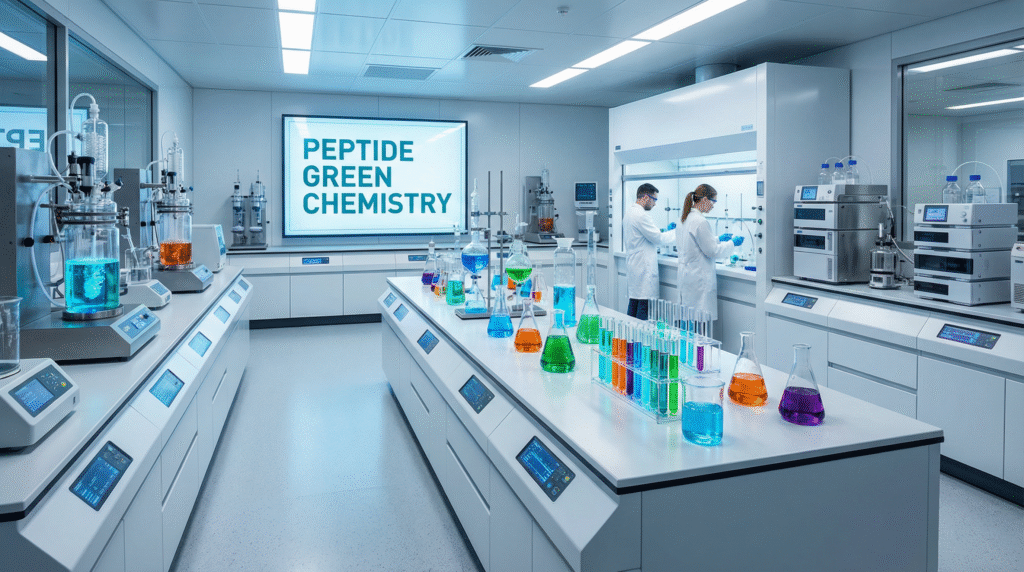
The global peptide therapeutics market, projected to surpass $75 billion, is underpinned by a chemical synthesis engine that is paradoxically both precise and profligate. Traditional solid-phase peptide synthesis (SPPS), the workhorse of the industry, is notoriously solvent-intensive, with an estimated Environmental Factor (E-factor) often exceeding 100, meaning over 100 kg of waste is generated per kilogram of final API. A staggering 80-90% of this waste is solvent, dominated by hazardous, polar aprotic solvents like N,N-Dimethylformamide (DMF) and N-Methyl-2-pyrrolidone (NMP). In an era of escalating ESG (Environmental, Social, and Governance) mandates, investor scrutiny, and tightening regulations—such as the EU’s restriction on NMP—adopting Green Chemistry principles is no longer a niche ideal but a strategic and operational imperative.
This comprehensive guide provides a practical framework for implementing green chemistry in peptide synthesis, focusing on intelligent solvent selection guides, evaluating emerging sustainable reaction media, and building a roadmap towards more efficient, cost-effective, and environmentally responsible manufacturing.
The Solvent Problem: Why Peptide Synthesis is a Sustainability Challenge
To innovate sustainably, we must first quantify and understand the environmental burden of current processes.
The Environmental and Economic Cost of Conventional Solvents
The standard SPPS process relies heavily on a small group of problematic solvents:
| Solvent | Primary Use in SPPS | Key Hazards & Concerns | Regulatory Status |
|---|---|---|---|
| N,N-Dimethylformamide (DMF) | Universal solvent for coupling, deprotection, washing. | Reproductive toxicity, high boiling point (difficult to recover), high environmental persistence. | EU REACH Substance of Very High Concern (SVHC); restrictions in place. |
| N-Methyl-2-pyrrolidone (NMP) | Alternative to DMF, especially for difficult sequences. | Reproductive toxicity. | EU REACH authorization required; use is heavily restricted. |
| Dichloromethane (DCM) | Cleavage from resin, precipitation. | Carcinogen, ozone depletion potential (historically), volatile organic compound (VOC). | Stringent exposure limits; phase-down under the Montreal Protocol. |
| Diethyl Ether, Hexane | Peptide precipitation and washing. | Extremely flammable, peroxidizable, VOC. | Major safety and storage concern. |
The Business Case for Green Solvent Adoption
Beyond compliance, green chemistry drives tangible value:
- Cost Reduction: Reduced solvent consumption and simplified waste treatment lower operational costs. High solvent recovery rates directly improve margins.
- Risk Mitigation: Proactively moving away from restricted substances de-risks the supply chain against future bans and avoids costly last-minute process changes.
- Enhanced Brand and Market Access: A verifiable green chemistry program is a powerful differentiator with ESG-focused investors, large pharma partners, and tenders from environmentally conscious healthcare systems.
- Operational Safety: Replacing toxic, flammable solvents with safer alternatives improves workplace safety and reduces insurance liabilities.
“The sustainability of a peptide therapeutic begins not in the clinic, but in the reaction vessel. Our industry’s reliance on DMF and NMP is a legacy technical debt we can no longer afford. Green chemistry isn’t about sacrificing yield or purity; it’s about applying smarter molecular design to achieve the same—or better—results with a fraction of the environmental burden. The solvent is the first and most impactful place to start.” — Dr. Lena Kowalski, Director of Process Chemistry, Sustainable Pharma Innovators.
Green Chemistry Principles and Solvent Selection Frameworks
Adoption should be guided by established principles and systematic evaluation tools.
The Twelve Principles of Green Chemistry Applied to Peptides
Several principles are directly relevant to solvent selection:
- Prevention: It is better to prevent waste than to treat or clean up waste after it is formed. (Use less solvent, design for recovery).
- Safer Solvents and Auxiliaries: The use of auxiliary substances (e.g., solvents) should be made unnecessary where possible and innocuous when used.
- Design for Energy Efficiency: Chemical processes should be designed to minimize energy requirements, recognizing that solvent choice impacts distillation and drying energy.
- Catalysis: Catalytic reagents are superior to stoichiometric reagents. (While not directly about solvents, it reduces overall process mass intensity).
Practical Solvent Selection Guides
Several tools help chemists rank solvents based on multiple criteria:
- GlaxoSmithKline (GSK) Solvent Sustainability Guide: A classic tool that categorizes solvents as “Preferred,” “Usable,” or “Undesirable” based on safety, health, and environmental impact.
- CHEM21 Solvent Selection Guide: A more recent, comprehensive guide developed by the EU’s CHEM21 project, ranking solvents from “Recommended” to “Hazardous.” It provides clear alternatives.
- Life Cycle Assessment (LCA): The gold standard for evaluating the total environmental impact of a solvent from cradle-to-grave, including production, use, and disposal.
Sustainable Solvent Alternatives for Peptide Synthesis
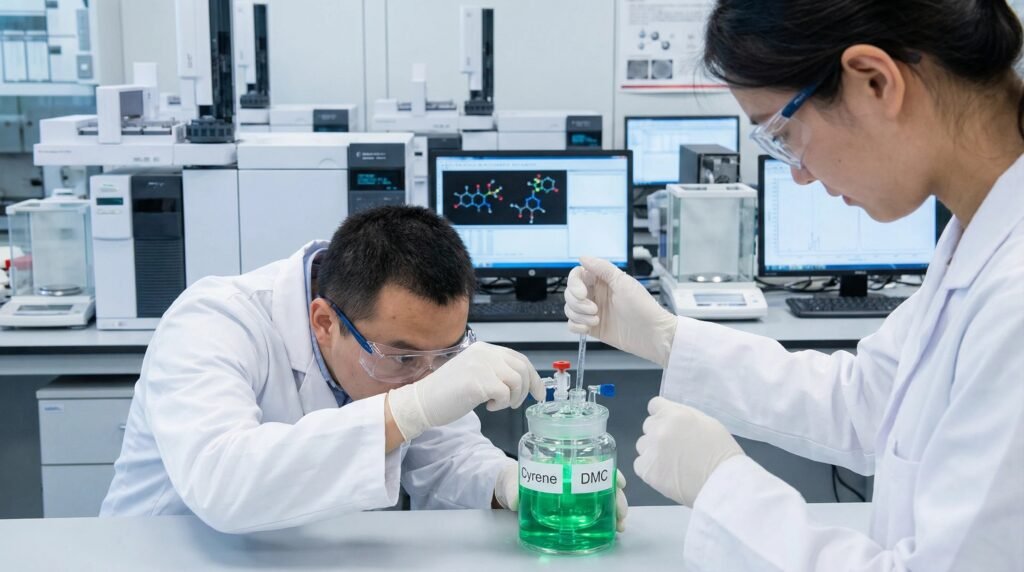
A new generation of “green” solvents is proving viable for SPPS and liquid-phase peptide synthesis (LPPS).
Direct Replacements for DMF and NMP
| Green Solvent | Properties & Advantages | Considerations for Peptide Synthesis | Status |
|---|---|---|---|
| Cyrene™ (Dihydrolevoglucosenone) | Bio-based, derived from cellulose. Non-toxic, non-mutagenic, biodegradable. High boiling point allows for similar SPPS protocols. | May require optimization of coupling reagents and reaction times. Slightly different swelling properties for some resins. | Most advanced bio-alternative; multiple successful case studies for SPPS. |
| Dimethyl Carbonate (DMC) | Low toxicity, biodegradable. Can be used as a green methylating agent and solvent. | Lower polarity than DMF. Best used in mixtures (e.g., with 2-MeTHF or Cyrene) for SPPS to achieve adequate resin swelling and solvation. | Effective in hybrid solvent systems. |
| 2-Methyltetrahydrofuran (2-MeTHF) | Derived from renewable resources (e.g., corn cobs). Excellent solvating power, forms a low-boiling azeotrope with water for easy drying. | Peroxidizable, requires stabilization. Excellent for LPPS, peptide precipitation, and as a component in SPPS solvent mixtures. | Well-established green solvent for extractions and reactions. |
| Ethyl Acetate (EtOAc) | Low toxicity, naturally occurring. Readily biodegradable. | Limited solvating power for some protected amino acids. Useful for peptide precipitations and washes, replacing diethyl ether. | Common, inexpensive green alternative for workup. |
Moving Beyond Traditional Solvents: Innovative Reaction Media
- Ionic Liquids: Non-volatile, non-flammable salts that can act as both solvent and catalyst. Can enable high-purity peptide synthesis with minimal waste, though cost and potential toxicity of some ionic liquids are concerns.
- Deep Eutectic Solvents (DES): Mixtures of hydrogen bond donors and acceptors that are liquid at low temperatures. Cheap, non-toxic, and biodegradable components (e.g., choline chloride + urea). Promising for enzymatic peptide synthesis and as media for difficult-to-dissolve amino acids.
- Solvent-Free or Neat Reactions: Mechanochemical synthesis using ball mills. Eliminates solvent entirely for coupling steps. An emerging area with potential for specific peptide sequences, though scalability and process control are active research topics.
Implementation Roadmap: From Assessment to Commercial Process
Transitioning to greener solvents requires a phased, science-based approach.
Step 1: Baseline Assessment and Goal Setting
- Calculate Process Mass Intensity (PMI) for your current peptide processes. PMI = total mass in process (kg) / mass of API (kg). This quantifies the starting point.
- Conduct a Solvent Hazard Review: Audit all solvents used against the CHEM21 or GSK guide. Identify “Undesirable” solvents for priority replacement.
- Set SMART Goals: e.g., “Replace 100% of DMF in our lead candidate’s SPPS process with a recommended alternative within 18 months.”
Step 2: Solvent Screening and Process Optimization
- Literature and Database Review: Identify potential green alternatives for your specific chemistry (e.g., SPPS of long, hydrophobic peptides).
- Small-Scale Screening: Test solvent performance in key unit operations: resin swelling, coupling efficiency, deprotection kinetics, and crude peptide purity/profile (HPLC, MS).
- Hybrid Systems: Don’t assume a 1:1 replacement. Often, a mixture of a green solvent with a small amount of a more effective solvent (e.g., DMSO) can achieve performance with drastically reduced hazard.
- Recycle and Recovery Studies: Design the solvent recovery process in parallel. Green solvents like 2-MeTHF are often easier to recover than DMF.
Step 3: Scale-Up, Validation, and Regulatory Strategy
- GMP Campaigns: Manufacture engineering and registration batches using the new green process to demonstrate robustness.
- Comparability Assessment: Rigorously compare the API from the new green process to the historical process. Focus on identity, purity, impurity profile, and stability. A successful comparability study is key to regulatory acceptance.
- Regulatory Submission: Document the change as a post-approval change (e.g., Type 1B/Type II variation, PAS). The justification should be based on improved environmental profile and demonstrated comparability.
Future Trends: Integration with Advanced Manufacturing
The future of green peptide synthesis lies in the convergence of solvent innovation with process intensification.
- Continuous Flow Peptide Synthesis: Flow chemistry drastically reduces solvent volumes by nature. Combining flow with green solvents like Cyrene or 2-MeTHF amplifies the sustainability benefit.
- AI for Solvent and Process Optimization: Machine learning models can predict solvent performance, optimal mixtures, and reaction outcomes, accelerating the screening and development of green processes.
- Circular Economy Models: On-site or centralized solvent recycling hubs, and the use of bio-based solvents derived from waste streams, move the industry towards a closed-loop system.
FAQs: Peptide Green Chemistry and Solvent Selection
Q: Are green solvents always more expensive than traditional solvents like DMF? How does the total cost balance out?
A: While some advanced bio-solvents like Cyrene may have a higher upfront purchase cost per liter than bulk DMF, a total cost of ownership (TCO) analysis often favors green solvents. TCO includes: solvent consumption (often lower in optimized processes), waste disposal costs (hazardous waste disposal is extremely expensive), regulatory compliance costs (avoiding SVHC restrictions), and potential recovery value. Furthermore, as production of green solvents scales, their price is decreasing. The financial argument strengthens when considering risk mitigation and brand value.
Q: Will switching to a green solvent compromise the yield or purity of my peptide, especially for complex or long sequences?
A: Not necessarily, but it requires scientific optimization, not a simple drop-in replacement. Early green solvents sometimes underperformed. Modern alternatives like Cyrene have demonstrated comparable or even superior performance to DMF in many SPPS applications, including for challenging sequences. The key is to treat it as a process re-optimization project: adjusting coupling reagent concentrations, reaction times, and temperature. The outcome is often a robust, high-yielding process with a vastly improved environmental profile.
Q: How can a peptide API manufacturer (CDMO) support our company’s green chemistry goals if we don’t have the internal expertise to develop new processes?
A: This is a core opportunity for strategic partnership. A forward-thinking CDMO, like Sichuan Pengting Technology Co., Ltd., can be an invaluable ally. They can offer: 1) Platform Green Processes: Experience with proven green solvent systems (e.g., Cyrene-based SPPS) that can be applied to your molecule. 2) Co-Development Services: Collaborative screening and optimization to tailor a green process for your specific peptide. 3) Regulatory Support: Guidance on the comparability data package and variation strategy.
Partnering with a CDMO that invests in green chemistry allows you to leverage their expertise and infrastructure to meet your ESG goals without building the capability from scratch.
Core Takeaways
- Strategic Imperative: Adopting green chemistry in peptide synthesis is essential for regulatory compliance, cost management, risk mitigation, and meeting stakeholder ESG expectations.
- Solvent is the Primary Lever: Replacing hazardous solvents (DMF, NMP, DCM) with safer, bio-based, or renewable alternatives (Cyrene, 2-MeTHF, EtOAc) is the most impactful first step to reduce environmental footprint.
- Guided by Frameworks, Driven by Data: Use established solvent selection guides (CHEM21, GSK) and performance data (PMI, LCA) to make informed choices, not assumptions.
- Optimization is Key: Successful implementation requires process re-optimization, not just substitution. Hybrid solvent systems and new reaction media (DES, ionic liquids) offer additional tools.
- Collaboration Accelerates Transition: Partnerships with experienced API suppliers and CDMOs who have invested in green chemistry platforms can dramatically reduce the time, cost, and risk of implementing sustainable manufacturing processes.
Conclusion: Synthesizing a Sustainable Future for Peptide Therapeutics
The journey towards green peptide chemistry is a clear convergence of ethical responsibility, sound economics, and innovative science. By systematically re-engineering synthetic processes around the principles of solvent selection, waste minimization, and safer materials, the peptide industry can decouple its remarkable growth from its historical environmental impact. This transition promises not only cleaner manufacturing but also more efficient and potentially more cost-effective production paradigms. The tools, solvents, and frameworks exist; the imperative now is for widespread and committed adoption.
This transformation requires expertise and commitment at every stage of the supply chain. The choice of manufacturing partner is pivotal. Sichuan Pengting Technology Co., Ltd. is committed to being a leader in this transition. As a professional and reliable peptide API supplier, we integrate green chemistry principles into our development and manufacturing services. We actively develop and optimize sustainable synthetic platforms, utilizing advanced green solvents and efficient recovery systems.
By partnering with us, clients gain access to this expertise, ensuring their peptide therapies are manufactured to the highest standards of both quality and environmental stewardship. This partnership not only future-proofs your supply chain against regulatory change but also aligns your innovative medicines with the growing global demand for sustainable healthcare solutions.
Disclaimer
This article contains information, data, and references that have been sourced from various publicly available resources on the internet. The purpose of this article is to provide educational and informational content. All trademarks, registered trademarks, product names, company names, or logos mentioned within this article are the property of their respective owners. The use of these names and logos is for identification purposes only and does not imply any endorsement or affiliation with the original holders of such marks. The author and publisher have made every effort to ensure the accuracy and reliability of the information provided.
However, no warranty or guarantee is given that the information is correct, complete, or up-to-date. The views expressed in this article are those of the author and do not necessarily reflect the views of any third-party sources cited.