Two sellers say their peptide is 99% pure. Are they the same? Not always. The number tells you little until you know how it was tested.
Peptide purity shows how much of a sample is the peptide you want. The rest is other peptide-related material. A lab reads it from a chart called an HPLC chromatogram. HPLC stands for high-performance liquid chromatography. The number has limits. It also links to grades, and each grade suits a different job.
How Is Peptide Purity Shown on a Product Page?
A purity percentage compares the peptide you want with the peptide-related impurities. One test gives the number. Labs print it on a paper called a certificate of analysis, or COA.
Two terms show up on most reports. HPLC purity tells you the test that was used. Chromatographic purity tells you what that test measures. It measures the size of the peaks on a chart.
Some things are not counted. Water is one. Counterions are another. Acetate and TFA are two examples. Net peptide content is a different measure, and it has its own section below.
Purity Figures on Pengting Spec Pages
| Product | Purity shown on the spec page |
| Alarelin Acetate | 99% |
| Atosiban | 98% |
| Acetyl Hexapeptide-8 | ≥99% |
Each page shows just one number. Each batch also ships with an HPLC chromatogram. It lets you see how the test was done.
How Is HPLC Purity Read From a Chromatogram?
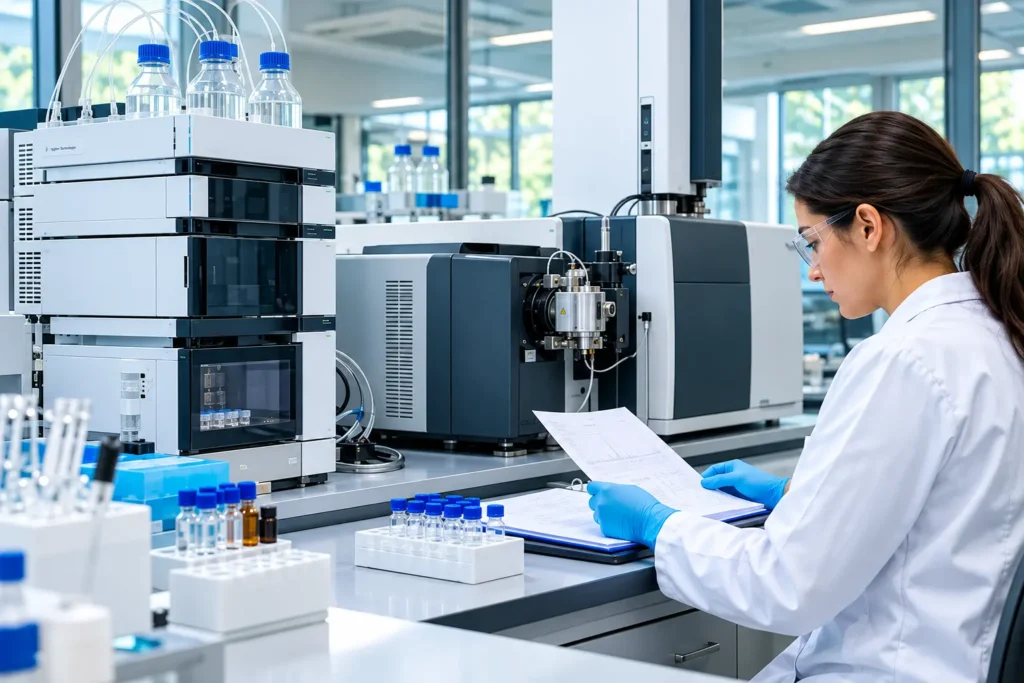
HPLC purity is the area of the target peak divided by the area of all peaks, times 100. A chromatogram is a chart drawn by the machine. The test has four steps:
- The sample moves through a column.
- Each part of the sample comes out at a different time.
- A detector shows each part as a peak. It uses UV light at 214 nm, because the peptide bond absorbs that light. Some labs use 220 nm.
- The tallest peak is the target peptide peak. The smaller peaks are impurities.
Purity % = target peptide peak area ÷ total peak area × 100
Chromatogram Terms
| Term | What it shows |
| Main peak | The target peptide |
| Impurity peaks | Other peptide-related material |
| Retention time | When a peak leaves the column |
| Area % | A peak’s share of the total area |
The number is only true for the test that was used. So the report should name the test.
Pengting says every batch comes with a COA, an HPLC chromatogram, an MS report and an MSDS. Peptide purity by HPLC goes deeper into the chart.
Why Two 99% Results Can Differ
Two laboratories may test the same peptide and come up with different values. They may have various settings for UV light. They may transport the sample using various liquid mixtures. They may also draw the flat baseline of the chart differently.
Some contaminants may be hidden. The target peptide may co-elute with a related molecule. The two then share a summit. The graphic does not differentiate between them. An contaminant that does not absorb UV light could not appear at all. One number from one test is a reasonable starting check. This isn’t the whole story.
What Is in the Missing Percentage?
The missing section of the number is peptide related contaminants. They are formed during peptide synthesis.
Common Impurity Types
- Deletion sequences: one amino acid is missing from the chain.
- Truncated sequences: the chain stops too soon.
- Incompletely deprotected peptides: a protective group is still on the chain.
- Oxidized or side-reaction products: the chain changed while it was made, or after.
Long or complicated peptides are more difficult to synthesize at extremely high purity. A 100% outcome is not a realistic aim. Consistent performance and clear documents matter more.
Why Does Peptide Purity Matter for Research Results?
Peptide purity is important since contaminants might screw up a test. As purity goes down, batches vary more. The discrepancy is greatest below roughly 80% purity.
Impurities may also operate by themselves. A deletion sequence may have a different effect on a target than the whole chain. That may cloud a bioassay. It may potentially bias quantitative research. The coarser the screen, the more dirt it will tolerate. Various occupations need various ratings, thus.
Which Purity Grade Fits Which Research Use?
Purity grades start at crude and go up to 98% and above. Each level fits a different job.
Common Supplier Guidance, Not a Universal Standard
| Grade | Typical use |
| Crude | Early screening |
| 75% | Arrays, antibody work, ELISA |
| 95% | In vitro bioassays, quantitative studies |
| 98% | SAR, crystallography, pharma-type work |
Each supplier sets its own levels. Read each label before you compare.
98% Purity Versus 99%
A one-point deficit is seldom significant by itself. It tells you a lot more than that one point . The test procedure, the chromatogram, and the documents supporting the number.
Why Are Purity and Net Peptide Content Different?
Two questions in a vial. How pure is the peptide? And how much of the powder is really peptide?
Water, counterions, and salts make the two replies different. The lab does another test for net content. For example, amino acid analysis.
Net content may be below 100% even for a perfectly pure peptide. This is much more common if the chain comprises a lot of basic amino acids. They have more counterions. Net content is particularly important when you require the precise strength of a solution for a test.
Identity Needs a Second Test
HPLC cannot confirm the identity of the peptide. Mass spectrometry can. A good report has both results.
How Can You Check a Purity Claim Before You Buy?
A purity claim is only as good as the papers behind it.
Buyer Checklist
- The test technique is named, e.g. HPLC
- See attached chromatogram.
- The peptide is correct by mass spectrometry data.
- The lot number is the same as your vial number.
- The date of the exam is given.
- Results are given with limits next to them.
Common Mistakes
- Comparing numbers from different tests. A 99% from one test is not the same as a 99% from another.
- Reading purity as amount. A 99% number does not tell you how much peptide is in the vial.
- Skipping the identity data. A clean peak means little if the mass is wrong.
- Trusting a number with no chart. A number alone cannot be checked.
Pengting says you can get sample documents before you decide to buy. COA fields and red flags and QC documentation go through the same checks.
How Does Pengting Handle Purity Documentation?
Sichuan Pengting Technology Co., Ltd. is based in Sichuan, China. It does R&D, custom work and large-scale production. Its products are peptide APIs and cosmetic peptides. Its focus is peptide raw materials.
The company works with a cooperative manufacturing base. It is 6,500 square meters in size. The team has 5+ PhD R&D engineers. The company has over a hundred effective raw materials. It holds ISO 9001. It follows GMP standards through its manufacturing partner.
Delivery Times
- Usual delivery time: 15 to 30 days
- Europe and America: 15 to 20 days
- Southeast Asia: 7 to 10 days
- Urgent orders: shipped within 72 hours
Pengting supplies research materials to verified business clients. You can ask for a sample COA on its contact page.
FAQs
How is peptide purity measured?
A lab uses reversed-phase HPLC with UV light. It divides the area of the target peak by the area of all peaks. Mass spectrometry is added to check identity.
Does 99% purity mean the vial is 99% peptide?
Nope. The number on the chart only indicates the purity of the peptide. The vial also contains water and counterions. There’s another criterion for content.
Is higher purity always better?
Not by me. The right level depends on the work. A high number without a test technique or chromatogram tells you less than a lower number with complete data.
What purity do I need for my work?
Pick the right grade for the task. Screening, quantitative tests, and sensitive investigations need varying amounts. The grade table above gives the regular levels. Research materials.
Can a peptide reach 100% purity?
No. During the manufacture of the peptide, small amounts of contaminants are produced. “The perfect number is better than steady results and clear documents.
Does purity change from batch to batch?
Yes, it can. Each batch is evaluated separately. The lot code on the COA should be the same as the code on your vial. A report on another lot informs you nothing about your own lot.
What should a COA show?
A COA should show the test method, the result, and the lot. Ask for the HPLC chromatogram and MS data too.
Conclusion
Always check how a number was tested. A number with no named test cannot be checked. Look for identity data too. Mass spectrometry shows the peptide is the right one. Keep purity apart from content.
A clean peptide and a full vial are two different questions. Each one needs its own test. Both matter. To see real papers before you decide to buy, ask Sichuan Pengting Technology Co., Ltd. for a sample COA on the contact page of its website.