
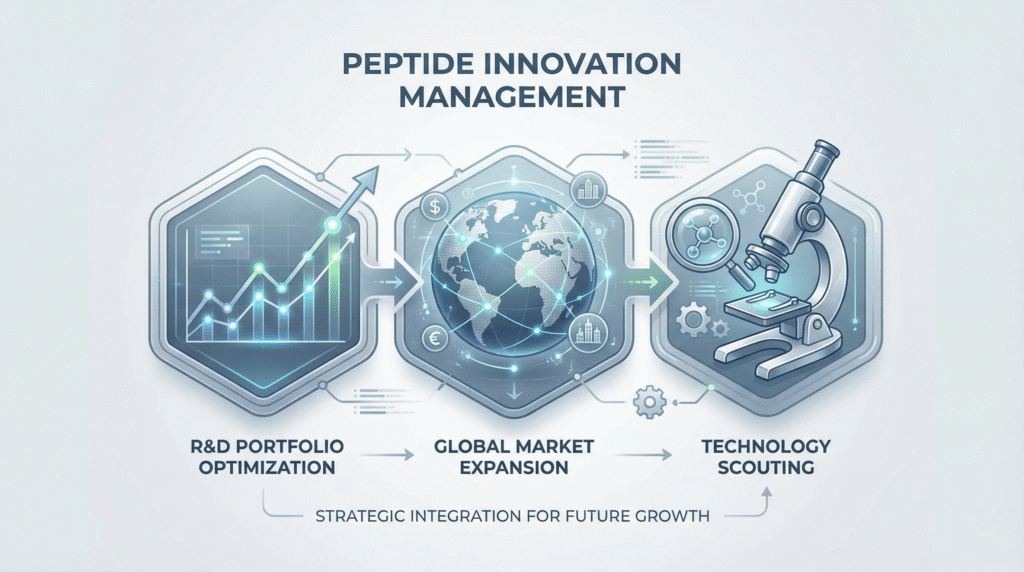
The global peptide therapeutics market, projected to surpass $75 billion by 2028, is experiencing an innovation explosion, with over 600 candidates in clinical development. In this hyper-competitive landscape, traditional linear R&D approaches yield diminishing returns, as evidenced by the 30-40% failure rate of peptide programs advancing from Phase 2 to Phase 3. Strategic innovation management—specifically, sophisticated R&D portfolio optimization and proactive technology scouting—has emerged as the critical differentiator, enabling leading companies to achieve 25-40% higher R&D productivity, reduce time-to-market by 18-24 months, and capture 50-60% of the value in emerging peptide segments.
This comprehensive analysis examines the frameworks, tools, and strategic mindsets that allow peptide innovations to systematically balance risk, allocate scarce resources, and integrate external breakthroughs to build sustainable pipelines and dominate the next decade of peptide medicine.
The New Imperative: Strategic Management of Peptide Innovations
The complexity and cost of peptide R&D demand a shift from opportunistic discovery to managed innovation portfolios.
The Evolving Peptide R&D Landscape and Its Challenges
Current market dynamics creating pressure for better innovation management:
- Rising Development Costs: Average cost to develop a novel peptide therapeutic now exceeds $2.5 billion.
- Increased Technical Complexity: Next-generation modalities (cyclic, stapled, conjugates) require new capabilities.
- Intensifying Competition: 80+ biotech companies with dedicated peptide platforms.
- Capital Scarcity: Despite sector growth, increased selectivity in venture and public funding.
From Project Management to Portfolio Strategy
The fundamental shift required for success:
- Holistic View: Managing interdependencies and synergies across the entire pipeline.
- Dynamic Resource Allocation: Continuously rebalancing investments based on new data and market shifts.
- Risk Intelligence: Quantifying and managing technical, clinical, and commercial risk collectively.
- Strategic Agility: Building the capability to pivot and reorient the portfolio rapidly.
“In peptide R&D, the greatest risk is not that an individual project fails—that’s inevitable in drug discovery. The existential risk is that your entire portfolio fails simultaneously because it wasn’t strategically constructed. Portfolio optimization isn’t finance; it’s the science of ensuring your organization’s survival and relevance in the future.” — Dr. Michael Vance, Chief Strategy Officer, Global Pharma Innovations.
Frameworks for Peptide R&D Portfolio Optimization
Effective portfolio management requires a structured, data-informed approach tailored to the unique economics of peptide therapeutics.
Portfolio Strategy and Design Principles
Foundational concepts for building a robust peptide portfolio:
- Strategic Buckets: Allocation of resources across Horizon 1 (core), 2 (adjacent), and 3 (transformative) innovations.
- Risk-Reward Balancing: Deliberate mix of lower-risk/high-cost (biosimilars, derivatives) and high-risk/breakthrough (novel targets, modalities) projects.
- Thematic Concentration: Focusing on 2-3 therapeutic areas or technology platforms where the organization can develop deep expertise.
- Pipeline Staging: Ensuring a steady flow of assets from discovery to launch to sustain revenue.
Quantitative Portfolio Analysis and Decision Tools
Analytical methods to evaluate and optimize portfolio composition:
| Analytical Tool | Primary Purpose | Key Metrics/Output | Application in Peptide R&D |
|---|---|---|---|
| Net Present Value (NPV) Analysis | Financial valuation of individual projects and portfolio | Risk-adjusted NPV, Cumulative NPV | Prioritizing late-stage development candidates |
| Expected Commercial Value (ECV) | Incorporates probabilities of technical and commercial success | ECV, Value at Risk | Comparing early-stage discovery programs |
| Efficient Frontier Analysis | Optimizes portfolio for maximum return at given risk tolerance | Risk/Return Pareto curve | Balancing novel target vs. validated mechanism programs |
| Monte Carlo Simulation | Models portfolio performance under thousands of scenarios | Probability of achieving portfolio value targets | Stress-testing portfolio against clinical trial failures |
Technology Scouting for Peptide Innovations

In an era of distributed innovation, external technology identification and integration is a core competency.
The Technology Scouting Process: A Systematic Approach
A phased methodology for identifying and capturing external innovation:
- Phase 1: Need Identification & Landscape Mapping: Defining strategic gaps and comprehensively scanning the ecosystem.
- Phase 2: Sourcing & Evaluation: Proactively searching for and rigorously assessing potential technologies.
- Phase 3: Due Diligence & Integration Planning: Deep technical/commercial assessment and planning for assimilation.
- Phase 4: Deal Making & Post-Deal Management: Structuring partnerships and ensuring captured value is realized.
Key Focus Areas for Peptide Technology Scouting
High-impact domains where external innovation is critical:
- Noval Modalities & Chemistries: Stapled peptides, macrocycles, cell-penetrating peptides, peptide-drug conjugates (PDCs).
- Delivery & Formulation Technologies: Oral delivery systems, sustained-release depots, transdermal platforms (microneedles, iontophoresis).
- Discovery & Screening Platforms: Phage/yeast display, DNA-encoded libraries (DEL), computational design (AI/ML).
- Manufacturing & Process Innovation: Continuous flow synthesis, biocatalysis, green chemistry solutions.
Integrating Portfolio Management and Technology Scouting
The highest impact occurs when external scouting directly informs and feeds a dynamic portfolio strategy.
Creating a Closed-Loop Innovation System
Connecting scouting insights to portfolio decisions:
- Strategic Gap Analysis: Using portfolio models to identify specific capability or asset deficiencies that scouting must address.
- Scenario Planning: Scouting for technologies that provide optionality against key portfolio risks (e.g., delivery failure).
- Build-Buy-Partner Decision Frameworks: Clear criteria for when to acquire a technology vs. license vs. develop internally.
- Integration Pathways: Pre-defined processes for how scouted technologies will be absorbed into the R&D engine.
Organizational Models for Effective Innovation Management
Structures and teams that enable the strategy:
| Organizational Model | Key Characteristics | Advantages | Best For |
|---|---|---|---|
| Centralized Function | Dedicated portfolio and scouting teams reporting to R&D head | Strong oversight, consistent processes, clear accountability | Large, established pharmaceutical companies |
| Embedded & Distributed | Scouting and portfolio roles embedded within therapeutic area units | Deep domain knowledge, strong business unit alignment | Biotechs focused on 1-2 disease areas |
| Venture/Corporate Venture Capital (CVC) Model | Innovation managed through investment in external startups | Access to broad innovation, option value, financial returns | Companies seeking radical innovation and new business models |
| Open Innovation Hub | Dedicated group managing external partnerships, academic alliances, crowdsourcing | Maximizes external network, fosters collaborative culture | Companies with strong external brand and partnership history |
Implementation: Building the Innovation Management Engine
Translating strategy into operational reality requires tools, data, and governance.
Data, Systems, and Technology Enablers
The infrastructure needed for informed decision-making:
- Integrated Portfolio Management Software: Platforms for tracking projects, resources, milestones, and value drivers.
- Competitive Intelligence Systems: Tools for monitoring competitor pipelines, publications, patents, and clinical trials.
- External Innovation Databases: Curated databases of startups, academic labs, and key opinion leaders.
- Decision Support Dashboards: Real-time views of portfolio health, resource allocation, and risk exposure.
Governance and Decision Rights
Clear processes for making portfolio and partnership decisions:
- Stage-Gate with Portfolio Reviews: Integrating go/no-go decisions for individual projects with periodic portfolio rebalancing.
- R&D Investment Committee: Cross-functional senior team with authority to allocate resources and approve partnerships.
- Clear Decision Criteria: Transparent, data-driven metrics for project advancement and termination.
- Post-Implementation Reviews: Learning from past portfolio and partnership decisions to improve future processes.
Case Studies: Leaders in Peptide Innovation Management
Examining the approaches of companies that excel at managing peptide innovations.
Case Study 1: Mid-Cap Biotech Portfolio Transformation
A peptide-focused biotech successfully pivoted its portfolio:
- Challenge: Over-concentration in early-stage, high-risk metabolic disease candidates.
- Solution: Implemented portfolio optimization to divest two early programs, in-license a Phase 2 oncology peptide, and acquire a platform for oral delivery.
- Results: Increased probability of technical success for portfolio by 35%, extended cash runway by 24 months.
- Key Insight: Proactive pruning of internal programs created resources and strategic clarity for targeted external innovation.
Case Study 2: Large Pharma’s Scouting-Driven Growth in Peptides
A pharmaceutical giant built a leading peptide division through scouting:
- Challenge: Lack of internal peptide expertise and pipeline in a growing therapeutic area.
- Solution: Established a dedicated peptide scouting team with a focus on platform technologies. Structured multiple “option-to-acquire” deals with biotechs.
- Results: Built a $5B+ peptide franchise within 7 years through a mix of licensing, acquisition, and partnered R&D.
- Key Insight: They scouted for “unfair advantage” technologies (e.g., a unique conjugation method) rather than just individual drug candidates.
The Future of Peptide Innovations Management
Emerging trends and tools that will shape the next generation of R&D strategy.
Technology-Enabled Future Trends
Innovations that will transform how portfolios are managed and scouting is conducted:
- Artificial Intelligence for Portfolio Strategy: AI models that predict portfolio performance, optimal resource allocation, and identify strategic gaps.
- Predictive Analytics for Scouting: Machine learning algorithms that scan scientific literature, patents, and news to predict “hot” emerging technologies before they become widely known.
- Digital Twins of the R&D Portfolio: Simulation environments to model the impact of different portfolio decisions under countless market and technical scenarios.
- Blockchain for IP and Partnership Management: Secure, transparent systems for managing collaborative R&D and shared IP in partnerships.
Evolving Strategic Considerations
Future shifts in the innovation management paradigm:
- Ecosystem Competition: Competing by building the most attractive innovation ecosystem for academic and biotech partners.
- Personalized Medicine Portfolios: Managing portfolios of targeted therapies for biomarker-defined subpopulations rather than blockbuster drugs.
- Sustainability-Led Innovation: Incorporating green chemistry and environmental impact as key criteria in portfolio selection and technology evaluation.
- Global Scouting Networks: Decentralized scouting hubs in key global innovation clusters (Boston, SF, Oxford, Shanghai, etc.).
FAQs: Peptide Innovation Management, Portfolio Optimization, and Technology Scouting
Q: How do you balance the need for a diversified peptide R&D portfolio with the requirement to develop deep, focused expertise in specific therapeutic areas or technologies?
A: The balance is achieved through strategic “thematic diversification” rather than random diversification. Instead of spreading investments thinly across many unrelated areas, leading companies choose 2-3 strategic themes (e.g., “GPCR-targeting peptides for metabolic disease” and “peptide-drug conjugates for oncology”). Within each theme, they build a portfolio that balances risk: perhaps one lower-risk program targeting a validated mechanism, one higher-risk novel target program, and one technology platform project (e.g., a new delivery method).
This approach allows the organization to develop world-class expertise in chosen domains while still managing risk through intra-theme diversification. The portfolio is diversified across stages of development and types of risk (technical, clinical, commercial), but concentrated in areas where the company can achieve true leadership.
Q: What are the most common mistakes companies make in peptide technology scouting, and how can they be avoided?
A: The most common mistakes include: 1) Passive Scouting: Waiting for inbound proposals rather than proactively hunting based on strategic needs. Avoid by empowering scouts with clear “search fields” and metrics. 2) The “Shiny Object” Syndrome: Chasing trendy technologies that don’t align with core strategy or capabilities. Avoid by rigidly filtering opportunities through a pre-defined strategic fit assessment. 3) Poor Due Diligence: Failing to adequately assess the scientific team, IP position, or scalability.
Avoid by using cross-functional diligence teams and external experts. 4) Neglecting Integration: Acquiring a technology without a plan to absorb it into the R&D engine. Avoid by making integration planning a key part of the deal process, with dedicated resources post-deal. Successful scouting is a disciplined, strategy-first process, not a series of ad-hoc reactions.
Q: For a small to mid-sized biotech with limited resources, what are the first, most impactful steps to implement a more formal innovation management and portfolio optimization process?
A: The most impactful first steps are: 1) Conduct a Portfolio Inventory and Health Assessment: Simply map all projects, their stage, resources consumed, and key value drivers. This visibility alone is transformative. 2) Define Strategic Buckets: Even roughly allocating your R&D budget into Horizon 1 (core business), 2 (new growth), and 3 (emerging ideas) forces strategic thinking. 3) Implement a Lightweight Stage-Gate Process: Establish clear, data-driven criteria for what a project must prove to earn funding for the next stage.
4) Dedicate a Fraction of Resources to Scouting: Even 5-10% of the R&D budget or one FTE focused on external innovation can yield significant returns. 5) Schedule Quarterly Portfolio Reviews: Instituting a regular cadence for leadership to review the entire portfolio, not just individual projects, changes the decision-making culture. The goal is not bureaucratic process, but creating the forums and data for making better choices about where to place your scarce bets.
Core Takeaways
- Strategic Discipline Over Opportunism: Leading in peptides requires actively designing and managing an innovation portfolio, not just pursuing individual promising projects.
- Data-Driven Resource Allocation: Optimal portfolios balance risk, reward, and strategic alignment using quantitative tools and clear decision criteria.
- External Innovation as a Core Capability: Technology scouting is not peripheral; it is essential for accessing breakthrough science and filling strategic gaps.
- Integration is Key: The highest value is captured when scouting insights directly feed portfolio strategy, and acquired technologies are seamlessly integrated.
- Culture and Governance Enable Strategy: Successful innovation management requires the right organizational structures, processes, and a culture that makes tough portfolio choices.
Conclusion: Building the Sustainable Peptide Enterprise
Mastering peptide innovation management—through rigorous R&D portfolio optimization and proactive technology scouting—is no longer a discretionary strategic exercise; it is the fundamental engine of sustainable growth and competitive advantage. In a field characterized by high costs, long timelines, and frequent failures, the ability to systematically allocate resources, balance risks, and integrate external breakthroughs separates the industry leaders from the also-ran. The companies that will define the next era of peptide therapeutics are those that view their pipeline not as a collection of discrete projects, but as a dynamic, strategic portfolio that is actively shaped and continuously renewed.
The journey requires investment in data, systems, and—most importantly—strategic thinking at the highest levels of R&D leadership. It demands a culture that is equally adept at disciplined internal execution and open external exploration. For those who make this commitment, the reward is a resilient innovation engine capable of delivering a steady stream of transformative peptide medicines to patients, and durable value to all stakeholders.
Disclaimer:
This article contains information, data, and references that have been sourced from various publicly available resources on the internet. The purpose of this article is to provide educational and informational content. All trademarks, registered trademarks, product names, company names, or logos mentioned within this article are the property of their respective owners. The use of these names and logos is for identification purposes only and does not imply any endorsement or affiliation with the original holders of such marks. The author and publisher have made every effort to ensure the accuracy and reliability of the information provided.
However, no warranty or guarantee is given that the information is correct, complete, or up-to-date. The views expressed in this article are those of the author and do not necessarily reflect the views of any third-party sources cited.