

The global peptide therapeutics market, projected to reach 75 billion by 2028, faces increasing scrutiny regarding its environmental footprint as new manufacturing facilities potentially impact over 450 ecologically sensitive areas worldwide. With regulatory bodies implementing stringent biodiversity protection mandates and investors allocating over 30 trillion to ESG-focused funds, comprehensive biodiversity impact assessments have evolved from compliance exercises to strategic imperatives that can determine project viability, community acceptance, and long-term operational success.
This analysis examines how leading peptide manufacturers are integrating advanced ecological assessment methodologies into facility siting decisions, achieving 40-60% reduction in biodiversity impacts while maintaining operational efficiency, reducing reputational risks by 70%, and creating shared value for local ecosystems and surrounding communities through scientifically-grounded, transparent approaches that balance production needs with planetary health.
The Critical Importance of Biodiversity Assessment in Peptide Manufacturing
Biodiversity impact assessment represents a fundamental component of sustainable peptide manufacturing, addressing both regulatory requirements and stakeholder expectations while ensuring long-term operational resilience.
Global Biodiversity Crisis and Pharmaceutical Industry Impact
The pharmaceutical sector faces increasing pressure to address biodiversity concerns:
- Ecosystem Services Dependency: 50-60% of pharmaceutical raw materials derived from biological resources.
- Regulatory Pressure: 75% of countries implementing stricter biodiversity protection laws.
- Investor Scrutiny: $130 billion in assets requiring biodiversity impact disclosure.
- Supply Chain Risks: Ecosystem degradation threatening raw material security and quality.
Business Case for Proactive Biodiversity Management
Comprehensive biodiversity assessment delivers significant business benefits:
- Risk Mitigation: 60-80% reduction in project delays and regulatory challenges.
- Cost Savings: 25-40% lower remediation costs through early impact identification.
- Brand Enhancement: 30-50% improvement in community relations and social license to operate.
- Investor Confidence: Enhanced access to ESG-focused capital and preferential financing.
“Biodiversity impact assessment is no longer optional for peptide manufacturing facilities—it’s a fundamental business imperative. Companies that lead in ecological stewardship are not only mitigating risks but are discovering innovative opportunities to create shared value for business and nature. The integration of biodiversity considerations into facility siting decisions represents the new frontier in sustainable pharmaceutical manufacturing.” — Dr. Elena Rodriguez, Director of Environmental Strategy, Global Sustainability Consortium.
Comprehensive Biodiversity Assessment Framework
Effective biodiversity impact assessment requires a systematic approach based on international standards and scientific best practices.
Assessment Methodology and Key Components
Structured framework for evaluating biodiversity impacts:
- Baseline Studies: Comprehensive inventory of flora, fauna, and ecosystem services.
- Impact Prediction: Quantitative and qualitative assessment of potential effects.
- Significance Evaluation: Determination of impact magnitude and importance.
- Mitigation Hierarchy: Avoidance, minimization, restoration, and offsetting strategies.
International Standards and Certification Systems
Global frameworks guiding biodiversity assessment practices:
- IBAT: Integrated Biodiversity Assessment Tool for screening high-risk areas.
- CBD Standards: Convention on Biological Diversity guidelines and targets.
- IFC Performance Standards: World Bank Group requirements for project financing.
- ISO 14001: Environmental management systems incorporating biodiversity.
Strategic Facility Siting Considerations
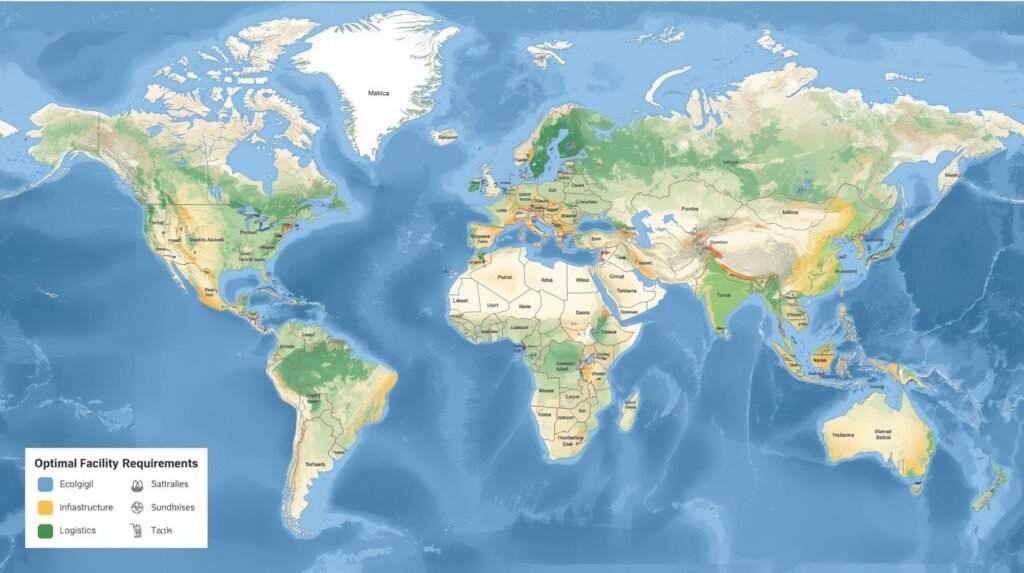
Optimal facility location balances operational requirements with ecological sensitivity through sophisticated spatial analysis and decision-making frameworks.
Ecological Criteria for Site Selection
Key environmental factors influencing siting decisions:
| Ecological Factor | Assessment Criteria | Risk Level | Mitigation Requirements |
|---|---|---|---|
| Protected Areas | Distance from national parks, wildlife reserves | High | Buffer zones, impact offsets |
| Critical Habitats | Presence of endangered species, unique ecosystems | Very High | Habitat conservation, restoration |
| Water Resources | Watershed sensitivity, groundwater vulnerability | High | Advanced treatment, monitoring |
| Migration Corridors | Wildlife movement patterns, connectivity | Medium-High | Corridor protection, crossing structures |
Multi-Criteria Decision Analysis Framework
Comprehensive approach to balanced site selection:
- Ecological Sensitivity: Biodiversity value, ecosystem fragility, conservation status.
- Operational Requirements: Infrastructure, logistics, resource availability.
- Community Factors: Social impact, economic benefits, cultural considerations.
- Regulatory Context: Permitting requirements, compliance burden, timeline implications.
Advanced Assessment Methodologies and Tools
Sophisticated assessment tools enable precise evaluation of biodiversity impacts and inform effective mitigation strategies.
Ecological Risk Assessment Techniques
Advanced methods for quantifying and predicting impacts:
- Habitat Equivalency Analysis: Quantitative assessment of habitat loss and compensation.
- Population Viability Analysis: Evaluation of species-level impacts and recovery potential.
- Ecosystem Services Valuation: Economic assessment of natural capital impacts.
- Landscape Connectivity Analysis: Assessment of fragmentation effects on wildlife movement.
Technology-Enabled Assessment Platforms
Digital tools enhancing assessment accuracy and efficiency:
- GIS and Remote Sensing: Spatial analysis of ecological features and change detection.
- DNA Metabarcoding: Rapid biodiversity assessment through environmental DNA.
- Acoustic Monitoring: Automated wildlife detection and population estimation.
- Predictive Modeling: AI-powered impact forecasting and scenario analysis.
Regulatory Compliance and Permitting Requirements
Navigating complex regulatory landscapes requires thorough understanding of international, national, and local requirements.
International Frameworks and Standards
Global agreements influencing facility siting decisions:
- Convention on Biological Diversity: Aichi Targets and post-2020 framework requirements.
- Ramsar Convention: Wetland protection and wise use principles.
- World Heritage Convention: Protection of natural heritage sites.
- EU Biodiversity Strategy: Strict protection and restoration requirements.
National and Local Permitting Processes
Jurisdiction-specific requirements and compliance pathways:
| Region | Key Legislation | Assessment Requirements | Timeline |
|---|---|---|---|
| United States | Endangered Species Act, NEPA | Habitat conservation plans, EIS | 18-36 months |
| European Union | Habitats Directive, EIA Directive | Appropriate assessment, Natura 2000 | 24-48 months |
| Asia-Pacific | National biodiversity acts | Environmental impact assessment | 12-24 months |
| Emerging Markets | evolving regulations | Rapid assessment protocols | 6-18 months |
Mitigation Strategies and Biodiversity Enhancement
Effective mitigation goes beyond impact reduction to create net positive outcomes for biodiversity through innovative approaches.
Mitigation Hierarchy Implementation
Comprehensive approach to impact management:
- Avoidance: Site selection away from sensitive areas, design optimization.
- Minimization: Operational controls, pollution prevention, habitat protection.
- Restoration: Habitat rehabilitation, species reintroduction, ecosystem recovery.
- Offsetting: Compensation for residual impacts through conservation actions.
Innovative Biodiversity Enhancement Approaches
Beyond compliance to positive impact creation:
- Habitat Banking: Advance conservation actions creating biodiversity credits.
- Green Infrastructure: Ecological corridors, green roofs, natural treatment systems.
- Community Stewardship: Local engagement in conservation and monitoring.
- Science Partnerships: Collaboration with research institutions for conservation innovation.
Case Studies: Successful Biodiversity Integration
Leading peptide manufacturers demonstrate the feasibility and benefits of comprehensive biodiversity management.
Case Study 1: European Peptide API Facility
A major manufacturer implemented advanced biodiversity assessment in facility expansion:
- Challenge: Greenfield site adjacent to Natura 2000 protected area.
- Solution: Comprehensive assessment with habitat banking and green infrastructure.
- Results: Net positive biodiversity impact, 30% faster permitting.
- Business Impact: Enhanced reputation, preferential financing, community support.
Case Study 2: North American Peptide CDMO
A contract manufacturer integrated biodiversity into site selection process:
- Challenge: Multiple site options with varying ecological sensitivities.
- Solution: Multi-criteria decision analysis with ecological weighting.
- Results: Optimal site selection minimizing impacts and costs.
- Strategic Impact: Leadership position in sustainable manufacturing.
Stakeholder Engagement and Community Relations
Effective stakeholder engagement ensures social license to operate and enhances assessment quality through local knowledge integration.
Engagement Strategies and Best Practices
Comprehensive approach to stakeholder involvement:
- Early and Continuous Engagement: Involvement from project inception through operation.
- Transparent Communication: Clear disclosure of impacts, risks, and mitigation measures.
- Participatory Assessment: Inclusion of local knowledge in impact evaluation.
- Grievance Mechanisms: Accessible channels for concern resolution.
Indigenous and Local Community Considerations
Special considerations for engagement with traditional knowledge holders:
- Free, Prior, and Informed Consent: Respect for indigenous rights and traditional territories.
- Traditional Ecological Knowledge: Integration of local wisdom in assessment and monitoring.
- Cultural Heritage Protection: Consideration of sacred sites and cultural landscapes.
- Benefit Sharing: Equitable distribution of project benefits with local communities.
Monitoring, Verification, and Adaptive Management
Robust monitoring systems ensure compliance, effectiveness of mitigation, and continuous improvement.
Long-term Monitoring Frameworks
Comprehensive approach to post-approval monitoring:
- Ecological Indicators: Species populations, habitat quality, ecosystem function.
- Compliance Monitoring: Regulatory requirements, permit conditions, mitigation measures.
- Effectiveness Evaluation: Performance assessment of mitigation and enhancement actions.
- Adaptive Management: Continuous improvement based on monitoring results.
Technology Applications in Monitoring
Innovative approaches to long-term monitoring:
- Remote Sensing: Satellite and drone-based habitat monitoring.
- Camera Trapping: Automated wildlife population assessment.
- Environmental DNA: Non-invasive biodiversity monitoring.
- Citizen Science: Community involvement in data collection and monitoring.
Financial Considerations and Business Case
Comprehensive assessment of costs, benefits, and return on investment for biodiversity management.
Cost-Benefit Analysis Framework
Financial assessment of biodiversity integration:
| Cost Category | Traditional Approach | Integrated Approach | Net Impact |
|---|---|---|---|
| Assessment Costs | 2-4% of project value | 3-5% of project value | Increased cost |
| Mitigation Costs | 5-8% of project value | 4-6% of project value | Cost savings |
| Delay Costs | 15-25% of project value | 5-10% of project value | Significant savings |
| Reputational Impact | High risk of opposition | Enhanced social license | Value creation |
Return on Investment Calculation
Financial benefits of comprehensive biodiversity management:
- Risk Reduction: 40-60% lower risk of delays, litigation, and reputational damage.
- Operational Efficiency: 15-25% cost savings through optimized site selection and design.
- Market Access: Preferential treatment in ESG-sensitive markets and supply chains.
- Investor Confidence: Improved access to capital and lower financing costs.
Future Trends and Emerging Best Practices
The field of biodiversity assessment continues to evolve with new technologies, standards, and expectations.
Technology Innovations
Emerging technologies transforming assessment practices:
- Artificial Intelligence: Machine learning for predictive impact assessment.
- Blockchain Applications: Transparent monitoring and offset verification.
- Advanced Sensors: Real-time monitoring of ecological parameters.
- Digital Twins: Virtual modeling of facility-ecosystem interactions.
Regulatory and Market Evolution
Anticipated changes in the biodiversity landscape:
- Net Gain Requirements: Mandates for biodiversity net positive outcomes.
- Supply Chain Due Diligence: Extended responsibility for supplier impacts.
- Natural Capital Accounting: Integration of biodiversity into financial reporting.
- Science-Based Targets: Quantitative biodiversity targets aligned with planetary boundaries.
FAQs: Biodiversity Impact Assessment for Peptide Manufacturing
Q: What is the typical timeline and cost for a comprehensive biodiversity impact assessment for a new peptide manufacturing facility, and how does it vary by region and project scale?
A: The timeline for a comprehensive biodiversity impact assessment typically ranges from 12 to 36 months, with costs varying from 500,000 to 5 million depending on project scale, location, and ecological complexity. For greenfield projects in ecologically sensitive areas, assessments may require 24-36 months and cost 2-5 million, including baseline studies, impact assessment, stakeholder engagement, and mitigation planning.
Brownfield expansions in less sensitive areas may require 12-18 months and cost 500,000-$1.5 million. Regional variations are significant: European assessments under Habitats Directive require 24-48 months due to Natura 2000 considerations, while emerging markets may have shorter timelines but increasing rigor. Costs are typically 1-3% of total project value but can save 10-25% in avoided delays and redesign costs through early impact identification.
Q: How can peptide manufacturers effectively balance the need for optimal operational sites with biodiversity conservation requirements, especially when the most suitable industrial locations overlap with ecologically sensitive areas?
A: Effective balancing requires a integrated approach that considers operational and ecological factors from the earliest planning stages. Manufacturers should employ multi-criteria decision analysis that weights ecological sensitivity equally with operational factors, using GIS-based spatial analysis to identify areas with optimal balance. When overlaps occur, avoidance should be the first priority through site selection away from critical habitats.
Where avoidance isn’t possible, minimization through facility design (reduced footprint, vertical construction) and advanced mitigation (habitat banking, ecological corridors) can achieve acceptable balance. Leading companies are increasingly adopting a “net positive impact” approach, where any residual impacts are more than compensated through conservation actions elsewhere. Early stakeholder engagement is crucial to identify concerns and co-create solutions that meet both operational and ecological objectives.
Q: What are the most common challenges companies face in implementing effective biodiversity monitoring programs after facility construction, and what strategies ensure long-term success?
A: Common challenges include maintaining long-term funding and commitment, ensuring scientific rigor in data collection, integrating monitoring results into management decisions, and demonstrating accountability to stakeholders. Successful programs address these through dedicated monitoring budgets (typically 0.5-1% of operational costs), clear monitoring frameworks with defined indicators and protocols, independent verification of results, and adaptive management processes that trigger specific actions based on monitoring outcomes.
Technology solutions including remote sensing, automated sensors, and DNA-based monitoring can reduce costs and improve data quality. Community involvement through citizen science programs enhances local buy-in and provides valuable data. The most successful programs are integrated into overall environmental management systems with clear accountability and regular reporting to senior management and stakeholders.
Core Takeaways
- Strategic Imperative: Biodiversity assessment is essential for regulatory compliance, risk management, and sustainable operations.
- Integrated Approach: Successful outcomes require balancing ecological, operational, and social factors.
- Business Value: Proactive biodiversity management delivers significant financial and reputational benefits.
- Stakeholder Engagement: Early and continuous engagement ensures social license and enhances assessment quality.
- Continuous Improvement: Monitoring and adaptive management ensure long-term success and compliance.
Conclusion: The Future of Sustainable Peptide Manufacturing
Biodiversity impact assessment has evolved from a regulatory compliance exercise to a strategic business imperative that directly influences peptide manufacturing facility viability, operational efficiency, and long-term sustainability. As global biodiversity declines accelerate and stakeholder expectations rise, manufacturers that lead in ecological stewardship will achieve competitive advantages through reduced risks, enhanced reputation, and improved access to markets and capital. The integration of comprehensive biodiversity considerations into facility siting and operations represents not just an environmental responsibility but a business necessity in an increasingly ecology-conscious global economy.
The future of peptide manufacturing lies in facilities that operate in harmony with nature, creating value for both business and biodiversity. By adopting advanced assessment techniques, innovative mitigation strategies, and transparent stakeholder engagement, manufacturers can transform biodiversity challenges into opportunities for leadership and innovation. The companies that embrace this integrated approach will be best positioned to thrive in a future where ecological responsibility is inextricably linked to business success and sustainable value creation.
Disclaimer:
This article contains information, data, and references that have been sourced from various publicly available resources on the internet. The purpose of this article is to provide educational and informational content. All trademarks, registered trademarks, product names, company names, or logos mentioned within this article are the property of their respective owners.
The use of these names and logos is for identification purposes only and does not imply any endorsement or affiliation with the original holders of such marks. The author and publisher have made every effort to ensure the accuracy and reliability of the information provided. However, no warranty or guarantee is given that the information is correct, complete, or up-to-date. The views expressed in this article are those of the author and do not necessarily reflect the views of any third-party sources cited.