
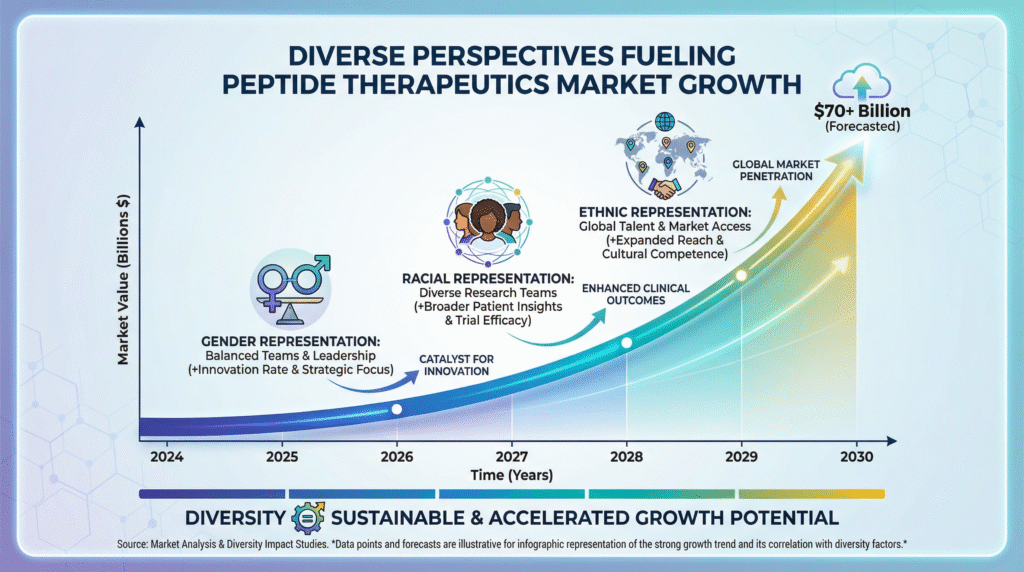
The global peptide therapeutics market, projected to reach $75 billion by 2028, stands at a critical juncture where its scientific ambition must be matched by its commitment to human capital. With over $30 trillion in global assets now managed under ESG principles and studies consistently showing that diverse teams drive 19% higher innovation revenue, the imperative for robust diversity, equity, and inclusion (DEI) strategies has moved from the periphery to the core of competitive strategy. However, the peptide sector, like much of biopharma, faces significant gaps: women hold less than 30% of senior leadership roles in life sciences, and racial and ethnic minorities remain starkly underrepresented, particularly in R&D and executive positions.
This comprehensive analysis provides a definitive framework for measuring, benchmarking, and improving diversity within peptide organizations, translating moral imperative into a measurable business advantage that fuels innovation, mitigates risk, and builds resilient, future-ready companies.
The Business Imperative for DEI in the Peptide Industry
Beyond compliance, diversity is a demonstrable driver of performance, innovation, and sustainability in a knowledge-intensive industry.
The Innovation Dividend of Diverse Teams
How heterogeneity directly impacts peptide discovery and development:
- Enhanced Problem-Solving: Teams with diverse backgrounds approach scientific challenges from multiple angles, reducing groupthink in target identification and formulation design.
- Broader Market Insight: Diverse teams are better equipped to understand global patient populations, informing clinical trial design and market access strategies for peptide therapies.
- Talent Attraction and Retention: 67% of job seekers consider workplace diversity an important factor, making it critical in the war for specialized peptide talent.
- Risk Mitigation: Inclusive cultures with high psychological safety report lower rates of quality incidents and improve GMP compliance through open communication.
The Current State: A Diagnostic of the Peptide Sector
Available data points to significant opportunity for improvement:
- Leadership Representation: Biotech boards average 22% female representation, below the S&P 500, with even lower figures for women of color.
- R&D Pipeline Leaks: Attrition of diverse talent between graduate levels and principal investigator/senior scientist roles.
- Geographic Disparities: Concentration of manufacturing and research in specific regions can limit cognitive diversity and cultural perspective.
- Data Scarcity: Many small and mid-sized peptide companies lack the infrastructure to systematically collect and analyze workforce demographics.
“In an industry built on decoding the complex language of biology, we cannot afford a monolithic perspective. Diversity in our labs and boardrooms isn’t just about fairness; it’s the most powerful catalyst for the breakthrough science that will define the next generation of peptide therapeutics. What we measure, we improve—and it’s time to measure with rigor.” — Dr. Lena Mitchell, CEO, BioDiverse Therapeutics.
A Framework for Measuring Diversity, Equity, and Inclusion

Effective management begins with measurement. A multi-dimensional framework captures the full spectrum of DEI.
Core Diversity Metrics (Representation)
Quantitative measures of workforce composition:
| Metric Category | Specific Metrics | Calculation & Benchmark Source |
|---|---|---|
| Gender Diversity | % Female, % Non-binary, Gender ratio in leadership (Director+, C-Suite, Board) | Benchmark against BIO industry reports or Life Sciences Diversity Consortium |
| Racial/Ethnic Diversity | Representation by race/ethnicity (using local classifications), % from underrepresented groups in leadership | Compare to local population demographics and industry peers |
| Global & Cultural Diversity | % of workforce internationally mobile, % with multilingual capabilities, nationality distribution | Internal trend analysis, important for global companies |
| Career Stage & Function | Representation across job families (R&D, Manufacturing, Commercial, Corporate), % in technical vs. support roles | Identify pipelines and potential barriers in specific areas like peptide chemistry or process development. |
Equity and Inclusion Metrics (Experience)
Qualitative and process-oriented measures that gauge the workplace environment:
- Pay Equity: Ratio of compensation for similar roles disaggregated by gender and race/ethnicity, adjusted for experience and location.
- Promotion Velocity: Average time to promotion for different demographic groups, highlighting potential systemic barriers.
- Attrition by Demographic: Voluntary turnover rates segmented by key groups. Higher attrition in a group signals inclusion issues.
- Inclusion Survey Scores: Regular anonymous surveys measuring psychological safety, sense of belonging, and fairness of opportunity.
- Sponsorship & Mentorship: Participation rates in formal programs by demographic, tracking of mentees’ progress.
Industry Benchmarking: Establishing a Baseline
Understanding your position relative to peers and the broader market is essential for goal-setting.
Sources of Benchmarking Data
Where to find comparative data for the peptide and broader life sciences sector:
- Industry Consortia: Organizations like the Life Sciences Diversity Collective or local biotech associations often publish aggregated reports.
- Public Company Disclosures: Review ESG reports of public peptide and biopharma companies for their reported metrics.
- Specialized Surveys: Engage with consulting firms that conduct annual life sciences diversity surveys for participant benchmarks.
- Geographic Benchmarks: Compare company data to regional talent pool data from universities and government statistics.
Setting Realistic and Ambitious Goals
Moving from data to targets:
- Internal vs. External Goals: Set short-term goals for improving internal metrics (e.g., reduce promotion gap by 20%) and longer-term representation goals aligned with industry leaders.
- SMART Criteria: Ensure goals are Specific, Measurable, Achievable, Relevant, and Time-bound (e.g., “Increase representation of women in VP+ roles from 25% to 35% within 3 years”).
- Balance Lagging and Leading Indicators: Pair representation goals (lagging) with action-oriented goals for hiring, promotion, and inclusion (leading).
Strategic Initiatives for Meaningful Improvement
Data and benchmarks must be activated through targeted, sustained initiatives.
Talent Acquisition and Pipeline Strategies
Building a diverse talent funnel from the start:
| Initiative | Description | Key Performance Indicators (KPIs) |
|---|---|---|
| Structured Interviewing | Implementing role-specific, competency-based questions for all candidates to reduce unconscious bias. | Reduced variance in interview scores; increased diversity of candidates moving to final rounds. |
| Partnerships with HBCUs/HSIs & Global Institutions | Building R&D internship and co-op programs with historically Black colleges and universities (HBCUs), Hispanic-serving institutions (HSIs), and universities in emerging markets. | Number of hires from partner institutions; retention rates of those hires. |
| Blind Resume Reviews (for early career) | Removing identifying information from resumes for initial screening of entry-level and graduate roles. | Demographic mix of candidates selected for interview vs. applicant pool. |
| Diverse Slate Policy | Requiring hiring managers to interview a demographically diverse slate of candidates for open positions. | % of roles filled with a diverse slate; hiring manager compliance. |
Development, Advancement, and Inclusion Tactics
Ensuring all talent can thrive and lead:
- Mentorship & Sponsorship Programs: Formal programs pairing junior talent from underrepresented groups with senior leaders who can provide advocacy (sponsorship), not just advice.
- Skills-Based Leadership Training: Offering training in core leadership competencies (e.g., influencing, strategic communication) accessible to all high-potential employees, not just those already in the “inner circle.”
- Equitable Project Allocation: Auditing who gets assigned to high-visibility, career-advancing projects (e.g., leading a new peptide platform team) to ensure equitable access.
- Employee Resource Groups (ERGs): Funding and empowering ERGs for women, LGBTQ+, Black, Hispanic/Latino, and other employees. Use ERGs as a sounding board for policies.
- Inclusive Meeting Protocols: Training on techniques to ensure all voices are heard in meetings, which is critical for scientific brainstorming and project reviews.
Governance, Accountability, and Transparency
Sustained progress requires leadership ownership and clear accountability structures.
Leadership and Board Accountability
Embedding DEI in corporate governance:
- Board Oversight: Establishing a board committee (often the Nominating & Governance committee) with explicit DEI oversight, reviewing metrics and strategy regularly.
- Executive Compensation Links: Tying a portion of executive bonus compensation to the achievement of specific, measurable DEI goals (e.g., representation, inclusion survey scores).
- Public Goals & Reporting: Increasingly expected by investors. Publishing annual diversity data and progress against goals in ESG reports or on the company website.
- DEI Leadership: Appointing a senior leader (Chief Diversity Officer) with budget, staff, and direct access to the CEO and board.
Data Transparency and Communication
Building trust through openness:
- Internal Reporting: Sharing aggregated diversity metrics and progress with all employees regularly, not just leadership.
- Narrative with Numbers: When sharing data, provide context—what the goals are, what initiatives are underway, and where challenges remain.
- Listening Strategies: Conducting regular “pulse” surveys and inclusion focus groups to understand the employee experience behind the numbers.
Future Trends: The Evolving Landscape of DEI in Life Sciences
The standards for measurement and action are continuously rising.
Emerging Metrics and Expectations
What the future of measurement holds:
- Socioeconomic Diversity: Growing interest in measuring and improving socioeconomic background diversity, linked to educational access in STEM.
- Cognitive & Neurodiversity: Intentional inclusion of individuals with thinking differences (e.g., autism, ADHD) recognized for unique strengths in pattern recognition and concentration.
- Supply Chain Diversity: Expanding DEI expectations to include diverse-owned suppliers and contract manufacturers in the peptide supply chain.
- Algorithmic Auditing: Using tools to audit HR and people-analytics algorithms for hidden bias in recruitment or performance management software.
Regulatory and Investor Drivers
External forces shaping the agenda:
- Mandatory Disclosure Rules: Following trends in the EU and California, more jurisdictions may mandate standardized workforce diversity disclosure for companies of a certain size.
- Investor Stewardship: Large asset managers are increasingly voting against directors at companies perceived to have poor diversity practices or transparency.
- Customer & Partner Pressure: Large pharma partners and healthcare systems are beginning to assess the DEI practices of their biotech suppliers and partners.
FAQs: Peptide Industry Diversity Metrics and Strategies
Q: What are the most critical diversity metrics a small to mid-sized peptide biotech should start tracking first?
A: For an SME, start with foundational representation metrics that are manageable to collect: gender breakdown across the entire company and specifically in leadership (Director level and above), and racial/ethnic breakdown using standard EEOC categories. Crucially, pair this with two experience metrics: overall voluntary attrition rate, and results from a simple, annual anonymous inclusion survey (even 5-10 questions on psychological safety and fair treatment).
This combination gives you a snapshot of “who is here” and “how they are experiencing the workplace.” Avoid getting paralyzed by trying to measure everything at once. Focus on consistent, annual measurement of these core metrics to establish a baseline and track trends.
Q: How can we ensure our diversity and inclusion initiatives are genuinely effective and not just “check-the-box” programs?
A: True effectiveness is measured by outcomes, not activity. Shift from counting “number of trainings delivered” to measuring impact. Link your initiatives directly to the metrics. For example, if you launch a mentorship program, track the promotion rate and retention of participants versus a control group over 2-3 years.
If you implement structured interviews, measure the demographic shift in candidates who pass the interview stage. Use inclusion survey data to identify specific pain points (e.g., “career development fairness”) and design targeted initiatives to address them, then re-survey to see if scores improve. Hold leaders accountable for the outcomes (metric movement) within their teams, not just for running programs. Effectiveness is evidenced when metrics move and the lived experience of employees, as captured in surveys and attrition data, improves.
Q: We’re afraid of collecting demographic data due to privacy concerns and employee reluctance. How should we approach this?
A: Transparency and clear communication are key. Explain to employees *why* you are collecting the data (to build a more fair and inclusive workplace, to identify areas for support) and *how* it will be used (in aggregate only, for analysis and goal-setting, never for individual decisions). Assure absolute confidentiality; data should be collected and stored separately from personnel files, often by a third-party HR system or a small, trusted People/HR team.
Make disclosure voluntary, but communicate its importance. Over time, as trust builds, participation rates usually increase. Start with broader categories and allow an “opt not to disclose” option. Leading with action—showing you are using the data to make positive changes—will increase future participation.
Core Takeaways
- Measure with Purpose: Effective DEI strategy is built on a foundation of robust, multi-dimensional metrics covering representation, equity, and inclusion experiences.
- Benchmark to Aspire: Understanding your position relative to the peptide industry and broader life sciences sector is critical for setting realistic yet ambitious goals.
- Initiatives Must Be Tied to Outcomes: Programs in hiring, development, and inclusion are only as good as their measurable impact on key metrics over time.
- Accountability Drives Change: Sustained improvement requires clear leadership ownership, board oversight, and, increasingly, linking progress to compensation.
- Transparency Builds Trust: Communicating goals, data, and progress—both internally and externally—is now a business imperative for attracting talent and investment.
Conclusion: Building the Inclusive Future of Peptide Therapeutics
The journey toward a truly diverse, equitable, and inclusive peptide industry is not a side initiative; it is integral to the sector’s ability to innovate sustainably and fulfill its promise to patients worldwide. By adopting a rigorous, data-driven approach to measurement, benchmarking, and strategic intervention, companies can move beyond goodwill to generate tangible improvements in both their culture and their bottom line. The frameworks and strategies outlined here provide a roadmap for transforming the human ecosystem within peptide organizations, ensuring that the field draws upon the full spectrum of human talent and perspective.
As regulatory expectations evolve and investor scrutiny intensifies, leadership in DEI will become an even sharper competitive differentiator. The peptide companies that embrace this challenge today—not as a compliance exercise, but as a core strategic priority—will be the ones that attract the best minds, foster the most innovative environments, and ultimately deliver the breakthrough therapies of tomorrow. The science of peptides is complex; the formula for inclusive success is clear: measure, act, and lead with accountability.
Disclaimer
This article contains information, data, and references that have been sourced from various publicly available resources on the internet. The purpose of this article is to provide educational and informational content. All trademarks, registered trademarks, product names, company names, or logos mentioned within this article are the property of their respective owners. The use of these names and logos is for identification purposes only and does not imply any endorsement or affiliation with the original holders of such marks. The author and publisher have made every effort to ensure the accuracy and reliability of the information provided.
However, no warranty or guarantee is given that the information is correct, complete, or up-to-date. The views expressed in this article are those of the author and do not necessarily reflect the views of any third-party sources cited.