
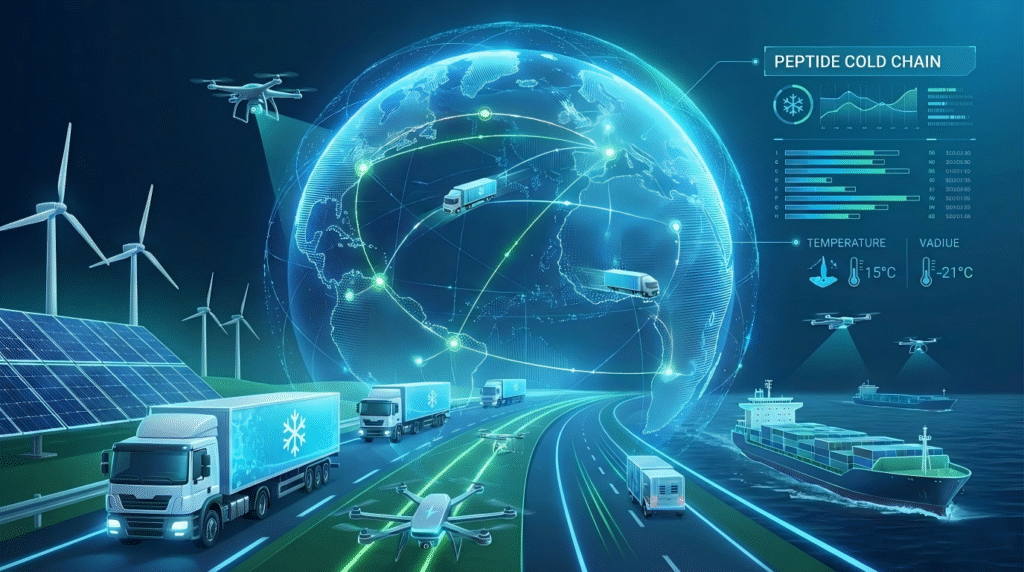
The global peptide therapeutics market, accelerating toward a $75 billion valuation, is built upon a paradox: its life-saving innovations are distributed via a logistics network responsible for an estimated 5-8 million metric tons of CO₂ emissions annually. With the pharmaceutical supply chain contributing up to 30% of a healthcare organization’s carbon footprint and over 65% of peptide products requiring energy-intensive cold chain transport, the traditional model of global logistics is both an operational necessity and a significant environmental liability. In an era where 80% of investors now mandate ESG disclosures and patients increasingly value corporate ecological stewardship, transforming peptide transportation from a high-emission cost center to a model of sustainable logistics is a non-negotiable imperative for competitive resilience.
This comprehensive analysis provides a data-driven roadmap for achieving 40-60% reductions in logistics carbon emissions through advanced route optimization, innovative packaging, modal shifts, and strategic partnerships, enabling peptide companies to future-proof their supply chains while fulfilling their commitment to planetary health.
The Carbon Cost of Complexity: Diagnosing the Peptide Logistics Footprint
Peptide transportation presents a uniquely challenging emissions profile due to its stringent and non-negotiable requirements for stability, security, and speed.
Key Drivers of Emissions in Peptide Logistics
Understanding the primary sources of carbon in the supply chain:
- Cold Chain Dominance: 60-80% of peptide shipments require 2-8°C or -20°C temperature control, utilizing active refrigeration that can increase a shipment’s carbon footprint by 200-300% compared to ambient transport.
- Air Freight Dependency: For high-value, time-sensitive clinical trial materials and commercial APIs, air transport is standard, emitting approximately 50 times more CO₂ per ton-kilometer than ocean freight.
- Last-Mile Inefficiency: Direct-to-patient and clinic deliveries often involve small, partially full vehicles, resulting in high emissions per dose delivered.
- Packaging Waste: Single-use expanded polystyrene (EPS) shippers, dry ice, and complex insulated packaging contribute significant upstream manufacturing emissions and downstream waste.
Quantifying the Impact: Industry Benchmarks and Pressures
- Regulatory & Investor Scrutiny: The EU Corporate Sustainability Reporting Directive (CSRD) and the U.S. SEC’s proposed climate rules will mandate detailed Scope 3 emissions disclosure, forcing transparency on logistics emissions.
- Customer Demand: Major healthcare systems and group purchasing organizations (GPOs) are setting ambitious net-zero goals for their supply chains, making sustainable logistics a condition for preferred supplier status.
- Financial Risk: Carbon pricing mechanisms and potential “green border” adjustments in key markets add a direct and growing financial cost to emissions.
“The carbon emissions from our global logistics network are not an unfortunate byproduct; they are a direct reflection of our operational choices. For peptide companies, sustainability is no longer just about the molecule in the vial, but about the entire journey that vial takes. Optimizing that journey for carbon efficiency is the next great frontier in pharmaceutical supply chain excellence.” — Marcus Thorne, Chief Supply Chain Officer, Global Biologics Logistics.
The Sustainable Transportation Toolkit: Strategies for Emission Reduction
Achieving significant carbon reductions requires a multi-pronged approach that balances patient safety, cost, and environmental impact.
1. Network and Modal Optimization
Rethinking how and where products move:
| Strategy | Implementation | Potential Carbon Reduction |
|---|---|---|
| Sea-Air Intermodal Shifts | Using ocean freight for the long-haul leg (e.g., Asia to Europe) combined with a shorter air segment, cutting air freight distance by 50-70%. | 20-40% per shipment |
| Near-Shoring & Regional Hub Strategy | Establishing regional fill-finish and packaging hubs closer to end markets to drastically reduce long-haul transport distances for finished goods. | 15-30% of finished goods footprint |
| Dynamic Route Optimization | Using AI-powered logistics platforms to consolidate shipments, select optimal routes in real-time, and avoid empty backhauls. | 10-25% for ground logistics |
2. Cold Chain Innovation and Passive Shipping
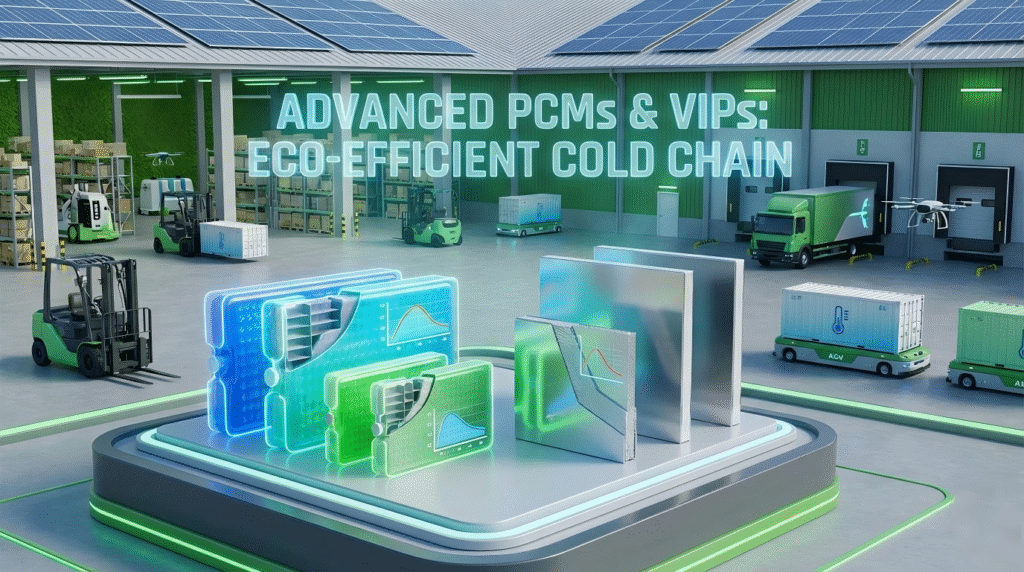
Moving from energy-intensive active cooling to intelligent passive solutions:
- High-Performance Phase Change Materials (PCMs): Advanced gels that maintain precise temperatures for 96-120+ hours, eliminating the need for active refrigeration on many routes and reducing emissions by over 90% for qualified lanes.
- Vacuum Insulated Panel (VIP) Shippers: Providing superior insulation in a thinner profile, allowing more product per pallet or air container, thereby improving load efficiency and reducing emissions per unit.
- Qualified Ambient Shipping: Investing in stability studies to extend the allowable temperature range for certain peptides (e.g., 2-25°C instead of 2-8°C), opening up more efficient transport modes.
- Reusable Cold Chain Assets: Implementing a closed-loop system for insulated shippers and PCMs, achieving 10-20 use cycles and reducing packaging waste and associated emissions by 80-90%.
3. Fleet and Fuel Decarbonization
Greening the vehicles and vessels in the supply chain:
- Carrier Selection & Partnership: Prioritizing logistics partners with certified green fleets (electric, hydrogen, or biofuel-powered vehicles for last-mile) and committed carbon reduction targets.
- Sustainable Aviation Fuel (SAF): Paying a premium to blend SAF into air cargo shipments, which can reduce lifecycle emissions by up to 80% compared to conventional jet fuel.
- Ocean Carrier Efficiency: Choosing shipping lines that utilize slow steaming, hull air lubrication, and waste heat recovery systems to improve vessel efficiency.
4. Packaging Lightweighting and Circularity
Reducing the mass and waste of the shipping unit itself:
- Lightweight Material Substitution: Replacing heavy EPS with molded fiber or advanced, lightweight foam composites.
- Right-Sizing: Using on-demand packaging systems to create shippers that match the product dimensions exactly, eliminating wasted space and material.
- Plant-Based & Recyclable Materials: Developing shippers from mycelium (mushroom-based) or cellulose fibers that are home-compostable or easily recycled in municipal streams.
Measurement, Reporting, and Verification (MRV): The Foundation of Credibility
You cannot manage what you do not measure. Robust carbon accounting is essential for tracking progress and reporting.
Establishing a Logistics Carbon Baseline
Key steps in the measurement process:
- Data Collection: Gather primary data from carriers (fuel usage, weight, distance) for key lanes, using industry-standard emission factors (e.g., GLEC Framework) for estimation elsewhere.
- Scope 3 Category 4 (Upstream Transportation) Calculation: This is where most logistics emissions reside. Use specialized software or lifecycle assessment (LCA) consultants to calculate accurately.
- Normalization: Express emissions in meaningful metrics, such as kg CO₂e per kilogram of product shipped or per $1M revenue, to track efficiency over time.
Technology Enablers for MRV
- IoT-Enabled Visibility Platforms: Sensors that track location, temperature, and shock also provide the data needed to calculate the emissions of that specific journey.
- Digital Freight Platforms: Platforms that automatically calculate and report the carbon footprint of each shipment option at the point of booking.
- Blockchain for Provenance: Emerging use for creating an immutable, shared record of a shipment’s environmental attributes (fuel type, SAF blend) across the supply chain.
The Business Case: Beyond Compliance to Value Creation
Sustainable logistics investments deliver a compelling return that extends far beyond risk mitigation.
| Value Driver | Mechanism | Quantitative Impact |
|---|---|---|
| Cost Reduction | Modal shifts (air to sea), load optimization, and reduced packaging waste lower direct logistics spend. | 5-15% reduction in total logistics cost |
| Risk Mitigation | Future-proofs against carbon taxes, fossil fuel volatility, and regulatory non-compliance fines. | Avoided costs of potential future carbon pricing ($50-100/ton CO₂) |
| Brand & Market Access | Meets demands of ESG investors and large healthcare customers with net-zero supply chain goals. | Enhanced supplier ratings, preferred status, and access to green financing. |
| Talent Attraction | Strong sustainability mission attracts and retains top talent, particularly in younger generations. | Improved employee satisfaction and reduced turnover. |
Future Trends: The Road to Net-Zero Logistics
The landscape of sustainable transportation is evolving rapidly with technology and policy.
Emerging Technologies
- Electric & Autonomous Freight: Long-haul electric trucks and autonomous platooning for highways will transform ground logistics emissions.
- Green Hydrogen for Aviation & Shipping: While long-term, hydrogen-powered aircraft and vessels represent the only viable path to fully decarbonize long-distance freight.
- AI for Predictive Logistics: Advanced AI will optimize entire networks proactively, predicting demand and positioning inventory to minimize emergency, high-emission shipments.
Ecosystem and Collaborative Models
- Physical Internet & Asset Sharing: Industry-wide sharing of standardized, reusable containers and pooling of logistics capacity to maximize asset utilization.
- Insetting over Offsetting: Moving from purchasing carbon credits to directly investing in emission reduction projects within the company’s own supply chain (e.g., funding a carrier’s fleet electrification).
FAQs: Sustainable Peptide Transportation and Carbon Reduction
Q: What is the single most impactful change a mid-sized peptide CDMO can make to quickly reduce its transportation carbon footprint?
A: The most impactful and immediately actionable change is to conduct a transportation mode and lane analysis. For each major shipping lane, evaluate if a shift from air freight to ocean freight (or sea-air) is possible by extending lead times and validating temperature control with passive shippers. For many transcontinental routes, this single switch can reduce emissions on that lane by 90-95%. Start with your least time-sensitive materials, such as certain raw materials or stability study samples.
The cost savings from avoiding air freight often pay for the investment in high-performance passive shippers within a few shipments, making it a win for both the environment and the bottom line.
Q: How do we ensure patient safety and maintain strict temperature control when shifting to more sustainable, but potentially slower, modes of transport like ocean freight?
A: Patient safety is non-negotible. The key is validation and quality by design. Shifting modes is not about taking risks; it’s about using better technology to enable greener options. Before changing modes, you must re-qualify your entire shipping system (package + route + duration) according to ISTA or ASTM standards. This involves thermal mapping the new route (placing sensors in containers) and performing a formal distribution qualification study using the new combination of passive shippers and longer transit times.
The data from these studies provides the scientific evidence that the product remains within specification. Many modern PCM-based shippers are validated for 5-10 days, making them perfectly suitable for most ocean freight durations.
Q: How should we communicate our sustainable logistics efforts to customers and investors without being accused of “greenwashing”?
A: Credible communication rests on three pillars: specificity, data, and standards. Avoid vague claims like “green shipping.” Instead, be precise: “We reduced emissions on our EU-US clinical trial material lane by 40% in 2023 by shifting to sea-air intermodal transport and using sustainable aviation fuel.” Back this up with data from your MRV process. Finally, align your reporting with recognized standards like the Global Logistics Emissions Council (GLEC) Framework or the GHG Protocol, and consider obtaining third-party verification or certification for your logistics emissions. Transparency about both successes and ongoing challenges builds far more trust than perfection.
Core Takeaways
- Strategic Imperative, Not a Nice-to-Have: Decarbonizing peptide logistics is essential for regulatory compliance, cost control, risk mitigation, and maintaining social license to operate in an ESG-focused world.
- Multi-Strategy Approach Required: Significant reductions (40-60%) are achievable through a combination of modal shifts, cold chain innovation, carrier partnership, and packaging redesign—no single solution suffices.
- Data is Foundational: Robust Measurement, Reporting, and Verification (MRV) of logistics emissions is the critical first step to managing them and is increasingly mandated by regulators and investors.
- Strong Business Case Exists: Sustainable logistics investments reduce costs, mitigate future financial risks, enhance brand value, and secure market access—delivering a clear return on investment.
- Collaboration is Key: Achieving net-zero logistics requires deep partnership with carriers, suppliers, and even competitors to share assets, standardize approaches, and drive systemic change.
Conclusion: Delivering Health Without Cost to the Planet
The journey towards sustainable peptide transportation is a complex but essential evolution, aligning the imperative of global health with the health of the global environment. By embracing a strategic, data-driven approach to carbon footprint reduction, peptide companies can transform their logistics networks from a significant source of emissions into a beacon of innovation and efficiency. The technologies and strategies exist today to make substantial progress. The decision to implement them is no longer just an environmental one; it is a core business strategy that will define the resilient, responsible, and successful peptide enterprise of the future.
As pressure from all stakeholders intensifies, leadership in sustainable logistics will become a powerful competitive differentiator. Companies that act now to redesign their supply chains for carbon efficiency will not only contribute to a healthier planet but will also build more agile, cost-effective, and future-proof operations—ensuring that the remarkable benefits of peptide therapeutics are delivered sustainably for generations to come.
Disclaimer
This article contains information, data, and references that have been sourced from various publicly available resources on the internet. The purpose of this article is to provide educational and informational content. All trademarks, registered trademarks, product names, company names, or logos mentioned within this article are the property of their respective owners. The use of these names and logos is for identification purposes only and does not imply any endorsement or affiliation with the original holders of such marks. The author and publisher have made every effort to ensure the accuracy and reliability of the information provided.
However, no warranty or guarantee is given that the information is correct, complete, or up-to-date. The views expressed in this article are those of the author and do not necessarily reflect the views of any third-party sources cited.