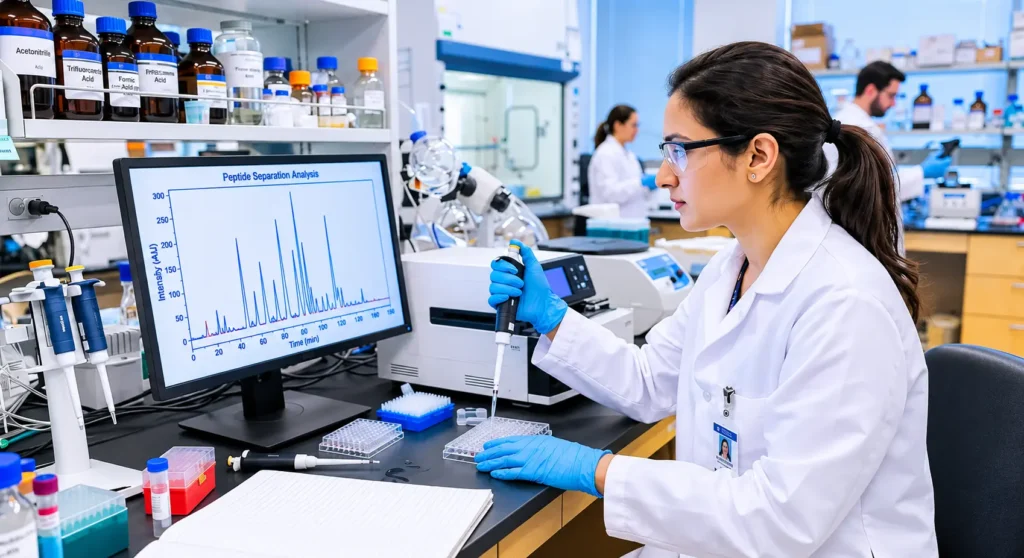
A vial says “Argireline.” The listing says “Acetyl Hexapeptide-8.” Are they the same peptide? Many buyers ask this question. One small number can tell you the answer.
A peptide CAS number is a unique identifier from the Chemical Abstracts Service. It points to one exact substance. Buyers use it to check what they are buying before they pay. Sellers use different names. The number stays the same.
In this guide, you can look up the number for free. Compare it to the formula, weight and sequence. Compare that with the batch report as well. Use it to compare quotations from various vendors. Learn the restrictions to the number before you purchase. A little misstep may cost you plenty.
Why Isn’t the Name on the Vial Enough?
Simply said, a product’s name is a sales label. A chemical identifier is a CAS number. Many sellers may use the same term for the same product. Argireline is another brand name for Acetyl Hexapeptide-8. The term Acetyl Hexapeptide-3 is used incorrectly by certain publications.
What Goes Wrong If You Trust Names Alone?
- Compound in the wrong sense: same name, distinct molecules.
- The correct form would be the free peptide, which does not include salt; instead, you get a salt.
- Bad paperwork: the certificate of analysis pertains to an entirely different product.
How Does a Peptide CAS Number Work as a Product Identity Check?
Since each CAS number is associated with a specific chemical, they are useful for verifying identities. Use a public database to look up the CAS number. It is quite probable that you will be OK if the record matches the name.
What Is a CAS Registry Number?
A unique identifier for a single chemical. It is distributed by an organization known as CAS. The American Chemical Society includes CAS in its membership. There is no secret significance to the numbers.
How Is the Number Built?
A CAS number has three parts, joined by hyphens. The first part has two to seven digits. The second part has two digits. The last part is one check digit.
The check digit helps catch typing mistakes. Start with the digit just before the check digit. Call it 1. Call the next one 2, and so on. Multiply each digit by its number. Then add up the results. For 616204-22-9, the total is 119. The last digit of 119 is 9, and that matches the check digit. A typo like 616204-22-8 fails. But a number can pass and still belong to the wrong substance.
What Do People Use It For?
A CAS number names one substance the same way everywhere. You see it on labels, safety sheets, buying papers and citations.
What Does It Not Tell You?
It is only a label. It does not tell you the structure, purity or quality.
Can One Peptide Have More Than One Form and CAS Number?
A CAS number belongs to one registered substance. Different forms of one peptide can be different substances. So ask which form your peptide CAS number covers before you compare quotes.
Do Salt Forms Have Different CAS Numbers?
They can. A salt form CAS may differ from the free form’s number. The molecular weight changes too.
What About Changed Peptides and Blends?
A change like acetylation can create a new registered structure. Blends and brand-new compounds may have no CAS number at all.
What Do Pengting’s Listings Show?
The BPC 157 listing shows “No salt / Acetate / Arginine salt / Hydrochloride” under one number, 137525-51-0. The Alarelin Acetate listing puts the salt in the product name.
Pengting’s blog says a COA should show the salt form (TFA or acetate). It should also show the net peptide content.

How Do You Match CAS, Formula, Weight and Sequence?
Verify that the label, the SDS, the product page, and the certificate of analysis all have matching fields. Molecular weight, sequence, CAS number, and molecular formula are the four pieces of information. On its own, a peptide’s CAS number is insufficient.
Examples From Pengting’s Custom Peptide Listings
| Product | CAS | Formula | Weight (as printed) | Also on listing |
| Acetyl Hexapeptide-8 | 616204-22-9 | C34H60N14O12S | 888.91 g/mol | ≥99%, white powder, −20℃ |
| BPC 157 | 137525-51-0 | C62H98N16O22 | 1419.55 | 98%, sequence listed |
| Bivalirudin | 128270-60-0 | C98H138N24O33 | 2180.33 | White powder |
| Atosiban | 90779-69-4 | C43H67N11O12S2 | 994.19 | 98%, 2–8℃ |
| Alarelin Acetate | 79561-22-1 | C56H78N16O12 | 1167.33 | 99%, −20℃ long term, 2–8℃ short term |
The formula for BPC 157 is printed as C62-H98-N16-O22. Its sequence is Gly-Glu-Pro-Pro-Pro-Gly-Lys-Pro-Ala-Asp-Asp-Ala-Gly-Leu-Val.
We determined the weight of each item using the instructions provided. About 0.02% of the five are in agreement. The approximate value of Acetyl Hexapeptide-8 in public records is 889.0. Find out what your CoA demonstrates. Inquire as to whether the quantities given are for the free peptide or the acetate salt of Alarelin.
What If the Numbers Do Not Match?
Pengting’s blog calls a name or CAS number that changes between papers a red flag. One public SDS even gives one number to two ingredients.
How Do You Run a CAS Lookup in Five Steps?
You can check a number in five steps.
- Copy the number from the listing.
- Search it in CAS Common Chemistry. It is free, and you can search by name, number or structure.
- Check the record in PubChem. It is a free database from the U.S. National Library of Medicine.
- Compare the name, structure, formula and weight.
- Check the form, salt or free, before you order.
Example: Acetyl Hexapeptide-8
Pengting lists Acetyl Hexapeptide-8 under 616204-22-9. Its molecular formula is C34H60N14O12S. The same formula is shown in the second database entry, CID 11228338. The sequence is reported as Ac-Glu-Glu-Met-Gln-Arg-Arg-NH2 in public sources.
Acetyl hexapeptide-3 is the name of an alternative record (CID 71587772). An additional formula, C35H62N14O11S, is shown. Thus, several records may be accessed from a single name. Which one is yours is revealed by the formula and the sequence.
How Do You Read a CoA Against the CAS Number?
A CoA is a lab report for one batch. Its peptide CAS number must match the product page and the SDS.
Which Papers Should You Ask For?
Pengting’s FAQ says every batch ships with a COA, an HPLC chromatogram, an MS report and an MSDS. Samples are available before you commit.
Why Check the Lot Number First?
The lot number on the CoA must match the vial. If it does not, the report tells you nothing about your batch.
Where Does the CAS Number Appear?
It is on the product page, the CoA and the SDS. Pengting’s blog says it sits in SDS sections 1–3.
What Do HPLC and MS Show?
HPLC shows purity. MS checks identity. A sample can look pure and still be the wrong peptide.
What Can a Peptide CAS Number Not Prove?
It cannot show that it is pure, the quality of the batch, that it is safe or that it has been approved. Purity is a separate number on the listing and the CoA. Pengting lists purity for each product, such as 98%, 99% or ≥99%.
There isn’t just one “good-enough” purity. The correct level depends on the usage. Pengting has a piece on peptide purity. It also recommends an independent HPLC and MS test on a tiny sample, prior to a bulk purchase.
How Do You Compare Quotes by CAS, Not by Name?
Line up the CAS number, form and weight first. Look at price second.
What Should a Quote Request Include?
- CAS number
- Form (salt or free)
- Sequence
- Purity
- Documents
- Delivery date
What Does Pengting’s Site Say About Cost?
Listings mention “Get the latest price” and numbers are not shown. Packing runs from 1 g to 1 kg. Trial orders start at 1 g per item. Bulk categories include 10 g, 50 g, 100 g, 500 g, and 1 kg+. Pricing is tiered.
The blog of Pengting claims pricing varies on length, purity, extras, order size and quickness. Custom orders will be quoted and technically reviewed within 48 hours of sequence receipt.
What Should You Look For When Buying Peptides?
Look for a listing and papers that agree with each other.
Checklist
- CAS number, formula and weight on the listing
- Batch CoA with HPLC and MS
- MSDS
- A lot number that matches the vial
- A small trial order
- A delivery date in writing
Red Flags From Pengting’s Blog
Walk away if you see one SDS for many peptides, no lot number, purity with no test method, or a name or CAS number that changes between papers.
How Are Peptides Sold, and Who Can Buy Them?
Pengting exclusively sells to confirmed business customers. It is not sold to the public. It labeled its GLP-1 analogs “For Research Use Only — Not for Human or Veterinary Use.” It asks for institutional authentication prior to a quotation.
Shipping is EXW or FOB Shenzhen/Shanghai port. Customs are managed by the importer. DDP is not offered. This is not legal advice, and rules vary by country.
How Does Pengting Help With CAS Checks?
Sichuan Pengting Technology Co., Ltd. shows a CAS number on its listings and sends batch papers. Its site gives these details:
- Factory Introduction: founded in 2021 and based in Leshan, Sichuan.
- Focusing on One Area: peptides only. Over a hundred raw materials are researched and produced. The categories are custom peptide and cosmetic peptide.
- Factory Scale: a cooperative manufacturing base of 6,500+ square meters and 5+ PhD R&D engineers.
- Factory Certification: ISO 9001, and GMP standards through its manufacturing partner. It does not yet hold cGMP or a US FDA DMF. Both are on its 2027 roadmap. It says 100% of raw materials are traceable.
- Delivery Cycle: custom synthesis takes 2–6 weeks. Supply delivery takes 15–30 days. Shipping takes 15–20 days to Europe and America and 7–10 days to Southeast Asia. Urgent orders ship within 72 hours.
An NDA template is sent within one business day. A quality agreement is signed once the scope is confirmed.
Frequently Asked Questions
What is a CAS number used for?
For one thing, a CAS number is the same everywhere. You see it on labels, SDS sheets, and citations.
Is a CAS number unique to one chemical?
Yes, a CAS number is unique to a single registered drug. One peptide may have various forms which can be separate entities.
Do salt forms have different CAS numbers?
They can. The salt form and the free form may have different number and weights. Ask what form the listing is in.
How do I look up a CAS number?
Find the number in CAS Common Chemistry. Then verify a second database. Compare formula, weight and name.
Does a peptide CAS number prove purity?
No. An element is identified by its CAS number. No mention of purity is made either. The outcome of the batch HPLC determines the purity.
Can a peptide have no CAS number?
Yes. There may not be any in blends or novel chemicals. Determine the weight, formula, and sequence instead.
Conclusion
Although there are other methods, a peptide CAS number is an excellent first check. Find out. Fill in all four fields. Compare the COA with the lot. Evaluate different quotations based on their forms. Quick and easy, each step might save you money by avoiding an incorrect order.
Sichuan Pengting Technology Co., Ltd. fits this need. It shows CAS numbers on its listings. It ships a COA, HPLC chromatogram, MS report and MSDS with every batch. It shares sample papers first. Use Get A Quote on its contact page.