What synthesis route survives when a small trial batch turns into a bulk request? This is a question that comes up often in peptide sourcing talks. The answer usually begins with the SPPS vs LPPS difference. Looking at peptide production data over the years, the choice of method affects cost, purity and speed.
This is something that procurement teams often learn the hard way when a batch arrives late or costs more than expected. The choice of the method of synthesis at the outset governs nearly all subsequent steps. This article describes how solid-phase and liquid-phase methods work. It also explains cost, quality checks and common buyer errors.
What Are SPPS and LPPS in Peptide Synthesis?
In SPPS vs LPPS difference SPPS is solid-phase peptide synthesis, a technique for assembling amino acids one by one on a solid resin bead. LPPS is liquid-phase peptide synthesis, where the same coupling steps occur in solution instead of on a resin. Both methods use amino acids linked in a specific order , with repeated coupling and deprotection steps . Depending on the setup you use, the amount of cleanup work you will have to do later.
The choice of solid-phase versus liquid-phase peptide synthesis is not just a laboratory habit. It affects the time of purification, batch size constraints and cost per gram. This distinction allows buyers to ask more pointed questions before placing an order.
Key Facts (SPPS vs LPPS difference) at a Glance
| Attribute | SPPS | LPPS |
| Full name | Solid Phase Peptide Synthesis | Liquid Phase Peptide Synthesis |
| Support medium | Insoluble resin bead | Dissolved in solvent |
| Automation | High, widely automated | Mostly manual or semi-automated |
| Best suited for | Short to mid-length chains | Long chains, large-scale runs |
What Are the Steps in SPPS?
Solid-phase peptide synthesis involves a cycle of attaching, protecting and releasing amino acids onto a resin bead. This process is repeated until the whole chain is built. Then the finished chain is cut off the resin. The chain is always anchored so that it is easy to wash away excess reagents.
Core Steps in Solid Phase Peptide Synthesis (SPPS)
- Resin loading: the first amino acid is attached to the solid support.
- Deprotection: removal of an intermediate blocking group to expose the active site
- Coupling: Next amino acid is added, frequently via Fmoc SPPS chemistry.
- Washing: The unused material is rinsed before the next cycle begins.
- Cleavage: the final chain is cut from the resin and cleaned up.
The cycle is a major reason why SPPS is still the method of choice for modern peptide production of shorter chains.
SPPS vs LPPS Difference: Which Has Better Scalability & Purity?
SPPS usually wins on speed and automation. LPPS often wins on the scale for very long chains or complex ones. There is no one best method for all jobs. Which one to choose depends on chain length, batch size and how much cleanup time a project can afford.
Comparing the Two Methods: SPPS vs LPPS Difference
| Factor | SPPS | LPPS | Best Fit |
| Scalability | Limited by resin size | Scales well in solution | LPPS for bulk runs |
| Purity control | High at each step | Needs more cleanup steps | SPPS for shorter chains |
| Cost per gram | Higher at large scale | Lower at large scale | LPPS for cost-sensitive orders |
| Typical chain length | Up to ~50 residues | Long chains, fragment joining | Depends on sequence |
The bottom line is simple in SPPS vs LPPS difference. SPPS is typically faster with short, standard sequences. Long or high volume orders tend to go to LPPS or a blend of both.
How Are Synthetic Peptides Made at Industrial Scale?
Synthetic peptides on scale often use a combination of SPPS for short pieces and LPPS style joining for longer chains. Many suppliers use a mix of both methods rather than picking one. Resin builds short pieces fast. If the target chain is too long for smooth single-pass SPPS, those segments are then joined together in solution.
Trusted suppliers follow quality steps for each batch produced in this way. Material for research use only (RUO) must be consistent and have good chemistry. The final sequence in solid phase vs liquid phase peptide synthesis is verified by tests like HPLC testing and mass spectrometry before it ships.
What Affects the Cost of Peptide Synthesis?
The price of peptide synthesis depends on the length of the chain, the batch size and the purity you want. Longer chains require more coupling steps, which increases both time and reagent use. LPPS often results in a lower cost per gram for larger batches. The higher the purity, the more purification passes are required, so purity goals matter too.
Buyers should request a cost breakdown based on these three factors. A supplier who explains costs this way is more reliable than one who just gives a flat number without context. This also assists when comparing quotes from different vendors.
Major Mistakes When Choosing Peptide Synthesis Method?
The most common error is choosing a method based on price alone without first analysing the peptide length of the chain. Running a short chain through a method designed for long chains is often more expensive and slower. Buyers also wait to enquire about purity data until after the order ships. There is no way to catch a mismatch early.

Mistakes Worth Avoiding
- Order without checking sequence length vs. method strengths.
- Do not ask for HPLC or mass spec data before shipment.
- Assuming one method for all project sizes.
- Not asking how a hybrid approach might reduce cost or time.
“Avoid these mistakes to save cost and turnaround time on future orders.”
What Quality Checks Confirm Peptide Purity?
Peptide purity is assessed by HPLC and mass spectrometry after synthesis completion. HPLC test separates the peptide from other byproducts and provides a purity in terms of %. Mass spectrometry confirms that the molecule is the exact weight of the target sequence. Together the two checks are the standard quality proof of RUO peptide material.
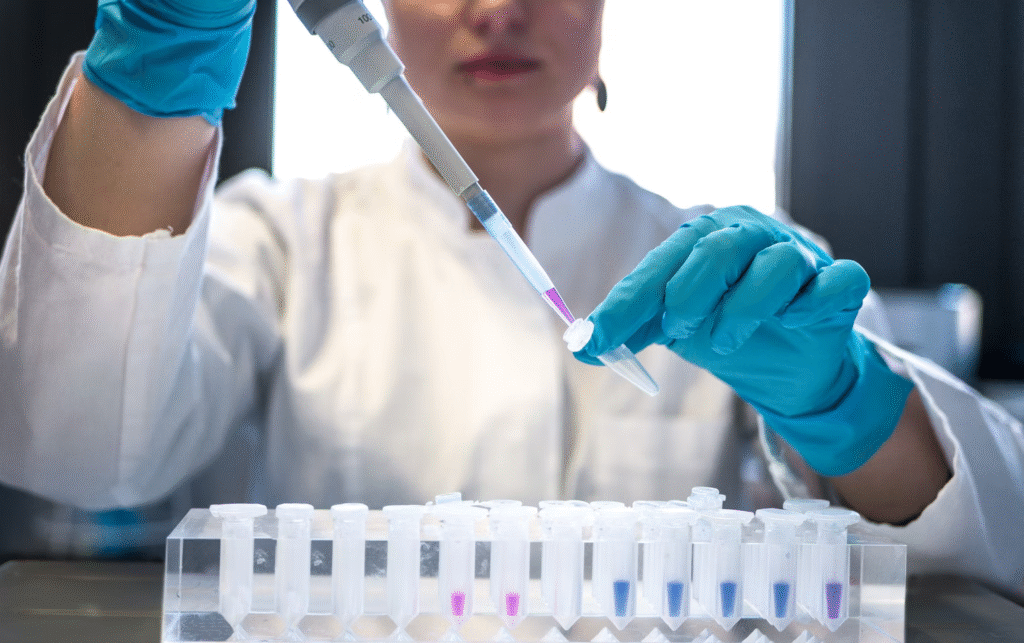
Buyers should insist on receiving a certificate of both results before accepting a shipment. Without that data a supplier is unable to check what was actually manufactured. This step prevents the buyer from receiving off-target or low purity material.
How to Choose the Right Peptide Synthesis Method
Peptide synthesis methods are about matching chain length, order size and turnaround needs with the strengths of each process. A bulk order of a long chain has very different needs than a short research peptide. You get the right fit and you save time and money.”
- Check the sequence length first:- SPPS works best for sequences of around 50 amino acid residues.
- Ask about batch size:- LPPS or hybrid synthesis is usually more economical at scale for large orders.
- Request purity data:- Any RUO peptide API shipment should include HPLC and mass spec data.
- Confirm lead time:- automated SPPS runs are often faster for standard sequences.
Frequently Asked Questions
What is the full form of SPPS?
SPPS is the abbreviation for Solid Phase Peptide Synthesis. It explains a method where amino acids are sequentially attached to an insoluble resin.
- The growing chain is held in each reaction step by the resin.
- Synthesis is complete and the finished peptide is cleaved off the resin.
Name the two ways in which polypeptides are synthesised?
There are two major methods: solid phase peptide synthesis (SPPS) and liquid phase peptide synthesis (LPPS). They build the chain with iterative coupling steps, one on a solid support and the other in solution.
- SPPS is very good for short, standard sequences that can be highly automised.
- LPPS is good for longer chains and larger production runs.
What is Fmoc SPPS?
The Fmoc SPPS is a solid phase synthesis method where the amino terminus of the amino acid is protected by the Fmoc group. Today it is the most widely used protection chemistry for solid phase peptide synthesis.
- Fmoc is deprotected under mild basic conditions between steps.
- This chemistry is compatible with a wide variety of standard and modified amino acids.
What is LPPS peptide synthesis used for?
LPPS peptide synthesis is mainly used for long chains and large-scale production. This permits reactions to occur in solution, which can reduce cost per gram at higher volumes.
- LPPS fragment condensation assembles pre-made peptide fragments.
- Often, LPPS are combined with SPPS-built fragments in hybrid workflows.
How are synthetic peptides made?
Synthetic peptides are made by chemically linking amino acids in a particular sequence. This can be done by either solid-phase or liquid-phase methods. The coupling and deprotection cycle is repeated until the chain is complete.
- All the amino acids are added in a planned, specific order.
- Post-synthesis tests of the sequence and purity confirm
Solid phase peptide synthesis (SPPS) is a technique to produce peptides.
Solid phase peptide synthesis allows for rapid short to mid-length chain synthesis with high repeatability. It is still the standard for most research grade orders under 50 amino acids.
- SPPS provides high levels of automation which reduces the production time.
- It is still the default for standard research sequences.
Conclusion
The SPPS vs LPPS difference is not a contest to find a winner. It’s about matching the method to the chain length, the batch size and the purity needs. SPPS is often the method of choice for short sequences. LPPS or a hybrid process is often better for long chains and bulk RUO peptide API orders.
Sichuan Pengting Technology Co., Ltd. is a good company to check out if you are sourcing bulk research-use-only peptide material or custom peptide synthesis services. It can recommend the routes that fit best for a certain sequence and order size, instead of forcing all projects into a single fixed process, it works with both synthesis routes.