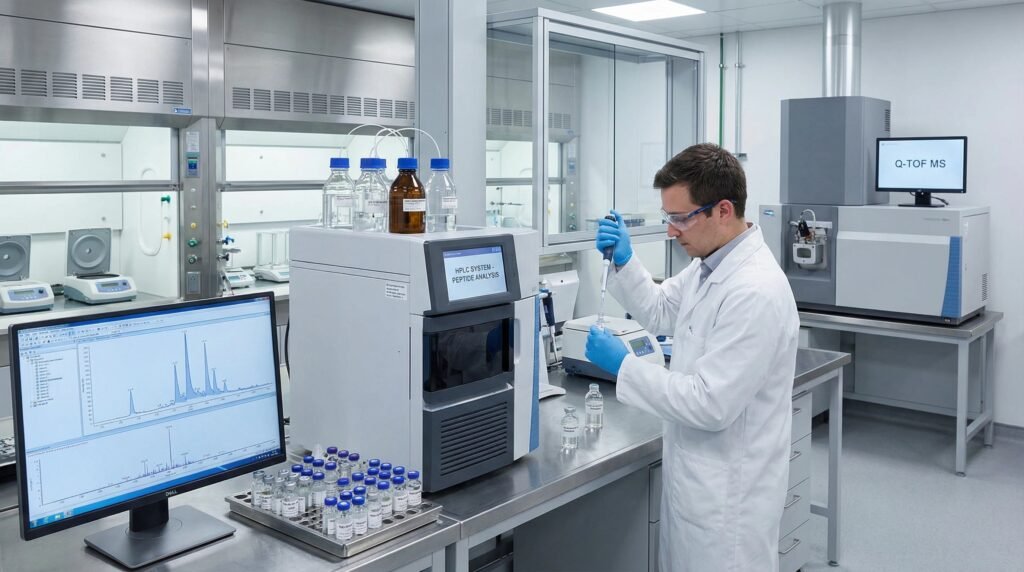
In the high-stakes world of peptide Active Pharmaceutical Ingredient (API) manufacturing, where multi-product facilities are the norm, the specter of cross-contamination looms large. A single, undetected microgram of a potent therapeutic peptide carried over into the next product batch represents a direct threat to patient safety, product efficacy, and regulatory compliance. Cleaning validation is the critical discipline that erects a scientific barrier against this risk. For peptide residues, which are large, complex, and often sticky molecules, traditional non-specific methods like Total Organic Carbon (TOC) are insufficient. The industry standard demands specificity, sensitivity, and unequivocal identification. This definitive guide explores the application of High-Performance Liquid Chromatography (HPLC) and Mass Spectrometry (MS) as the cornerstone analytical techniques for peptide cleaning validation.
We will delve into method development strategies, validation requirements, and practical implementation to ensure your manufacturing processes are not just clean, but verifiably and defensibly clean.
The Imperative for Specific Detection in Peptide Cleaning
Cleaning validation for peptides is not a one-size-fits-all proposition; it requires techniques that match the unique chemical nature of the contaminant.
The Limitations of Non-Specific Methods for Peptides
While useful for general hygiene, non-specific methods have critical gaps:
- Total Organic Carbon (TOC): Cannot distinguish between a hazardous peptide API residue, a harmless sugar excipient, or a cleaning agent. A passing TOC result provides false confidence if the carbon source is not the peptide of concern.
- Conductivity and pH: Measure cleaning agent removal, not product-specific residue.
- Visual Inspection: Hopelessly inadequate for detecting residues at the microgram or nanogram per square centimeter levels mandated by health-based exposure limits.
Why HPLC and MS are the Gold Standard
Chromatographic and mass spectrometric methods offer the necessary specificity:
- Specific Identification (HPLC with MS Detection): HPLC separates components; MS provides a molecular fingerprint. Together, they can confirm the presence of the specific peptide residue against a known standard, eliminating false positives from other organic matter.
- Unmatched Sensitivity: Modern LC-MS/MS systems can detect peptides in the picogram range, easily meeting the stringent detection limits required for highly potent compounds.
- Quantitative Precision: Allows for accurate measurement of residue levels against a calibrated standard curve, providing the numerical data needed to prove levels are below the calculated acceptance limit.
- Ability to Detect Degradants: Can identify not just the parent peptide, but also potentially generated fragments or degradants that might form during the cleaning process.
“Relying on TOC for peptide cleaning validation is like using a metal detector to find a specific book in a library—it tells you there’s metal, but not which book. HPLC-MS is the library catalog system; it gives you the title, author, and exact location. In a GMP environment, that level of specificity isn’t a luxury; it’s the foundation of patient safety.” — Dr. Anya Sharma, Head of Analytical Development, Global CMC Solutions.
Developing the HPLC-UV Method: The First Line of Quantification
A robust, stability-indicating HPLC method is often the workhorse for routine testing, with MS used for confirmation.
Key Method Development Considerations
Designing the method requires understanding the peptide’s properties:
| Parameter | Goal for Cleaning Validation | Typical Approach for Peptides |
|---|---|---|
| Chromatographic Column | Baseline separation of the target peptide from any potential interferences (cleaning agents, sampling matrix). | Reversed-phase C18 or C8 column. Gradient elution with water/acetonitrile (with 0.1% TFA or formic acid) is standard. |
| Detection Wavelength (UV) | Maximize sensitivity for the target peptide. Peptide bonds absorb at ~210 nm, but aromatic residues (Phe, Tyr, Trp) allow detection at 280 nm with better baseline stability. | Use 280 nm if possible for lower noise. Use 210-220 nm for higher sensitivity if no aromatic residues are present. |
| Sample Preparation & Compatibility | The method must be compatible with the sampling solvent (rinse water, swab extraction solvent). | Ensure the sampling solvent is miscible with the mobile phase and does not cause peak distortion. Dilution or solvent exchange may be needed. |
| Specificity/Forced Degradation | Demonstrate the method can detect the peptide in the presence of likely degradants (acid/base/hydrolysis products). | Stress the peptide standard and show resolution of degradation peaks from the main peak. |
The Power of Mass Spectrometry: Confirmation and Ultimate Specificity

MS detection moves the method from “indicative” to “confirmatory.”
MS Detection Modes for Cleaning Validation
| MS Technique | Principle | Role in Cleaning Validation |
|---|---|---|
| Single Quadrupole LC-MS | Measures mass-to-charge ratio (m/z) of ions. Provides a spectrum. | Good for confirming the identity of a peak seen in HPLC-UV by matching its m/z to the standard. Limited in complex matrices. |
| Tandem MS (LC-MS/MS) | Fragments selected precursor ions and analyzes the product ions. Creates a unique “fingerprint.” | The gold standard for specificity. Enables detection in complex backgrounds (e.g., detergent residues) by using a specific precursor>product ion transition. Essential for reaching very low limits of detection (LOD). |
| High-Resolution MS (HRMS) – Q-TOF, Orbitrap | Provides exact mass measurement with very high mass accuracy. | Excellent for identifying unknown peaks or degradants. Can confirm elemental composition. Used for method development and investigation, not always for routine testing. |
Developing the MS Method
- Ionization Source: Electrospray Ionization (ESI) is standard for peptides.
- Optimizing MRM Transitions (for MS/MS): For the target peptide, identify the most abundant precursor ion (e.g., [M+2H]²⁺, [M+3H]³⁺) and 2-3 characteristic product ions. The most intense transition is used for quantification; others are for qualification.
- Matrix Effects: Must be evaluated. Components from the swab or sampling solvent can suppress or enhance ionization. Use a stable isotope-labeled (SIL) peptide as an internal standard if possible, or demonstrate control via standard addition.
Method Validation: Proving Fitness for Purpose
For GMP use, the analytical method must be formally validated per ICH Q2(R1) guidelines, adapted for the purpose.
Key Validation Parameters for a Cleaning Validation Method
| Parameter | Acceptance Criteria (Example) | How to Perform |
|---|---|---|
| Specificity | No interference at the retention time of the target peptide from blank sampling matrix, cleaning agents, or equipment surface extracts. | Analyze blanks, placebo samples, and spiked samples. For MS/MS, confirm ion ratio consistency. |
| Linearity & Range | Correlation coefficient (r²) > 0.99 over a range from LOQ to at least 200% of the acceptance limit. | Analyze a minimum of 5 concentration levels in triplicate. |
| Accuracy (Recovery) | 70-120% recovery, with tight precision. This is the most critical parameter. | Spike known amounts of peptide onto the actual surface material (e.g., 316L SS coupon), sample with the validated swab technique, extract, and analyze. |
| Precision (Repeatability & Intermediate Precision) | RSD ≤ 10-15% for repeatability at LOQ and acceptance limit levels. | Analyze multiple preparations of spiked samples on the same day (repeatability) and different days/analysts (intermediate precision). |
| Limit of Detection (LOD) / Limit of Quantification (LOQ) | LOQ must be ≤ 30-50% of the calculated acceptance limit (e.g., 1 µg/mL). | Based on signal-to-noise ratio (S/N ≥ 10 for LOQ) or standard deviation of the response. |
| Robustness | Method performs acceptably with deliberate, small variations in parameters (e.g., mobile phase pH ±0.1, temperature ±2°C). | Experimental design (e.g., DoE) to test key parameters. |
Practical Implementation: From Swab to Report
The analytical method is part of a larger sampling and testing workflow.
The Sampling and Analysis Workflow
- Worst-Case Location Selection: Based on a risk assessment (hardest to clean areas: behind mixer blades, gasket seats, transfer line connections).
- Sampling:
- Swab Sampling: Use validated swabs (e.g., polyester, cotton) wetted with appropriate solvent. Swab a defined area (e.g., 10×10 cm) using a template. Place swab in extraction solvent.
- Rinse Sampling: Collect final rinse water from the entire equipment train.
- Sample Preparation: May involve vortexing, sonication, filtration, and dilution to be within the linear range of the method.
- Analysis: Run samples alongside a fresh calibration curve and quality control (QC) samples. The QC samples (at low, mid, high concentrations) must pass for the run to be acceptable.
- Calculation: Concentrations from the curve are converted to mass per area (for swabs) or total mass (for rinses) and compared to the pre-defined acceptance limit.
Strategy for Routine Monitoring vs. Validation
- Validation: Uses the full, validated HPLC-MS/MS method for the three consecutive batches to prove the cleaning procedure works.
- Routine Verification: May use a simplified, faster HPLC-UV method for periodic checks, with the provision that any result above a certain threshold triggers confirmation by the validated MS method.
Overcoming Common Challenges in Peptide Residue Analysis
Anticipating and solving these issues is key to a robust program.
| Challenge | Root Cause | Solutions |
|---|---|---|
| Poor Swab Recovery | Peptide adsorbs irreversibly to the equipment surface or the swab material. | Optimize swab solvent (e.g., add a surfactant like 0.1% SDS, use acetonitrile/water mixtures). Conduct exhaustive recovery studies on the actual surface material. |
| Matrix Suppression in MS | Co-eluting compounds from detergent or surface inhibit peptide ionization. | Improve chromatographic separation. Use a stable isotope-labeled internal standard (corrects for suppression). Employ efficient sample clean-up (SPE). |
| Peptide Degradation During Sampling/Storage | Residue on swab or in solution degrades before analysis. | Establish sample stability: demonstrate integrity in the swab extract solvent for the holding time between sampling and analysis. Store extracts at low temperature. |
| Method Sensitivity for Highly Potent Peptides | Acceptance limits in the parts-per-billion range challenge even LC-MS/MS. | Use state-of-the-art MS instrumentation. Employ extensive sample concentration (e.g., solid-phase extraction, SPE). Optimize MS source conditions for maximum ion yield. |
Future Trends: Automation and Advanced Detection
The field is moving towards greater efficiency and intelligence.
- Automated Swab Extraction and Analysis: Robotic systems for high-throughput sample preparation, increasing reproducibility and lab efficiency.
- On-line or At-line Analysis: Development of rapid, near-real-time sensors for cleaning verification, though likely complementary to off-line confirmatory HPLC-MS.
- Data Integrity and Digital Workflows: Integration of analytical data directly into electronic laboratory notebooks (ELN) and laboratory information management systems (LIMS) for seamless, audit-ready reporting.
- Multi-Residue Methods: For facilities with many peptides, developing a single LC-MS/MS method that can screen for multiple potential carryover peptides, though validation becomes more complex.
FAQs: HPLC and MS Methods for Peptide Cleaning Validation
Q: For a multi-product facility, can we use one generic HPLC-UV method for all peptides, or do we need a specific method for each one?
A: You almost always need a product-specific method. Peptides have different sequences, hydrophobicity, and chromatographic behaviors. A single generic gradient is unlikely to adequately separate all potential peptide residues from interferences or from each other. The method must be validated for the specific “worst-case” peptide residue you are testing for. However, you can develop a platform method with a standardized column and mobile phase system, then optimize the gradient for each new peptide, which speeds up development.
Q: How critical is it to use a stable isotope-labeled (SIL) internal standard for LC-MS/MS quantification in cleaning validation?
A: Using a SIL internal standard is considered best practice and highly recommended, though not always mandatory. The SIL peptide behaves almost identically to the target analyte during extraction and ionization but has a different mass. It corrects for:
1. Matrix effects (ion suppression/enhancement).
2. Sample preparation losses (incomplete recovery from swab).
3. Instrumental variability.
This leads to significantly improved accuracy and precision, especially at low concentrations. For highly potent peptides with very low limits, a SIL standard is often essential for defensible data.
Q: Our API manufacturer (CDMO) performs the cleaning validation. Are we, as the sponsor, responsible for auditing their analytical methods?
A: Yes, absolutely. While the CDMO executes the validation, the sponsor holds the marketing authorization and ultimate responsibility for product quality. Your quality agreement must grant you the right to audit their cleaning validation program, including their analytical methods. You should review and approve the validation protocol and report. Specifically, you must ensure their HPLC-MS methods are appropriately developed and validated, their swab recovery studies are sound, and their acceptance limits are scientifically justified. A CDMO’s commitment to robust analytical science is a key selection criterion.
Core Takeaways
- Specificity is Non-Negotiable: For peptide residues, HPLC with MS detection (preferably MS/MS) is the required standard to provide unambiguous identification and quantification, moving beyond non-specific methods like TOC.
- Validation is a Regulatory Requirement: The analytical method must be fully validated per ICH guidelines, with swab recovery being the most critical and challenging parameter to establish.
- MS/MS is the Gold Standard: Tandem mass spectrometry provides the sensitivity and specificity needed to meet low acceptance limits for potent peptides and to analyze samples in complex matrices containing detergents.
- Swab Recovery is the Foundation: A method is only as good as its ability to recover the residue from the surface. Recovery studies on the actual equipment material are mandatory.
- Lifecycle Management is Key: The method and the overall cleaning validation program require ongoing monitoring, periodic re-validation, and updates based on changes in the process or products.
Conclusion: Building a Defensible Barrier Against Contamination with Analytical Rigor
The implementation of robust, validated HPLC and MS methods for peptide cleaning validation represents the highest standard of quality assurance in multi-product manufacturing. It transforms cleaning from an operational step into a scientifically controlled and verified process. By investing in advanced analytical development and rigorous validation, companies can generate the unequivocal evidence needed to satisfy regulatory scrutiny, protect patients, and safeguard the integrity of their valuable peptide therapeutics.
The complexity of this analytical undertaking underscores the importance of expertise throughout the supply chain. It begins with a peptide API manufactured under strict controls, as the quality of the standard and the understanding of the molecule’s properties are foundational. Sichuan Pengting Technology Co., Ltd. contributes to this foundation. As a professional and reliable peptide API supplier, we provide not only the high-purity GMP peptide but also the deep chemical understanding that supports robust analytical method development. Our commitment to quality and consistency ensures that the reference standards used in cleaning validation methods are reliable. Furthermore, as a manufacturer invested in the highest standards, we understand and implement these same rigorous cleaning validation principles in our own multi-product facilities.
Partnering with a supplier like Sichuan Pengting Technology ensures that your peptide supply chain is built on a commitment to scientific excellence and contamination control from the very first step.
Disclaimer
This article contains information, data, and references that have been sourced from various publicly available resources on the internet. The purpose of this article is to provide educational and informational content. All trademarks, registered trademarks, product names, company names, or logos mentioned within this article are the property of their respective owners. The use of these names and logos is for identification purposes only and does not imply any endorsement or affiliation with the original holders of such marks. The author and publisher have made every effort to ensure the accuracy and reliability of the information provided.
However, no warranty or guarantee is given that the information is correct, complete, or up-to-date. The views expressed in this article are those of the author and do not necessarily reflect the views of any third-party sources cited.