
Why do two vials of the same peptide give two different test results? Both labels claim 98% purity. Buyers with years of sourcing expertise learn to ask the TFA salt vs acetate salt peptide question first. Often the counter ion, not the synthesis, is to blame.
Trifluoroacetate counter-ions are held by a TFA salt peptide. They fall behind in synthesis and purification. An acetate salt peptide holds acetate counter-ions following a swap step. Same sequence, different powder. For the customer three things change: peptide per milligram, acid left in the powder and phrasing on batch papers.
This guide clarifies the source of the counter-ion. It covers the mechanics of the swap and the math involved. Ends with a quick checklist for your next quote.
What a Peptide Salt Form Actually Is
A peptide salt form is a peptide that is complexed with a counterion in the dry powder. Peptides contain basic sites. These include the N-terminal amine and the side chains of lysine, arginine and histidine; Those sites hold a charge. In the freeze-dried powder, a negative ion sits adjacent to them.
The free base is the peptide alone. Very few catalogue peptides ship in this manner. It is a plain point. The sequence is the same. Only the powder surrounding it changes.
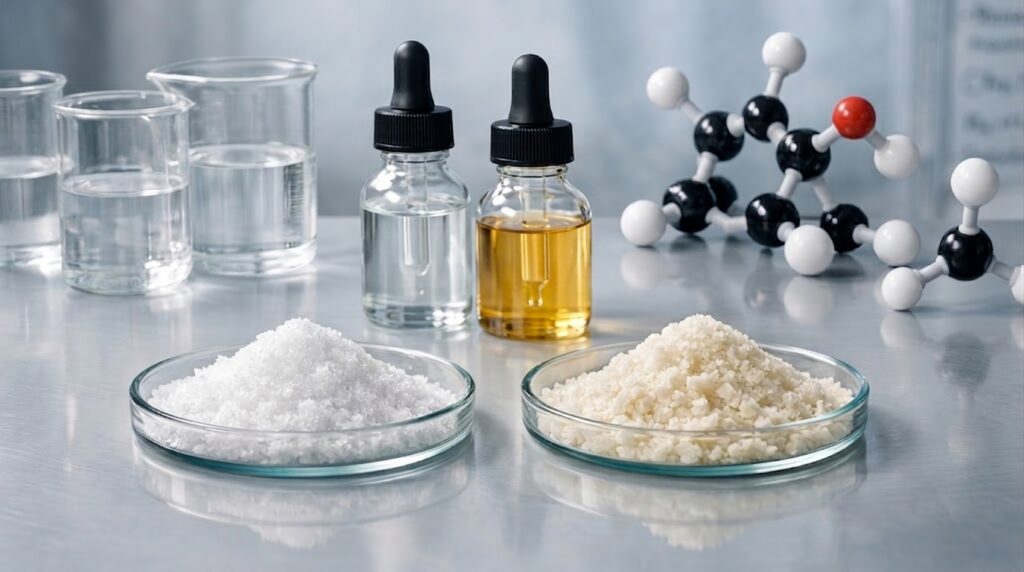
Terms You Will Meet on a Peptide Specification
| Term | Plain meaning | Where it appears |
| Free base | The peptide with no counter-ion attached | Substance name |
| Counter-ion | The negative ion paired to basic sites | Counter-ion content |
| Salt form | Peptide plus counter-ion, as supplied | Substance name, label |
| Net peptide content | Share of the vial that is true peptide | Assay section |
Why the Counter-Ion Is Part of the Weight You Buy
There are four things being weighed simultaneously when 10 mg of powder is measured. You measure out the peptide, counterion, water, and trace salts by weight. Molarity is only driven by the peptide. Fewer peptide molecules per milligram are produced by a heavier counter-ion.
TFA Salt vs Acetate Salt Peptide Compared
The sequence is same in both versions. Their mass, acid strength, price, and applicability to later stages of the process might vary.
| Point | TFA form | Acetate form | Why it matters to a buyer |
| Counter-ion | Trifluoroacetate | Acetate | Named on the substance line of the COA |
| Origin | TFA used in resin cleavage and HPLC purification | Acetic acid or acetate buffer, added after exchange | Shows why one form is the default |
| Counter-ion mass | 113 Da (from TFA, 114 Da) | 59 Da (from acetic acid, 60 Da) | Sets how much mass is not peptide |
| Net peptide content | Lower, from the heavier ion | Higher, from the lighter ion | Changes molarity at the same label weight |
| Acid strength | Strong acid, pKa ≈ 0.5 | Weak acid, pKa 4.76 | Affects pH when you reconstitute |
| Common stage of use | Early research, in-vitro chemistry | Later development, sensitive assays | Guides which form to request |
| Relative cost | Baseline | Higher, from the extra step and lost yield | Feeds budget and lead-time planning |
Neither form wins on its own. The right choice depends on what your assay can handle and what your papers must show.
Where the Trifluoroacetate Comes From
Trifluoroacetate is a common by-product of peptide chemistry. It’s not an addition. In solid-phase synthesis the chain is cleaved off the resin by trifluoroacetic acid. Additionally, it strips the shielding groups. In the mobile phase, reversed-phase HPLC often runs TFA.
Free acid is removed by freeze-drying. The fraction bound to fundamental sites remains bound. So a peptide will come to you as a TFA salt unless you choose a different form when you order.
How Counter-Ion Exchange Works
Counter-ion exchange swaps trifluoroacetate for another ion, often acetate. There are three normal ways. An ion exchange resin is used. Repeat freeze-drying from dilute acetic acid or ammonium acetate. With acetate buffers, one runs preparative HPLC.
Published work demonstrates that this may be done on a resin using a weak acid, such as acetic acid. No strong acids are required. Here are two business facts. The swap is always incomplete, and some product is lost. Acetate material costs extra because of its loss.
Why Some Acid Always Stays Behind
Pushing out one ion and replacing it with another is how the swap operates. “Almost done, but not quite. Good suppliers measure a number, not say “zero.” Get that number.«
Residual TFA Content and Its Effects
The trifluoroacetate remaining in a final batch is known as the residual TFA content. A percentage by weight is provided. Labs measure it using ion chromatography. Others utilize ¹⁹F NMR or capillary electrophoresis. It is mostly innocuous for the job in chemistry. It is worth eliminating for biology.
Where the Effect Shows Up
- Cell-based readings: In both directions, reports link residual trifluoroacetate to unusual growth and viability outcomes.
- Low-UV work: Trifluoroacetate absorbs in the far-UV range. This may bias UV readings, circular dichroism, and IR work.
- Solution pH: A strong acid will lower the pH of a new solution. Acetate buffers somewhat and lies closer to the neutral range.
- Batch to batch: Two lots will not perform the same even if the label weight is the same with varied acid doses.
Reading Salt Form on a Peptide COA
Knowing how to read a peptide COA turns a sales claim into a checked fact. Complete the fields in the order.
- Substance name – does it say TFA salt, acetate salt or freebase? If it says nothing, ask questions.
- HPLC purity – this is just for peptide related peaks. Outside of it, there is salt water.
- Counter-ion content – acetate or trifluoroacetate, by ion chromatography.
- Water content — Karl Fischer titration.
- Net peptide content – by amino acid analysis or nitrogen determination.
- Mass spectrometry – verifies free peptide mass. That peak doesn’t reveal the counter-ion. So you can’t determine the salt form from MS alone.
Here is the line most buyers need. Purity and net peptide content are two different numbers. A high purity figure says nothing about how much peptide sits in the vial.

The Molecular Weight Math Behind Each Salt
Peptide molecular weight calculation for a salt form uses one short formula:
Net peptide content ≈ MW(peptide) ÷ [MW(peptide) + (n × counter-ion mass)]
Here n is the number of basic sites that need a counter-ion.
Take a 1,000 Da peptide with two basic sites:
- Trifluoroacetate: 1,000 ÷ (1,000 + 226) = 81.6%
- Acetate: 1,000 ÷ (1,000 + 118) = 89.4%
Water and trace salts drag the figures down a bit. The lesson is simple. One label’s 10 mg is not another’s 10 mg of peptide. Calculate molarity from net content not from label weight.
Salt Form, Stability, and Storage Behavior
Acetate material often dries as a hard, uniform cake. The material from TFA dries soft and fluffy. Fluffy powders are difficult to weigh in tiny amounts and tend to gather up static. Both kinds take water from the air. Both need cool, dry and dark storage.
One limit is worth stating. Peptide salt form and stability are linked. But sequence, purity, and moisture matter just as much.
Choosing a Salt Form by Application
Salt form selection is about what your work can tolerate. Let the application determine it.
- Routine chemistry and in vitro work – the standard TFA form is usually fine and costs less.
- Cell-based, sensitive assays — acetate removes one known variable out of the test.
- Formulation and late-stage work – A pharmaceutical grade peptide salt is most typically acetate or hydrochloride. Regulators may regard another salt as a distinct substance. Early choices save repeat labour later.
- Cosmetic ingredient work – confirm that the counter-ion is compatible with your formula and your paperwork.
There is one myth to bust. TFA salts are not banned for clinical usage. Both trifluoroacetate salts of bivalirudin and corticorelin were introduced to the market. Acetate is just the most prevalent way.
What to Confirm Before You Order
Before a purchase order leaves your desk, have these five points resolved.
- Get the salt form on the quote and on the cert in writing, not in an email conversation.
- Confirm the document set: Pengting supplies DMF, COA, and MSDS. Raw materials are ISO, GMP compliant.
- Check batch flexibility: Pengting enables trial batches from 50 g to tonnes supply. You may try a tiny quantity first.
- Agree on the delivery cycle: Pengting lists a 15-30 day cycle, with rush orders fulfilled in 72 hours.
- Ask about traceability: Pengting says its packaging is degradable and its raw materials are 100 per cent traceable.
Sourcing Peptide APIs With Pengting
Sichuan Pengting Technology Co., Ltd. is a peptide maker based in Leshan City, Sichuan, China. The company was founded in 2021. It’s for R&D, custom orders and mass production. The goods are peptide APIs and cosmetic peptides; The operation runs from a 6,500-square-meter joint plant. The team has 5+ PhD R&D engineers.
One hundred effective raw materials have been put into full production here. Drug and biotech developers, CDMOs, compounding pharmacies, and clinics are among the buyers. Cosmetic and nutraceutical brands also order. These buyers are located in North America, Europe and Asia. The material is offered for study purposes only.
State the salt form and the documents you need in your first message when you request a quote. It saves a round of emails.
Frequently Asked Questions
What is the difference between TFA salt and acetate salt peptides?
The difference lies in the counter ion. A TFA salt is trifluoroacetate at 113 Da. An acetate salt has acetate at 59 Da. The lighter ion produces more peptide per milligram. The sequence is the same in both.
Why are most synthetic peptides supplied as TFA salts?
Most peptides ship as TFA salts because the trifluoroacetic acid cleaved the chain off the resin. It’s also used quite a bit in reversed phase purification. Trifluoroacetate is a drying-resistant ligand for basic sites.
Does salt form change the peptide sequence?
Nope. Salt form merely changes the counter-ion, not the order of amino acids. Mass spectrometry gives the same free peptide mass for both forms. The counter ion does not attach to the chain.
Why does an acetate salt peptide cost more?
This is an acetate form and requires an additional exchange step and some material lost in it. Suppliers charge for the additional labor and poorer yield. Lead times also tend to expand a little too.
Does 99% HPLC purity mean the vial is 99% peptide?
No. HPLC purity compares peptide-related peaks and ignores salt and water. A 99% pure batch can still be about 80% peptide by weight. See net peptide content vs purity and what 98% peptide purity means.
Which salt form should I choose for cell-based research?
Choose acetate form for cell-based research. Residual trifluoroacetate has been shown to interfere with growth and viability assays. It takes one variable out, by removing it. Be sure the measured counter-ion number is okay before you commit.
Conclusion
The TFA salt vs acetate salt peptide option is really a pair. One is how much acid your biology can handle. The other is what your papers should reflect. So decide on both before you place your purchase, since salt change mid-study requires repetitive work.
At Sichuan Pengting Technology Co., Ltd., we put the salt form in writing and back it with a full DMF, COA and MSDS set. That covers the checks listed above. Our range runs from 50 g trial batches to ton-level supply, so you can qualify a small lot before you scale. Tell us the salt form you need when you ask for a quote. Explore our custom peptide range or our cosmetic peptide range to start.