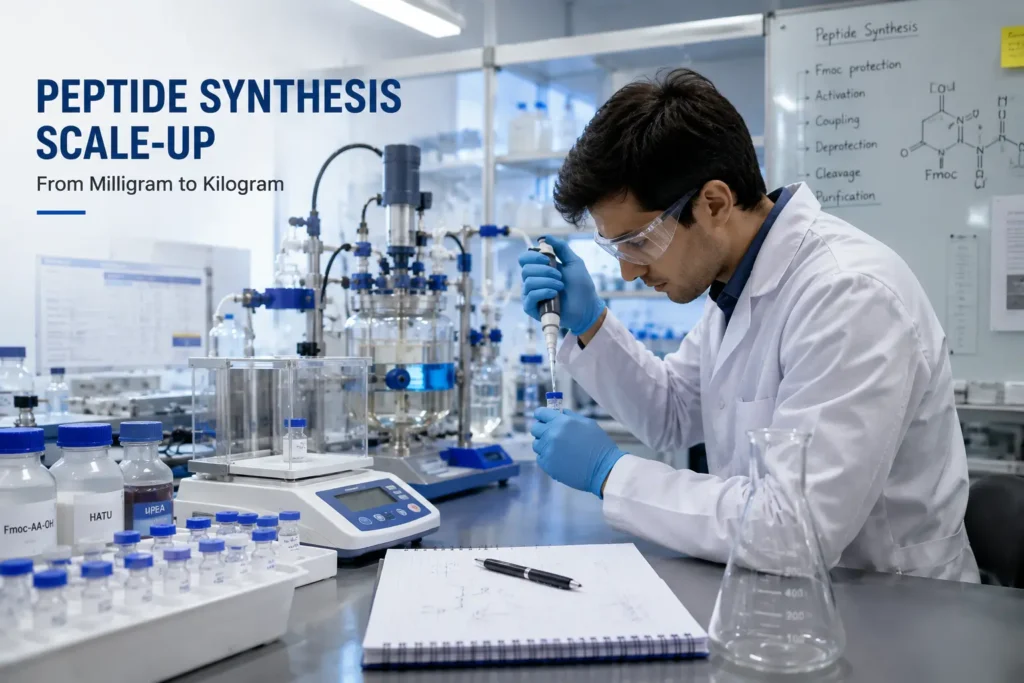
A synthesis that works well at 50 milligrams in a lab may not work at 500 grams. The chemistry wasn’t any better. That was all there was to it. Peptide synthesis scale up is the transition from small research quantities to much larger batches. It happens in stages which are the lab scale, pilot scale and commercial scale. In each stage, the coupling steps, the purification steps and the equipment need to be checked again. What works well in a small batch often needs real changes to continue working well in a big batch.
This article explains what changes on each scale. It also explains why the pilot scale is a stage in itself and not a stage you can skip. Finally, it discusses the cost drivers as a peptide synthesis scale up project is developed.
What Does Scale-Up Actually Mean in Peptide Synthesis?
Peptide synthesis scale up is the transition of a synthesis route from small research scale (mg) to larger production scale (g and kg). The aim is to achieve the same purity, yield and reliability even if batch size, equipment and steps change together.
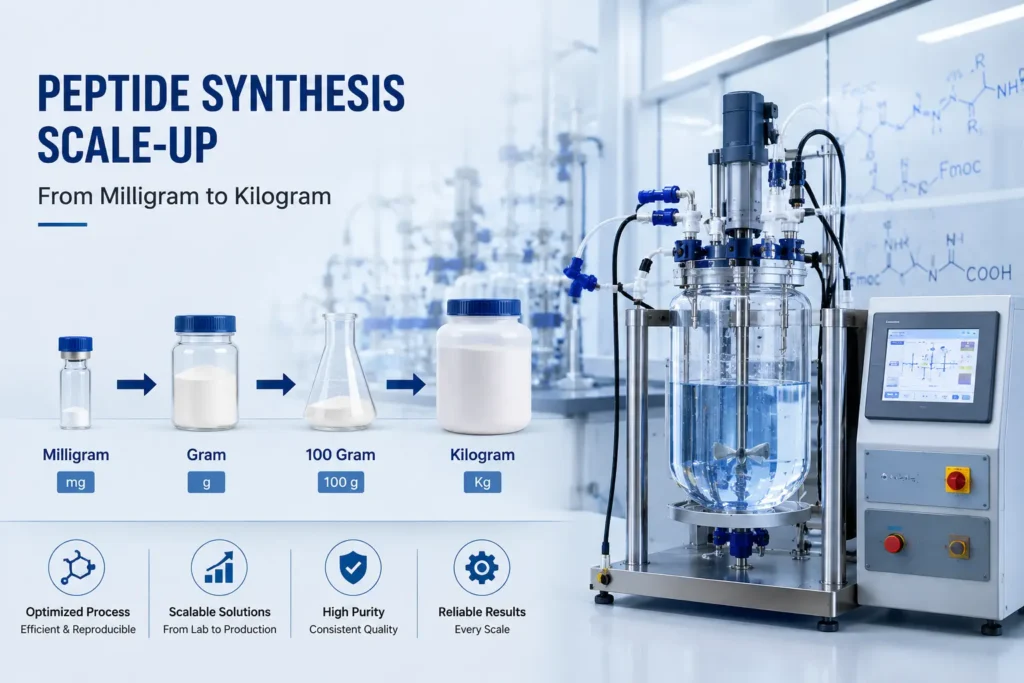
- Mass producing the same batch is not scaleup. The larger the batch size, the more different the reaction mixing, reaction run and purification will be.
- Production typically goes through standard phases. It doesn’t jump from lab size to full commercial size.
- The main difficulty is to maintain the same level of purity even with a large variation in batch size.
Introduction to Peptide Synthesis: A Quick Baseline
This introduction to peptide synthesis is a quick start. The most common method, solid-phase chemical peptide synthesis, constructs a peptide chain one building block at a time. There is also a difference between SPPS vs LPPS difference. Each building block is an amino acid. Each step adds one amino acid to a chain that is still attached to a solid resin. This chemistry is the same at all scales. But the performance can vary widely as the batch size increases.
The Three Main Stages: Lab, Pilot, and Commercial Scale
In general peptide production is a three-step process. Lab scale is milligrams to a few grams and is used for research and process development. Pilot scale operations range from grams to a few kilograms and are used to test the process before full production. The commercial scale is from kilograms to tons and is used for full, continuous production. Each step answers a different question, before more time and money are spent on the next. That’s why real planning is needed to scale up peptide synthesis, not just bigger tanks.
Peptide Synthesis Scale Stages at a Glance
| Stage | Typical Batch Size | Main Goal | Main Risk |
| Lab scale | Milligrams to low grams | Build and test the route | Route may not be fully worked out yet |
| Pilot scale | Grams to low kilograms | Test the process before commitment | Hidden problems show up here |
| Commercial scale | Kilograms and up | Run full production | Staying consistent batch to batch |
- Lab Scale: Where Chemistry Gets Established
Lab scale is when a team looks at whether a sequence can even be built. Work is done in small amounts, from milligrams to a few grams. The idea is to find the hard-coupling steps and the best conditions for each of them. Batch size is not the first problem yet. First, chemistry.
- Pilot Scale: The Critical Bridge Stage
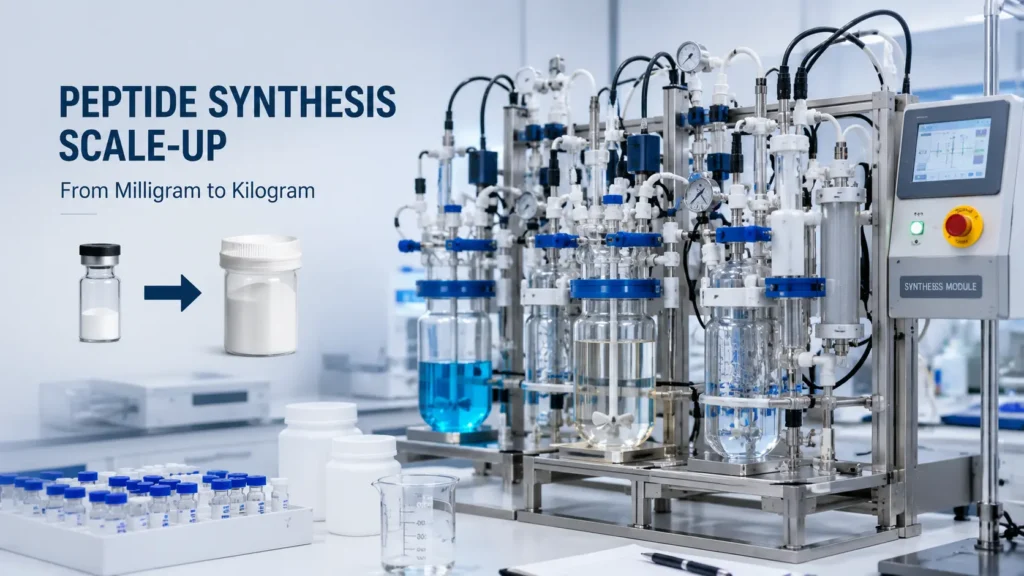
Pilot scale is to catch problems early before they become expensive at full size. Here the reaction tanks are larger, and the mixing is different. Purification steps successful at lab scale are tested under closer to real production conditions. It is not unusual for a route that looked clean at the milligram scale to show real weak points once run through the pilot scale.
- Commercial Scale: Production at Full Volume
Commercial scale is when a proven route is run in kilogram quantities or greater, batch after batch. “It’s not just about the chemistry at this stage, it’s about keeping the process steady. Supporting records for a quality system built on ISO/GMP rules become a normal part of the job, not an extra step.
What Actually Changes as Batch Size Increases
Once a peptide synthesis scale-up project leaves the lab scale, batch size affects a number of factors. The four points that come up most are:
- Mixing and reaction speed. Larger tanks don’t necessarily mix as well as smaller ones. Bad mixing can leave some coupling steps incomplete.
- Heat control. Some steps in the reaction release heat. This is easy to manipulate in a small flask. It might need active cooling on the scale of a kilogram.
- Purification method. Some forms of chromatography and other small-batch methods need to be modified to be viable at larger scales.
- Raw material supply. Large batches require a steady, reliable supply of bulk material, not small research grade quantities.
Lab Scale to Commercial Scale Peptide Production
Just because the equipment gets bigger, that doesn’t mean that a route that works at the milligram scale will work at the kilogram scale. As we move from the lab scale to commercial scale peptide production, we must face problems that were minor at the beginning. These may be incomplete coupling, clustered sequences or slow purification. These are minor at small scale. On a large scale they can be the main problem. And this is exactly the reason why pilot scale is a necessary step in peptide synthesis scale up, not an optional one.
Common Failure Points Discovered at Pilot Scale
Some issues only show up when a route is scaled up to pilot scale. An example is incomplete deprotection on a larger batch. Another is purification methods that don’t scale well. Also, if the chemistry is right, a larger tank may not mix well which can also cause a drop in yield.
Large Scale Peptide Synthesis: Process Considerations
Large scale peptide synthesis is more than a bigger vessel. A peptide synthesis scale up project that does not plan for this is likely to run into avoidable delays. Once a route is in full production size, the three most important things are:
- Checks and logs of processes that produce consistent results from batch to batch
- Sizing equipment capacity so tanks and purification steps keep pace
- Quality checks are done at every stage, not just the final batch.
What Drives Custom Peptide Synthesis Price and Cost at Different Scales
Custom peptide synthesis costs vary too much by sequence and scale to provide a single fixed number. Instead this section deals with the key drivers of the cost of custom peptide synthesis. There are four things that count:
- Sequence difficulty. All scales. Sequences that are hard to make (e.g. they clump) cost more than anticipated.
- Purity requirements. The cost of higher purity targets is more at the large scale than the lab scale.
- Scale stage. Running at pilot scale is more expensive than just materials and labor. At this stage there is testing and process work involved.
- Regulatory records. Commercial scale lots will require additional paperwork and quality system costs for regulated research use.
Cost per gram typically goes down with scale. But this decline is not a straight line. Some of the expected savings may be offset by hard sequences and tight purity requirements.
Choosing a Custom Peptide Synthesis Partner
More than fast lab-scale turnaround should be expected from a good custom peptide synthesis partner. Before you choose a scale-up project, ask yourself the following three questions:
- You have done projects at pilot scale before, not just at the lab scale?
- What was the approach for scaling up hard sequences in previous projects?
- Can they articulate well what changes in process, cost and timeline at each scale stage for this particular peptide?”
Frequently Asked Questions
- What is the difference between pilot scale and lab scale peptide synthesis?
The lab scale defines the synthesis route with milligram to gram quantities. Pilot scale tests that scale up to larger gram to kilogram amounts. Pilot scale is there to spot process problems before full production begins.
- Why can a lab scale peptide synthesis route not be directly taken to commercial scale?
All of them behave differently at larger scales in terms of reaction rate, mixing and purification. The danger in skipping pilot scale testing is finding expensive problems once full production is underway.
- What makes custom peptide synthesis more expensive at a larger scale?
Sequence difficulty, purity requirements, and process checks at each stage impact cost. Cost per gram drops as the batch size increases relative to small lab quantities.
- What is the typical time frame for peptide synthesis scale up?
Timelines for a peptide synthesis scale up project are very variable depending on the sequence difficulty and the scale of target. Pilot-scale testing and any required process changes add time beyond the initial lab-scale work.
- Does peptide purity change when scaling up production?
A good process with checks in place will keep it pure as you scale. Frequently, pilot-scale testing shows that purification will need to be modified to be able to maintain the same purity at larger volumes.
Conclusion
Peptide synthesis scale up in a stepwise process. It goes through lab, pilot and commercial scale. It means bigger equipment. But it means checking coupling, purification and process again each step. Pilot scale is to catch problems early before they get expensive at full size.
Sichuan Pengting Technology Co., Ltd. is a Research Use for research teams and buyers who are planning a scale-up project. Only a raw material supplier who has moved peptide routes from pilot to full production in the real world. If you have a specific sequence, their technical team can give you a rundown of the process, cost and timeline changes before proceeding with a project. For further reading, see peptide cyclization methods and difficult peptide sequences.