
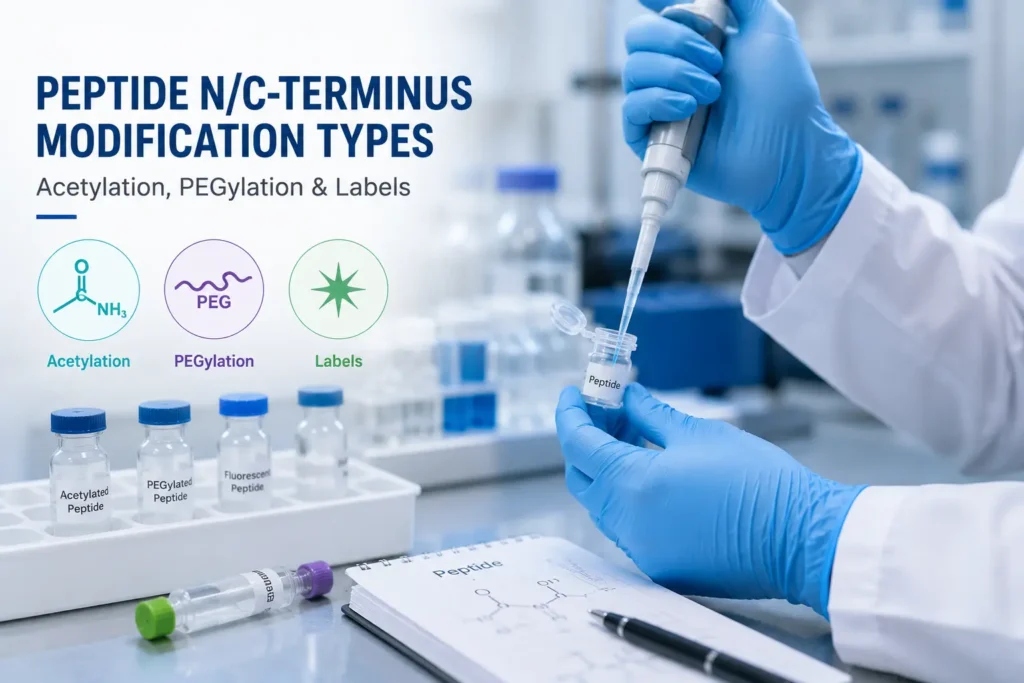
Unmodified peptides are prone to rapid degradation. That can be hard to spot on a test, too. This is the reason why the changes at N-terminus and C-terminus are now common in peptide research. These are not further steps. They are part of the plan, normal. The main peptide modification types are terminal capping, PEGylation, detection labels and structural methods.
Terminal capping is acetylation and amidation. PEGylation provides additional stability with time. The detection labels are biotin and FITC. Structural methods means attaching peptides. Each kind has a different problem to solve. Which one to choose depends on your needs.
This article is about the difference between C-terminus changes and N-terminus changes. It tells you what each change does. It also shows you how to pick the right one for your work.
What Is Peptide Modification?
Peptide modification is the chemical modification of a peptide. This change is not limited to the peptide’s basic chain of building blocks. Mostly it is done on the N-terminus, C-terminus or a side chain. Add stability, add detection, change solubility, or lock in a shape. Researchers use it too.
Modifications are added in two ways. Some happen during the synthesis, when the peptide chain is still being built. Others continue after the chain is complete. The choice of which way is used depends on the chemistry. The most common places for a change are the N-terminus and C-terminus. This is because they are outside the main working part of the peptide. What are the best peptide modification types? It depends. That goal could be stability or detection or delivery or shape control.
| Modification Type | Site | Main Job |
| Acetylation | N-terminus | Lowers breakdown by enzymes |
| Amidation | C-terminus | Copies natural peptide processing |
| PEGylation | Terminus or side chain | Extends time in circulation |
| Biotin/FITC labeling | Terminus or side chain | Allows tracking and detection |
| Peptide stapling | Internal segment | Locks the peptide’s shape |
Why the N-Terminus and C-Terminus Are Common Modification Sites
Chemistry has ready access to the two ends of a peptide. They are also outside the main active region of the peptide. They are good places for a change. A change there often does not get in the way of the peptide’s main job. But this is not always the case. It depends on the particular chain and what it has to bind to.
Peptide Modification Types: The Main Categories
The main peptide modification types are classified into four types. Acetylation and amidation are terminal caps. Changes that boost stability means PEGylation. Biotin, FITC and other glowing tags. Detection labels. Cyclization and peptide stapling are the shape-locking methods.
- Acetylation- stabilizes and prevents enzyme breakdown by capping the N terminus
- Amidation- caps the C-terminus, often to mimic natural peptide processing
- PEGylation- attaches long chains of polyethylene glycol to increase circulation time and decrease immune response.
- Detection labelling (biotin, FITC)- For tracking, binding tests or imaging.
- Peptide stapling- uses a chemical “staple” to hold the peptide in a single conformation.
Acetylation: N-Terminus Capping Explained
One of the most common peptide modification types is acetylation. This can help a peptide last longer. It does so without altering much of the peptide’s structure. It works by switching off the free amine group at the N-terminus
- What Acetylation Actually Does
Acetylation at the N-terminus inhibits the free amine at the N-terminus. This makes the peptide more difficult to digest. The enzymes responsible for this breakdown are called aminopeptidases. They target free amines on the N-terminus. This results in a peptide that is more stable in a lab environment.
- When Acetylation Is Typically Used
Acetylated peptides are often used in cell based tests. It is also used in live study models. Stability is more important than complete naturalness in these cases.
Amidation: C-Terminus Capping Explained
Amidation is the C-terminal analog of acetylation. It’s one of the most natural peptide modifications you can use. It replaces the free carboxyl group of the peptide with an amide group.
This is similar to the biosynthesis of many natural active peptides. The swap often increases stability. Sometimes it can also enhance the ability of the peptide to bind to its target. This same change is carried by many natural peptide hormones. Amidation is often the better choice for researchers who want to mimic the natural form of a peptide.
PEGylation: Extending Stability and Half-Life
The most studied form of stability-focused peptide modification is SPPS vs LPPS difference and PEGylation. That’s because PEGylation solves a big problem for peptide research. The problem has been in circulation for a short period.

- How PEGylation Works
PEGylation involves attaching one or more chains of polyethylene glycol to the peptide. These chains are attached to a terminus or to a chain. It increases the entire peptide. The larger size acts as a shield. It reduces enzyme degradation. It also reduces detection by the immune system in a model of research.
- Tradeoffs That Come With PEGylation
PEGylation is not without its downsides. A larger peptide may bind badly to the receptor. It may not move as well through tissue in some cases. Research teams have to balance a longer half-life versus potential loss of activity. This depends on their respective peptides and targets.
Biotin and FITC Labelling: Detection and Tracking
The biotin/FITC labeling is a series of modifications for visibility, not stability. These tags allow a research team to find, track or isolate a peptide in a complex system.
- Biotin labelling allows for binding-based detection and cleanup, taking advantage of the strong and well-characterized affinity of biotin for streptavidin/avidin.
- FITC labelling is a fluorescent label. It supports visual tracking by imaging or flow cytometry, a technique that scans and sorts cells by light.
- Both tags are usually placed on a side chain or terminus. The site is selected such that the tag does not overlap with the active site of the peptide.
Stapled Peptides: A Structural Constraint Approach
This method is shape-fixing. It doesn’t add the same kind of stability as PEGylation does. Peptide stapling involves the addition of a chemical “staple” that connects two points in the chain. It locks part of the peptide into a single, helix-like conformation.
This procedure is analogous to cyclization but not identical. Cyclization is discussed in our companion article on peptide cyclization methods. Cyclization closes the whole peptide into a ring. Stapling only locks a part of the chain. Often it leaves both ends free for further changes.
Why Locking the Shape Matters
Many of the peptide-target links depend on the peptide having a very specific 3D shape. Stapling keeps that shape in place. Without it, a peptide chain can bend and move on its own. You can lock the shape for more stability. It can also help the peptide bind the same way every time.
Peptide Modification Examples by Application
It is better to match a change to your research goal than to choose a change based on stability numbers. Here are a few simple use case examples:
- Longer time in a research model– PEGylation or terminal capping are typical options
- Tracking where a peptide goes in a cell– FITC or another fluorescent tag
- Cleanup and binding tests– biotin labeling with streptavidin-based system
- Locking a working shape– peptide stapling, useful when the target needs a helix shape
The Peptide Modification Process: What to Expect
Remembering these general steps helps a research team to plan ahead. It also reduces surprises. Steps are similar for most peptide custom modification types. The exact chemistry still varies case-by-case.
- The time frame- depends on the type of modification. Some continue with synthesis. Some go on after
- Cleanup and testing steps verify that the change is where we expect it to be. This is usually measured by HPLC and mass spec, two standard lab tests.
- Before you start a synthesis plan, check that the selected change is compatible with the peptide chain.
Exact chemicals and steps depend on peptide modification types and peptide chains. Talk about new research papers. Ask a synthesis provider about their experience. 2. This overview is not a lab protocol ready.
Selecting the Right Modification for Your Application
Matching peptide modification types to your research goal is the best way to avoid a costly redo down the road.
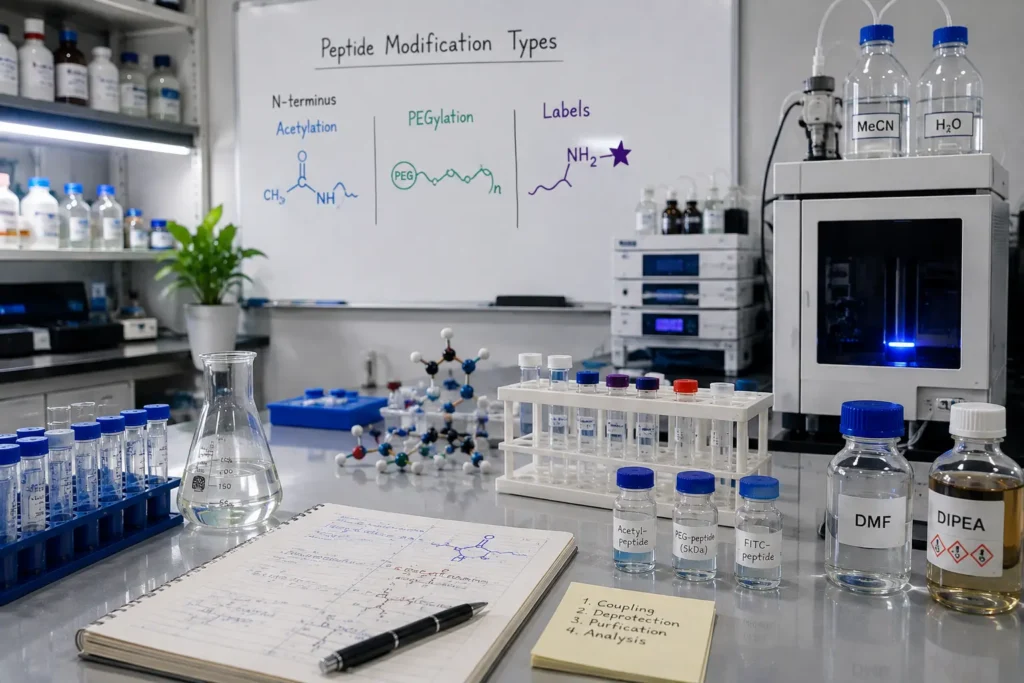
- Tie the change to your primary goal. Rarely does one modification provide the stability, detection and shape control
- Before finalizing the change site, verify that it can block the working part of the peptide
- Consider whether the added cost and effort is worth the real benefit your work needs
- Sometimes you can put more than one modification on the same peptide, as long as the sites don’t interfere with each other
Frequently Asked Questions
- What’s the difference between acetylation and amidation?
Acetylation capping N-terminus to prevent enzyme degradation. Amidation caps the C-terminus and often mimics the natural biosynthesis of active peptides. Both contribute to better stability, but in different ways and at different points.
- Why is PEGylation used in peptide research?
PEGylation increases the time of circulation of a peptide. It also adds polyethene glycol chains to make it less immune-detectable. It can also decrease the binding affinity of the peptide for its target. This depends on the peptide and the aim. So it’s not an upgrade, it’s a tradeoff.
- What is the difference between biotin and FITC labeling?
Biotin labeling can be used for binding based detection and cleanup due to high affinity for streptavidin. FITC labeling provides a fluorescent tag for visual tracking by imaging or flow cytometry. The right choice depends on whether you want binding or visual detection in your test.
- How is peptide stapling different from cyclization?
“Stapling locks a piece of a peptide into a fixed shape. Cyclization closes the entire chain into a ring. Both lock shape but they differ in the degree of peptide alteration and the degree of peptide freedom
- Can I perform multiple modifications on the same peptide?
Yes, in most cases. A peptide may have a modification that alters its stability (for example, acetylation) as well as a detection tag (for example, FITC). This works as long as the sites don’t overlap with each other.
- How do we verify a modification after synthesis?
Testing is usually on the basis of HPLC to test purity. Mass spectrometry shows that the modified peptide has the correct mass. These results are usually included in a certificate of analysis for research grade material.
Conclusion
Each peptide modification types addresses a different job. Terminal capping & PEGylation for stability. Labels like biotin and FITC help in detection. Stapling locks a peptide’s shape. The correct choice is to simply match the change to your precise research goal.
Sichuan Pengting Technology Co., Ltd. is a supplier of Research Use Only peptide APIs for teams sourcing modified peptides for lab use. Test data on file with each product. This is a good place to start once you have your modification plan. We are happy to discuss modification options for your research needs. Contact us for a custom synthesis quote. Be sure to check out our companion article on peptide cyclization methods for a related shape-locking strategy.