A peptide begins as text. Just letters- amino acids. Target sequences include these lists. The final product is pure. It can now be tested. Synthesis involves everything in between. Everyone who buys or works with peptides should learn about peptide synthesis & how peptides are synthesized.
Synthesis of peptides repeats two processes. Steps of coupling and deprotection. They form the amino acid chain. The majority of labs employ solid-phase peptide synthesis (SPPS). Chains are severed from supports at the end. Then it’s cleaned. This removes byproducts. One last check follows. Only then is it complete.
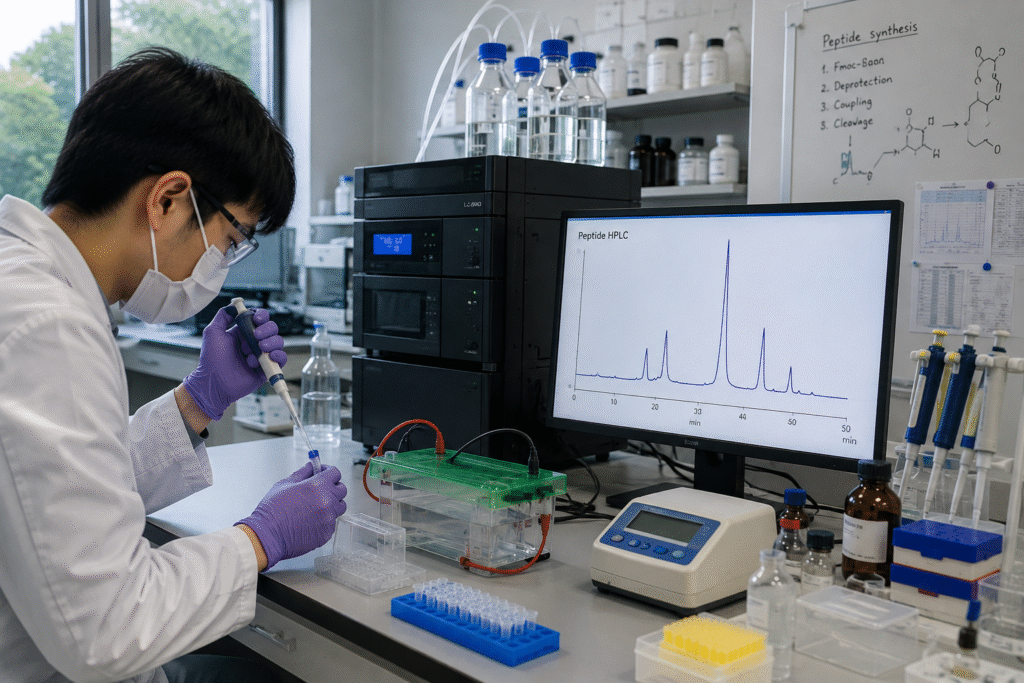
We’ll walk through the procedure of how peptides are synthesized in this post. SPPS and liquid phase synthesis are compared. The image contrasts rough and pristine peptides. What affects time and cost is also discussed.
What Is Peptide Synthesis?
To understand peptide synthesis and how peptides are synthesized you need to understand one simple idea. Peptide synthesis is the joining together of amino acids in a specific order. This creates a chain of peptides. Most often this is done by labs using solid phase peptide syntheses. In SPPS the chain is assembled amino acid by amino acid. It is grown on a solid resin support. When it’s built, the chain is unlocked. And it is cleaned up and checked. Only then is it considered a complete, research-grade peptide.
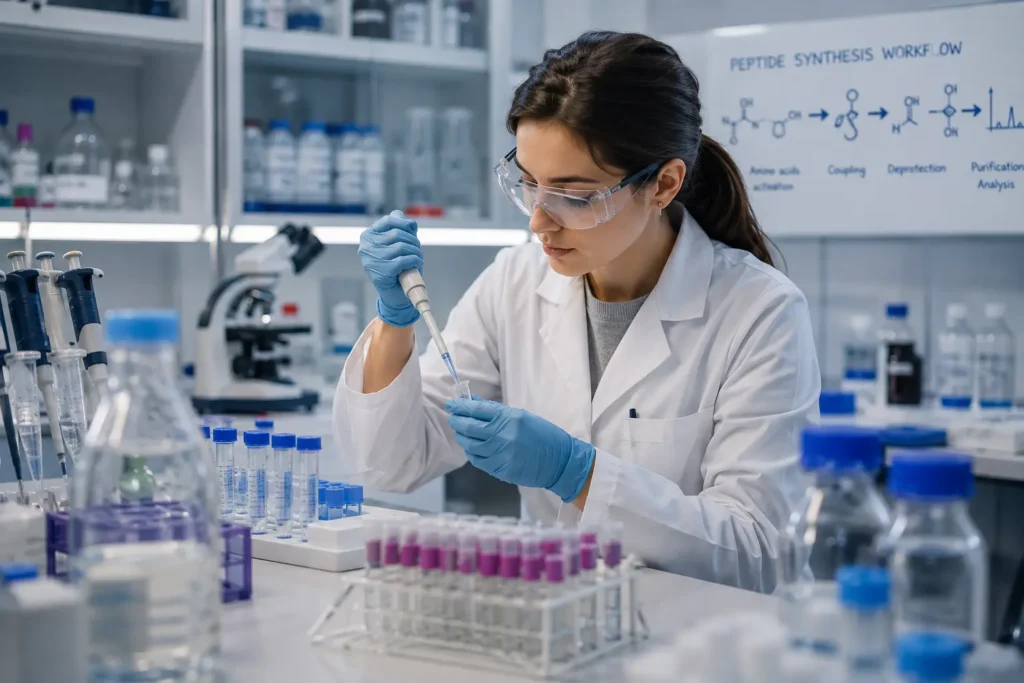
- Builds a chain of amino acids in the exact order the target needs them
- Uses one of two basic techniques: solid phase (SPPS) or liquid phase (LPPS)
- Progresses in several different phases before it’s considered done
- Uses the same basic chemistry for short and long, more difficult peptides.
| Aspect | Quick Fact |
| Core methods | Solid phase (SPPS) and liquid phase (LPPS) |
| Building block | Single amino acids, added one by one |
| End goal | A clean, checked, correct-sequence peptide |
| Key checks | Weight (mass spec) and purity level (HPLC) |
The Full Peptide Synthesis Workflow: Step by Step
To know how peptides are synthesized you have to learn about the workflow. The peptide synthesis workflow includes six major steps. First, there is resin loading. Then you have repeated cycles of coupling and deprotection. Then the chain is released from the resin. The crude peptide is purified. Then it checks. Finally it is packed for delivery. Each step is built upon the previous one. Cutting corners or rushing it often gets you in trouble. It can later show up as low purity. Also, it could be a failed check. This is how most standard labs synthesize peptides together in these six steps.
- Step 1- Resin Loading
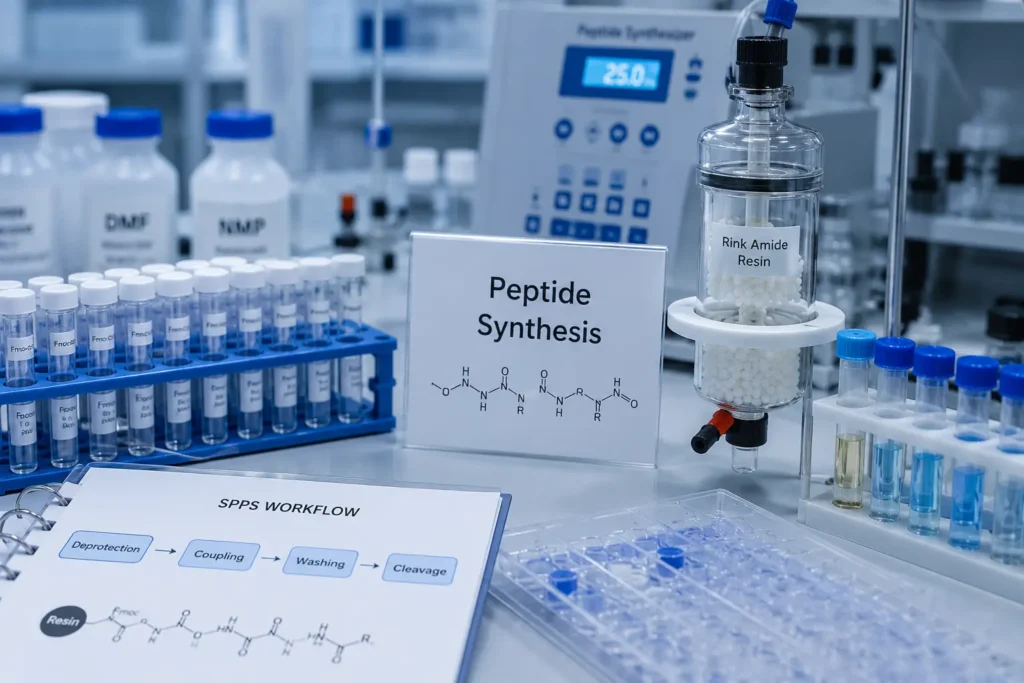
The synthesis begins with a small step. The first amino acid is attached to a solid resin. In the standard SPPS this is the C-terminus of the peptide. This point becomes the anchor point. The rest of the chain builds on that. It makes one piece at a time.
- Step 2- Coupling and Deprotection Cycles
This is the crux of the whole process. It just repeats itself. Each cycle does a few small things. First it cleaves off a “cap” group from the active end of the chain. Then it attaches the next amino acid. This cycle is repeated for every amino acid. It stops only when the whole chain is built.
- Step 3- Cleavage From the Resin
So once the entire chain is built, this is the next step. The chain is cut from the solid resin. Any remaining cap groups are removed as one. The peptide cleaved from the resin is called the “crude” peptide.
- Step 4- Purification
The crude peptide is not a final product yet. It’s in the right order. But it also makes by-products. It also has short broken chains. It also contains other bits of rubbish. Purification clears all of that up. Reverse-phase HPLC is the most common method. This method extracts the correct peptide from the rest.
- Step 5- Analytical Verification
The peptide then passes two checks before it is declared finished. Mass spectrometry weighs up. This confirms it is the target sequence. Its purity level is measured by HPLC. This is the purity in percent. These two checks show what was actually made.
- Step 6- Final Formulation and Delivery
The last stage is freeze drying. This is also referred to as lyophilization. This converts the peptide into a stable powder. Then it’s off to pack. There’s paperwork that goes with it, too. This often involves a certificate of analysis (COA). It also contains mass spec data.
From Crude to Purified Peptide: What Actually Changes
Many new people trip on the conversion from crude to purified peptide. Crude peptide is normally not 100% pure. The process makes short broken chains on the way. It makes other byproducts as well. This is corrected in the purification step. It is a major aspect of how peptides are fabricated to a usable level.
- What changes: crude production mix The purified product is only that one target peptide.
- How it works: reversed-phase HPLC separated by chemical characteristics. Solubility in water is an important property of a molecule. It doesn’t sort by size alone.
- Purity needs differ by use: What you need depends on what you are going to use it for. Some research work can get away with lower purity. Other work requires very high well-checked purity.
- The trade off is: the higher the purity you push to, the less peptide you’ll have left at the end.
SPPS vs LPPS: What’s the Actual Difference?
In SPPS vs LPPS difference solid phase peptide synthesis grows the chain on a solid resin. Any excess reagent can therefore be washed away after each step. Liquid-phase peptide synthesis is a different matter. Instead, each coupling step takes place in a liquid solution. Which means we need to clean up after every step. It is not only done once at the end. Both routes are just two ways that peptides can be made. Both ways the final goal is the same. This goal is an exact, verified sequence.
- Solid Phase Peptide Synthesis Process: Why is It Standard
The main benefit of this process is its simplicity. Excess reagents can be washed out easily. The growing chain can’t be pulled out in the middle of a build. That single feature dramatically sped up synthesis. It beat older, only-liquid methods by a mile. The first solid phase method was developed in the 1960s. That work later earned a Nobel Prize in chemistry. It remains the default for most peptide work today.
- Liquid Phase Peptide Synthesis Method: Where It Still Matters
In a few cases this method still wins. It is better for some larger industrial scale runs. So, some sequences don’t work great on solid resin. There are some reactions that don’t play well in the resin format. Also, some cleanup steps do not fit. SPPS depends on that format, so it can’t always jump in here.
| Factor | SPPS | LPPS |
| Typical scale | Small to mid-size runs | Fits large, industrial runs well |
| Cleanup timing | Once, after the full chain is built | After each single coupling step |
| Common use | Most standard research and custom work | Select large-scale or hard-to-fit sequences |
| General complexity | Simpler, step by step | More cleanup work at each stage |
What Affects Peptide Synthesis Timeline & Complexity
All sequences follow the same basic work flow. But a couple of things change how long it takes. Knowing these things ahead of time helps set fair, real expectations.
- Sequence length- longer sequence requires more coupling cycles. More cycles, more time.
- Sequence difficulty- some sequences break the standard workflow They need more fixes.” (See also the companion article on hard sequences)
- Purity level needed- higher purity targets require additional clean up. They need more checks too.
- Scale- going from milligrams to grams or kilograms brings new problems. Small batches don’t have these problems. (See our upscaling article.)
What Drives Peptide Synthesis Price
There are some obvious factors that determine the peptide synthesis price. It’s not a fixed number. A fixed price would soon become outdated. Cost shifts with the sequence, and the scale, and the spec. It is more useful to look at the cost drivers than to look for a single quoted price.
- Sequence length and complexity This includes known problem areas such as aggregation (clumping).
- The level of purity needed, and the work of cleanup needed to get there;
- Batch size, from small research numbers to larger production runs.
- Any additional changes on top of the base synthesis. (See our article on types of modifications.)
Choosing a Peptide Synthesis Company
Choosing a good peptides synthesis company is simple, just a few clear checks. It’s not just a gut feeling. A quick review like how peptides are synthesized at the start can save a lot of trouble down the road.
- Verify the provider’s real, proven work with your type of sequence
- What checks are standard questions. See which one costs more.
- Request referrals. Or ask for a peptide synthesis review of a similar project.
- Be clear on timing up front. Large scale and hard sequences can add delay.
Frequently Asked Questions
- What are the main peptide synthesis steps?
The main steps of peptide synthesis are: loading of resin, cycles of coupling and deprotection, cleavage of the chain, purification and final check. In almost every SPPS project, this is the way peptides are synthesized. The number one cause of a failed check is skipping a step or rushing cleanup.
- What does the SPPS vs LPPS difference actually mean?
SPPS constructs the peptide on a solid resin. Excess reagent is easily washed out. Each coupling step of LPPS is performed in a liquid solution. After each step, not just at the end, cleanup is needed. Most normal custom work today utilizes SPPS. Some large or difficult to fit cases are selected for LPPS.
- How is peptide purity confirmed?
Two tools are used to check the peptide purity. The peptide weight is confirmed by mass spectrometry. The purity is determined as a percent by HPLC. These checks altogether provide clear evidence of what was actually produced.
- Why is peptide synthesis so expensive?
Some things add to the cost. These are the sequence length, complexity, purity level, batch size and any extra changes. The most expensive sequences tend to be the hardest or prone to clumps. They need additional patches on top of the normal workflow.
- Solid phase or liquid phase synthesis- which is better?
Currently, the solid-phase method is the most commonly used method for peptide synthesis. It’s the norm for the majority of custom work. Liquid-phase synthesis is still used occasionally. It suits some of the big industrial runs. It also fits certain sequences that don’t fit a resin-based method.
- Why is it necessary to purify a crude peptide?
Crude peptide is the target sequence plus byproducts. It also has short, broken chains. Purification gives the correct peptide with good purity. The most popular method is reverse-phase HPLC.
- Removes short chains from incomplete coupling reactions
- Separate the target peptide from other remaining by-products.
- Brings the final product to a clear, checked level of purity
Conclusion
“How peptides are synthesized” Making peptides involves several stages. The first phase is resin loading. Repeated binding cycles followed. Cleavage, purification, and final inspections follow. Today, most work goes to SPPS. In practice, this will vary based on event sequence, purity, and project size. That answers how short and long peptides are generated quickly and easily.
Visit Sichuan Pengting Technology Co., Ltd. to collaborate on this project. The firm produces ISO/GMP peptide raw materials. Shipments with DMF, COA, and MSDS documents work. It works with various-sized orders. From little quantities for investigation to years-long runs. This clear, adaptable framework is crucial after a series has moved beyond the methodology depicted here.