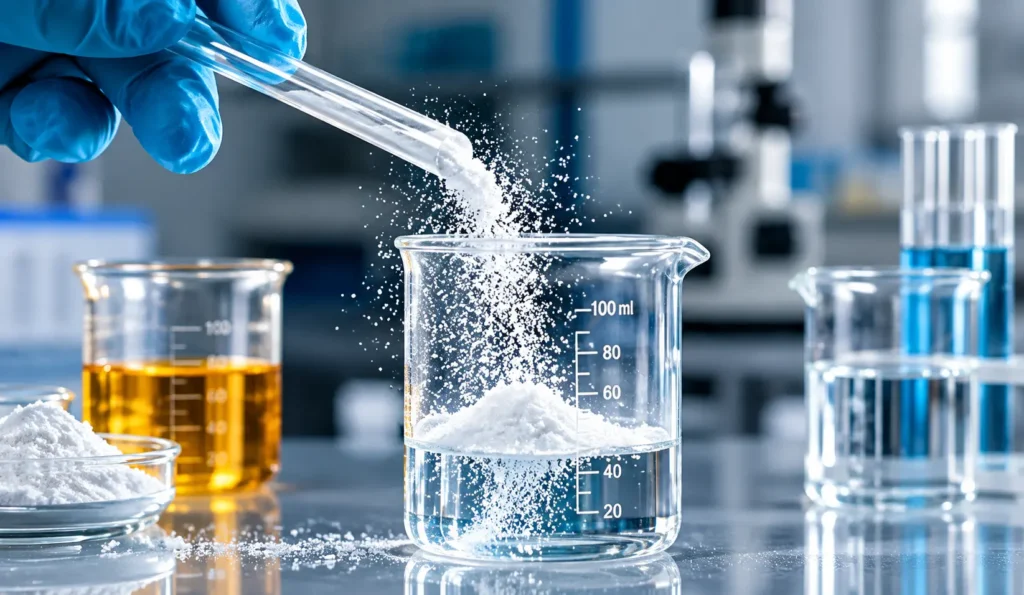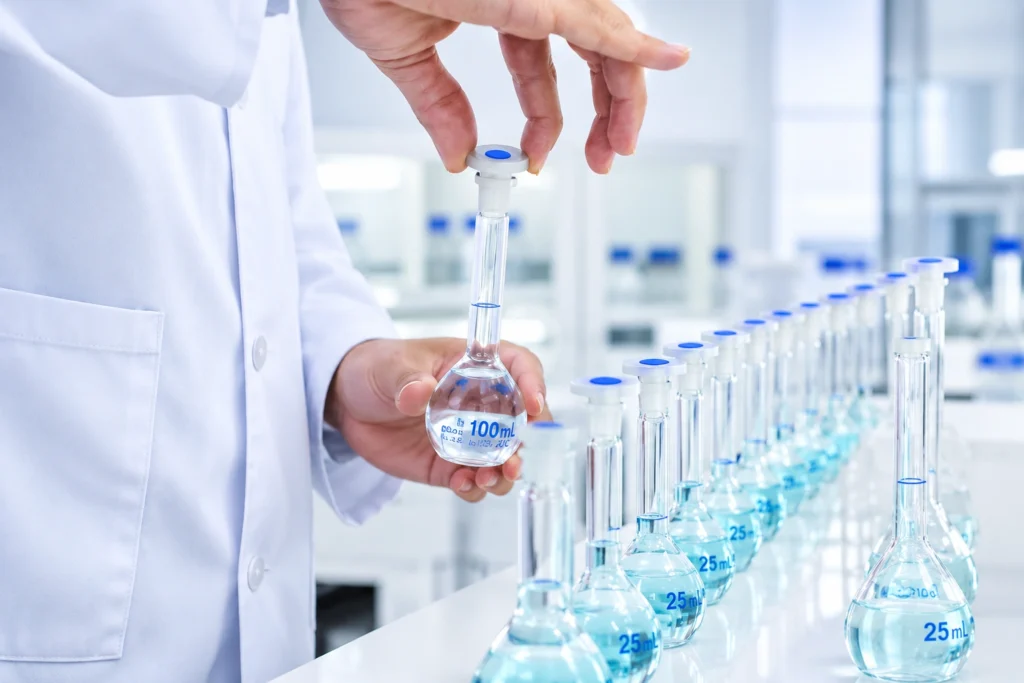
Why does one peptide dissolve well in one lab but become cloudy in another? The synthesis is rarely wrong. “It’s the sequence that matters. The outcome is shaped by the net charge, water-shy regions, and salt on the powder. At Sichuan Pengting Technology, a peptide API manufacturer since 2021, this peptide solubility guide is based on daily production and quality checks.
Here’s the charge calculation, the correct solvent, the COA fields that matter, and a safe manner to combine.
Why Do Some Peptides Refuse to Dissolve?
When a peptide has several water-shy regions and a small net charge, it resists water. Charged side chains drag it into water. Hydrophobic side chains force it back out.
Plain water is not always an ally for sequences with fifty percent or more hydrophobic residues. Some build extensive networks of hydrogen bonds. Rather of disintegrating, they form a gel.
Four Sequence Traits That Predict Trouble
- A high content of Ala, Val, Leu, Ile, Phe, Trp, and Met
- Zero net charge at your working pH.
- A pH around the isoelectric point (pI) at which solubility is a minimum
- A lengthy chain, since large chains stack more easily than small chains.
The published guidance from GenScript and Sigma-Aldrich is consistent. Before opening the vial, inspect the amino acid makeup.
Peptide Solubility Guide: The Core Rules
The first rule of our peptide solubility guide is easy. Calculate the net charge and then choose a solvent. Give −1 to each Asp (D), each Glu (E), and the C-terminal –COOH. Give +1 to each Arg (R), Lys (K), His (H), and the N-terminal –NH₂. Then add the values.
A positive sum means a fundamental peptide. An acidic peptide means a negative total. The number zero means neutral. One detail is of use here. Below pH 6, it behaves as +1 and close to zero above.
Peptide solubility and pH go together. Peptides are more charged at pH 6–8 than at pH 2–6. It works best when the pH is close to neutral. Except for very sticky and water-phobic sequences, there are very few.
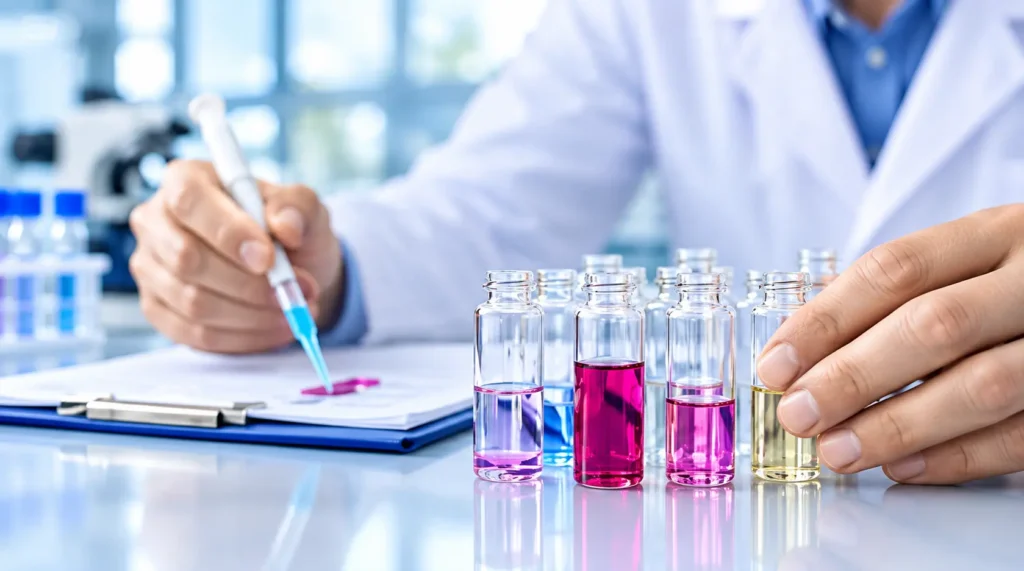
Net Charge and First Solvent Choice
| Net charge result | Peptide type | First solvent to try | If it resists |
| Positive (+1 or more) | Basic | Sterile distilled water | 10–30% acetic acid, drop by drop |
| Negative (−1 or lower) | Acidic | Water or 1X PBS | 0.1 M ammonium bicarbonate, 10–50 µL |
| Zero | Neutral or hydrophobic | DMSO, DMF or acetonitrile | Dilute slowly into water buffer |
What Does a COA Tell You Before Mixing?
A Certificate of Analysis (COA) states what’s truly in the vial. Knowing how to read a peptide COA stops most weighing errors. Read the fields in this order:
- Identity – the mass spectrometry result compared to the anticipated mass.
- HPLC purity – size of the peptide peak, not the quantity in the vial
- Net peptide content – how much peptide is in the powder after the water and salt are removed.
- Water content – Karl Fischer titration. The freeze-dried powder is rather hygroscopic.
- Salt form and counterion – the salt that is associated with the peptide. This is your weight figure.
- Reported solubility as tested by the supplier on that batch.
A lot can show a clean 98% peak and still hold less peptide per milligram than you expect. Related: Net Peptide Content vs Purity and What Does 98% Peptide Purity Really Mean?
TFA Salt vs Acetate Salt Peptide: What Actually Changes?
The sequence is the same. The counterion changes the mass you are weighing. To cut the peptide off the resin, solid-phase synthesis employs trifluoroacetic acid (TFA). The TFA is carried through the clean-up phase in RP-HPLC. So most peptides come in as TFA salts.
Acetate is the most frequent counterion used for latter stage work. The switch employs RP-HPLC with an acetic acid or ammonium acetate wash. The other route is ion-exchange resin.
Counterion Comparison at the Bench
| Point of difference | TFA salt | Acetate salt | Why it matters |
| Origin | Normal output of synthesis | Made by a salt exchange step | Sets what arrives by default |
| Powder mass | Heavier salt load | Lighter salt load | Same purity, different peptide weight |
| Cell work | Can affect cell health and readings | Usually better tolerated | Decides assay fit |
| Later-stage use | Raises safety and rule questions | Preferred for development work | Shapes long-term sourcing |
Check the salt form before you set a stock concentration. Skip that step, and your dose curve sits on the wrong axis.
How Do You Pick a Solvent Without Damaging the Peptide?
The charge result, which only moves in one direction, is followed by good peptide solvent selection. 1st strong solvent, 2nd buffer. The main reason for failure is flipping that order.
Basic Peptides: Water, Then Acid
Use sterile distilled water. Add 10-30% acetic acid dropwise if solids remain.
The acetic acid and TFA peptide solvent paths have various dangers. Last step: keep TFA under 50 µL. Dilute until the final level stays under 1%. Avoid using TFA in culture work since it harms cells.
Acidic Peptides: Water, Then Mild Base
Begin with water or 1X PBS. Add 10-50 L of 0.1 M ammonium bicarbonate or ammonium hydroxide if the powder holds together; otherwise. Then bring the solution back to about pH 7.
There is one warning that matters here. High pH may trigger the formation of disulfide bonds. On sequences that contain cysteine, never use ammonium hydroxide.
Neutral and Water-Shy Sequences
Dissolve the powder completely in a small amount of DMSO, DMF, or acetonitrile. Then increase the buffer in small increments. In the last assay, DMSO should be at 1% or less. Then urea and guanidine HCl.
Why Run a Small Solubility Test First?
Never the whole batch, a peptide solubility test requires roughly 1 mg. A milligram costs nothing. A broken vial costs a week to replace.
- Keep the main vial sealed while weighing a small test amount.
- Write down the results of each solvent route you try.
- Clear, hazy, gel-like, or floating bits are easy to see.
- Dilute that amount into your actual buffer. A peptide can dissolve, and can precipitate again.
For most assay work, a stock of 1–2 mg/mL is suitable. In the last well, it maintains a low solvent volume.
Dissolving Lyophilized Peptides Step by Step
Ordered and gradual, good peptide reconstitution. The following steps each eliminate a typical failure.
- Allow the sealed vial to reach room temperature prior to use. Cold glass draws moisture.
- Tilt the vial slightly so that the powder goes to the bottom of the vial and not to the lid.
- Add the solvent carefully down the wall of the inner tube.
- Stir gently. Hard vortexing leads to foam.
- If solid persists, use brief sonication or warming <40°C.
- Add the last buffer in chunks. Check clarity every time.
- Before using, spin the tube to drop out bits.
- Aliquot and store at -20°C. Do not freeze and thaw repeatedly.
Sequences That Need Extra Care
Oxidation is facilitated by peptidides containing tryptophan, cysteine, or methionine. Maintain little air contact when using a degassed solvent.
What Causes Cloudy Solutions in Hydrophobic Peptides?
A cloudy tube means the peptide has left the solution. Peptide aggregation and precipitation show up soon after dilution. The organic share drops, and the molecule loses its support.
Warning Signs and Fixes in Order
- Signs: haze, fine bits, a gel layer, or liquid that turns milky after dilution
- Fix 1: lower the working concentration
- Fix 2: dilute slowly, adding peptide into buffer, not buffer into peptide
- Fix 3: move the pH away from the pI
- Fix 4: keep a small share of co-solvent in the final mix
- Fix 5: use a chaotrope such as urea only as a last option
End modifications like acetylation or amidation further reduce solubility. When a peptide is combined again, it seldom restores the first outcome. The first attempt should be well-planned.
What Does a Manufacturer Control Before Shipping?
A consistent raw material is the foundation of good results. Sichuan Pengting Technology Co., Ltd. began in 2021 in Sichuan, China. The firm produces peptide APIs and cosmetic peptides. It operates from a cooperative factory, measuring 6,500 square meters, with 5+ PhD R&D engineers on the team.
They have brought more than 100 effective raw ingredients from research to full production there. They all fulfil ISO and GMP norms. Each one ships with the necessary DMF, COA, and MSDS documents. Your solvent selection is based on those documents.
Supply terms stay flexible. MOQ runs from 50 g trial batches to ton-level volume. The delivery cycle is 15–30 days. Europe and America take 15–20 days; Southeast Asia 7–10 days. Urgent orders ship within 72 hours. Materials are 100% traceable, and packaging is degradable. Request lot documents with your quote.
FAQS
Can every peptide dissolve in water?
No. Many brief, charged sequences are required for water to operate. An organic solvent is required initially for neutral and very hydrophobic ones.
- Test out water with short, charged chains.
- Begin with dimethyl sulfoxide (DMSO) for long water-shy chains.
Which solvent should I try first?
Sterile distilled water, but not the whole vial, was tested. If the buffer that follows is saline, switch to 1X PBS.
- Essential peptide: water, followed by 10-30% acetic acid
- Water or PBS, followed by a moderate base and an acidic peptide
Does pH change peptide solubility?
The net charge changes as a function of pH; thus, we may say yes. When the pH is between 6 and 8, peptides have a higher charge than at pH 2. As one approaches the pI, solubility drops to its lowest point.
- Be careful not to work near pH 7, since this is the point at which the test fails.
- If haze appears, you should avoid being near the PI.
When should I avoid TFA?
Avoid TFA for cell culture and cell-based experiments where residual acid kills cells. Or you can use the acetic acid route or an organic co-solvent.
- Keep any final TFA level under 1%
- If cells are involved, request an acetate form
Why is my peptide solution cloudy after dilution?
The peptide is precipitating out of solution. The less organic solvent, the less support for the molecule.
- Lower concentration target
- NEVER add buffer to peptide!!!!!
What should I check on the COA first?
Mass spectrometry is the first line of verification. Then read HPLC purity, net peptide content, water content, and counterion. Those five fields determine your weighting figure and solvent route.
- Purity is a peak size, not a quantity
- Net peptide content is the number you weigh against
Conclusion
Most of the problems in solubility are sequence problems. They’re predictable before the vial is opened. Calculate net charge, check COA, test 1 mg, and then dilute in the proper sequence.
Paperwork, not technique, is typically the problem. Sichuan Pengting Technology Co., Ltd. falls right in there. Deliveries of raw ingredients with DMF, COA, and MSDS data. The minimum order quantity is 50 g, so you may test handling on a trial batch. Traceable sourcing implies that the lot you test is the lot you scale.