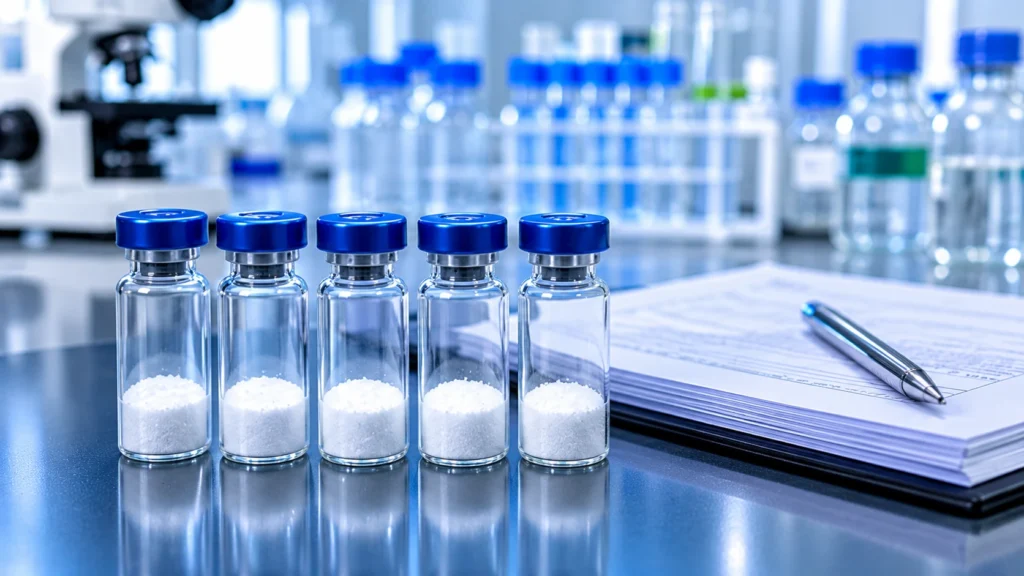
Two buyers order the same peptide. Why do their sheets look so different? A peptide specification sheet lists the limits a peptide batch must meet. Sichuan Pengting Technology Co., Ltd. makes peptide raw materials in Sichuan. It was founded in 2021. This article reads its real Alarelin Acetate listing, line by line.
In this guide, you will learn what the common fields mean. In addition, you will learn about water and counterion content, storage, and test methods. Following that, you will be able to distinguish between a technical data sheet, a certificate of analysis, and a common sheet.
What a Peptide Specification Sheet Tells You
A product specification is the written standard for a peptide. Each line names one feature of the peptide and the limit it must meet. The lines cover identity, appearance, purity, and storage. The limits are for the product, not for one batch.
A product specification sets the goal. A batch result shows the test numbers for one lot. A lot is one run of production. Each lot has its own number.
ICH Q6A is a guideline for drug substances. It says a specification is a list of tests, test methods, and acceptance criteria.
Pengting’s product pages show the core fields. Each page also invites buyers to ask for product specifications and quality documents.

The Fields on Every Sheet
Every peptide specification sheet has a few core lines. The table below shows each one for the Alarelin Acetate listing.
The Alarelin Acetate Listing
| Field | What it tells you | Alarelin Acetate listing |
| Product name | The exact material | Alarelin Acetate Powder |
| CAS No | A number for one exact substance | 79561-22-1 |
| Molecular formula | The atoms in one molecule | C56H78N16O12 |
| Molecular weight | The mass of one molecule | 1167.33 |
| Purity | The share of the target peptide | 99% |
| Appearance | The look of the powder | White powder |
| Storage | How to keep the material | −20℃ long term, 2℃–8℃ short term |
| Packing | The pack sizes offered | 1 g – 1 kg |
A CAS number is a number for one exact substance. So two suppliers know they mean the same peptide. Pengting explains more in its peptide CAS number buyer guide.
Reading the Purity, Appearance and Identity Lines
What does a purity figure mean?
A purity figure indicates the percentage of the target peptide in the sample. HPLC is used by a lab to analyze it. High-performance liquid chromatography, or HPLC, splits the sample and draws a chart known as a chromatogram from it.
Purity is the area of the main peak divided by the area of all peaks, times 100. Purity is not the same as net peptide content. Pengting’s HPLC purity guide goes deeper.
What should appearance say?
Appearance should say what the powder looks like. The Alarelin Acetate listing says white powder. You can check this by eye. A color change or clumping is a sign to ask questions.
How is identity confirmed?
Identity is confirmed by mass spectrometry (MS). It quantifies the molecule’s mass . The mass should be the molecular weight on the sheet.
The listing says 1167.33. The formula C56H78N16O12 adds up to around 1,167.3. So the number is like the peptide alone, without acetate. Ask the provider what document they are referring to.
“Every batch comes with a COA, HPLC chromatogram, MS report and an MSDS,” explains Pengting.
Why Water and Counterion Content Matter
Not all the powder in a vial is peptide. Some of it is taken by water. Some is also taken up by counterions.
A counterion is a tiny, charged companion of the peptide. It gives mass and balances the charge. The entry for Alarelin lists the acetate form. So acetate is the counterion here. Dry particles may also absorb moisture from the air, Pengting observes.
Net peptide content is the percentage weight of the vial that is peptide. Pengting’s blog is an example. A vial with 10 mg of content 78% means 7.8 mg of peptide. I only have an instance. This is not a product number of Pengting.
The Alarelin listing does not show water content or counterion content. Ask for both when you ask for a quote. Pengting’s guide on net peptide content vs purity explains the difference.
What the Storage Temperatures Mean
Storage conditions tell you how cold to keep the powder. The Alarelin Acetate listing says 2℃–8℃ for short term. It says −20℃ for long term. The sheet does not say how long short term is. Ask for that detail.
Pengting’s storage guide lists what can harm a peptide:
- Moisture
- Oxygen
- Heat
- Light
- Freezing and thawing many times
Read the storage lines before the lot arrives. Then your fridge or freezer is ready on day one.
Test Methods and Acceptance Criteria Explained
Acceptance criteria are the pass limits for each test on a sheet. Each test checks one thing and has a method and a limit. If a batch falls outside the limit, it fails. The specification gives the limit. The COA gives the result for one lot.
Tests, Methods and Limits
| Test item | Method | What the limit should say |
| Appearance | Visual check | The stated look (white powder in the Alarelin listing) |
| Purity | HPLC | A stated limit (the listing shows 99%) |
| Identity | Mass spectrometry | Mass matches the stated molecular weight |
| Net peptide content | Amino acid analysis | A stated range |
| Water and counterion content | The method named on the sheet | A stated limit |
The Alarelin listing does not name its test methods. Pengting’s blog names HPLC, MS and amino acid analysis.
Ask if 99% is a minimum or a typical result. The Alarelin listing gives one number and does not say. Pengting’s Carfilzomib listing writes “≥ 98%.” That looks like a minimum.
Specification, COA and Technical Data Sheet: Which One Do You Need
Each document answers a different question. The specification tells you what the product should be. The COA tells you what this lot was. The technical data sheet tells you how to handle the material.

The Four Documents Compared
| Document | What it covers | Tied to one batch? | When you use it |
| Specification | Limits for the product | No | Before you order |
| COA | Measured results for one lot | Yes | When a lot arrives |
| Technical data sheet | Product background, handling and storage | No | To plan handling |
| MSDS | Safety information | No | Before you store or handle the material |
Pengting’s COA guide says one COA covers one lot number and one batch. Pengting also says you can get sample documents before you buy.
Read more in how to read a peptide COA. You can also read the COA red flags post and the guide to supplier documents.
How to Compare a Peptide Specification Sheet From Two Suppliers
Check the lines that can differ between two sheets. This list helps:
- The same CAS number
- The same salt form
- A named test method for each limit
- Water and counterion numbers
- A lot number on the COA
- Storage that fits your plan
Pengting’s own listings show this. Alarelin Acetate lists 99% purity and −20℃ for long term storage. Atosiban lists 98% purity and storage at 2 ℃ ~ 8 ℃. So limits and storage change from one product to the next.
What to Ask Pengting Before You Order
Start with the lines the listing does not show. These are water content, counterion content, test methods, and the type of purity limit. Pengting’s site also gives these facts:
- Pack sizes run from 1 g to 1 kg.
- Trial batches start at 50 g. Supply can reach ton level.
- Delivery to Europe and America takes 15–20 days.
- Delivery to Southeast Asia takes 7–10 days.
- Urgent orders ship within 72 hours.
- Pengting says its raw materials comply with ISO/GMP standards.
- Pengting says 100% of its raw materials are traceable.
Send a request through the quote form. You can also look at the Custom Peptide category.

Frequently Asked Questions
- What information is on a peptide specification sheet?
A peptide specification sheet lists the product name and CAS number. It also shows the formula, weight, appearance, purity, and pack size. It tells you how to store the powder. A fuller sheet adds test methods, acceptance criteria, water content, and counterion content. The Alarelin Acetate listing shows CAS 79561-22-1, 99% purity, white powder, and −20℃ long term storage.
- What is acceptance criteria in a specification?
Acceptance criteria are the pass limits for a test. Each test on the sheet has one. Purity and appearance are two examples. If a batch falls outside the limit, it fails. The specification gives the limit. The COA gives the result for one lot.
- What is a technical data sheet?
A technical data sheet tells you about a material. It shows what the material is and how to handle it. It often lists identity data, appearance, storage, and packing. It does not give results for one batch. Use it to plan before you order. Read the COA for batch results.
- What is the difference between a COA and a specification?
A specification sets the limits a product must meet. A COA shows what was measured on one lot. The specification is the goal. The COA is the proof. A good COA lists the lot number, the test methods, and each result next to its limit.
- What is the difference between purity and net peptide content?
Purity shows how much of the peptide is the one you want. Net peptide content shows how much of the vial’s weight is peptide. A lot can be 99% pure and still hold less peptide by weight. Water and counterions make up the rest of the weight.
- What storage does the Alarelin Acetate listing state?
The Alarelin Acetate listing says −20℃ for long term storage. It says 2℃–8℃ for short term storage. It does not say how long short term lasts. Ask for that when you request a quote. Then you can plan your storage for the lot.
Conclusion
A peptide specification sheet is useful when each line has a limit and a test. Look at the purity, storage conditions, and pass limits. Ask for the water and counterion numbers. Check the COA for your lot.
Sichuan Pengting Technology Co., Ltd. is a good pick if you want this detail. Pengting says every batch comes with a COA, an HPLC chromatogram, an MS report and an MSDS. It says you can get sample documents before you buy. Send a request for the full specification.