Do you sell glp-1 peptides for research use? Is it safe if it says “Research Use Only”? This is often asked by people who read about incretin science. They sell the same molecules online that they use in labs, sometimes with salesy words. Then people inject these peptides themselves, without a doctor’s prescription.
This is not a buying guide folks. It tells the real science. It tells you the real rules. and describes the safe use of these drugs. Lab research and self-injection are two very, very different things.
You will learn about GLP-1. You’ll learn how tirzepatide and retatrutide stack up against semaglutide. You’ll learn what “Research Use Only” actually means. And you will also learn where the real clinical proof ends.
Is GLP-1 a Peptide? Here’s What That Means
GLP-1 is the peptide hormone. A peptide is a short string of amino acids, the little building blocks of proteins. Your gut makes GLP-1 when you eat.
GLP-1 is part of a group of hormones known as incretins. Incretins help your pancreas to make insulin. They also slow down digestion.
Semaglutide and other drugs mimic this natural hormone. GLP-1 peptides for research use change the molecule a little bit. This makes the drug stay in your body much longer. A natural hormone is not the same thing as a synthetic drug.
Table: Summary of GLP-1
| Term | What It Is | Found In |
| GLP-1 | Natural incretin peptide hormone | Human gut, released after meals |
| Semaglutide | Long-acting GLP-1 receptor drug | Ozempic, Wegovy, Rybelsus |
| Tirzepatide | Dual GIP/GLP-1 receptor drug | Mounjaro, Zepbound |
| Retatrutide | Triple GLP-1/GIP/glucagon drug | Investigational, not yet approved |
What Are GLP-1 Research Peptides?
GLP-1 research peptides are laboratory versions of these molecules. Scientists use them in cell studies and in animal studies. They are not built to be shot in themselves by humans.
This raw material is used in incretin peptide research. Scientists study how it attaches to receptors. A receptor is like a lock on a cell and the peptide is like a key. The research takes place long before a drug reaches the pharmacy.
GLP-1 is not one specific drug. Semaglutide, tirzepatide and retatrutide are three different drugs. They all work on the GLP-1 receptors in different ways. They are from different companies.
Peptide and GLP-1 research is hot right now. It’s that speed that is exactly why some sellers blur the line. They confuse “lab material” with “something safe to use at home.” That’s the confusion in which GLP-1 peptides for research use are sold wrong.
GLP-1 Peptide Structure: Simple Structure
The GLP-1 peptides for research use structure is a chain of 30-31 amino acids long This chain coils into a shape. That shape matches a receptor on cells in your pancreas and brain. Small changes in the shape of drugs change their effectiveness.
How Drug Makers Make GLP-1 Last Longer
- They add a fatty side chain so that the drug sticks to a protein in your blood. Semaglutide does this trick.
- They are changing one part of the chain, slowing down an enzyme called DPP-4. That enzyme normally degrades GLP-1 quickly.
- They form one chain that binds two receptors at the same time. Tirzepatide acts on both GIP and GLP-1 and does this.
- A third target is added. Retatrutide also targets the glucagon receptor.
Natural GLP-1 is gone in minutes. These are the changes that make tirzepatide and retatrutide not just “stronger GLP-1.“They are new molecules, with their own safety profile.
Tirzepatide, Retatrutide, and Semaglutide: What’s the Difference?
All three are GLP-1 peptides: tirzepatide, retatrutide and semaglutide. But they hit different receptors, and they’re at different stages of the approval process.”
Tirzepatide acts on two receptors: GLP-1 and GIP. One point for semaglutide: GLP-1 alone. Retatrutide targets three: GLP-1, GIP and glucagon.
| Compound | Receptors Targeted | FDA Status (mid-2026) | Approved Brand Names |
| Semaglutide | GLP-1 | Approved | Ozempic, Wegovy, Rybelsus |
| Tirzepatide | GIP, GLP-1 | Approved | Mounjaro, Zepbound |
| Retatrutide | GLP-1, GIP, Glucagon | Investigational — Phase 3 | None yet |
SURMOUNT-5: Tirzepatide bested semaglutide in head-to-head study People on tirzepatide lost 20.2% of body weight over 72 weeks. Patients on semaglutide lost 13.7% of their weight.
Retatrutide is not approved yet, but early results seem promising. TRIUMPH-1 study: Participants lost 28.3% of their body weight in 80 weeks. Eli Lilly may file for FDA approval later in 2026.
Do GLP-1 Peptides Really Work? Clinical Research Evidence
Yes, GLP-1 peptides do work — but only the FDA-approved drugs, used with a doctor’s care. In the STEP studies, semaglutide led to weight loss of about 10% to 18% of body weight. In the SURMOUNT studies, tirzepatide resulted in weight loss of between 13% and 23%.
This proof comes from real drugs. These drugs are made, tested and checked by FDA. This validation is not applicable to GLP-1 raw material RUO dispensed in clear vials. Those vials have never been tested like this before.
What Does “Research Use Only” (RUO) Actually Mean?
Research Use Only” is a label. The FDA created this label for lab products. It informs you the product is for lab research, not to be used on a person.
RUO labelling is a regulation that controls how a product is sold. It doesn’t say anything about how clean or safe the product is. A peptide supplier can sell the GLP-1 raw material RUO to laboratories. What they can’t do is sell it to people to inject at home.
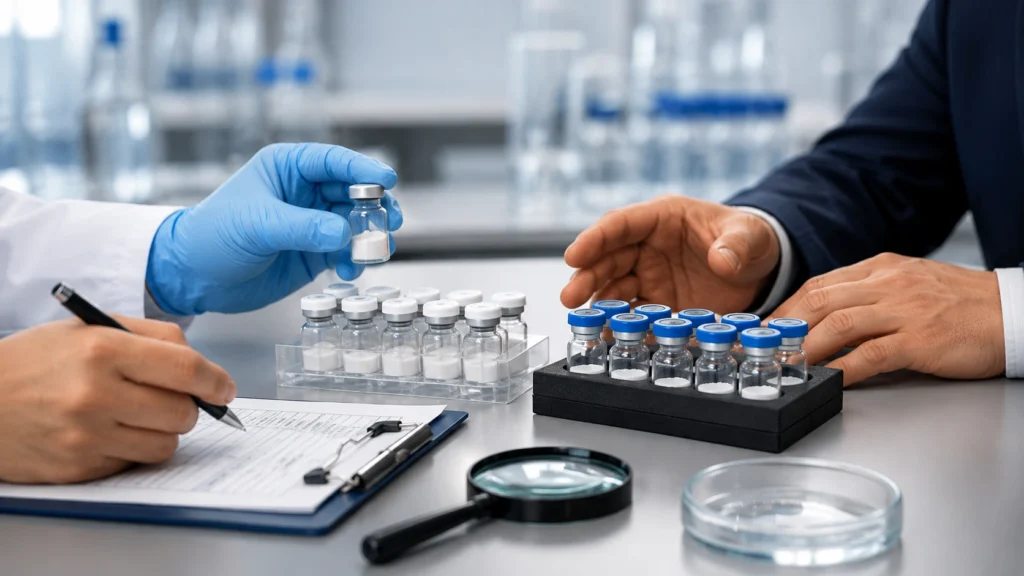
RUO label does not mean a product is safe. It is not a safety check, it is a legal category. A vial can be manufactured with zero quality control, even with an RUO label on it.
Why RUO GLP-1 Products Carry Real Risk
Real risk for RUO GLP-1 products. They disregard all the safety steps real drug makers take. The FDA has identified numerous problems with these unapproved products.
Problems Found in Unapproved GLP-1 Products
- No evidence of clean, pure ingredients – some vials were the wrong strength
- Unclear dosing — some labels told buyers to measure in “units,” although what one “unit” is can vary
- Fake labels – some products are labelled with names of non-existent pharmacies
- Errors in dosing are associated with many reports of harm, some needing hospital treatment
- No doctor screening for other health risks or drug interactions
It’s also a legal grey area to buy from a peptide supplier for self-administration. It may be legal to sell as a research chemical. But you can’t use it on yourself with that tag.
What Is the Best GLP-1 Peptide? Reframing the Question
There is no “best” GLP-1 peptide. FDA approval, your health, and your doctor’s advice are the three things that make the right choice, not a brand comparison of RUO vials.
Semaglutide, tirzepatide and retatrutide (when approved) all work differently. Each has its side effects. Each has its own burden of proof.What is the best GLP 1 medicine?” is actually a medical question, not a shopping question. Firstly the doctor will check your health, your goals and any other medicines you may be taking.
How to Access GLP-1 Medication Safely
Access begins with a licensed doctor. It doesn’t start with an online peptide provider
Safe Ways to Get GLP-1 Medication
- See your primary care physician or an endocrinologist. They can help see if semaglutide or tirzepatide is right for your health.
- Use a telehealth service staffed by U.S. licensed doctors. The real thing. Telehealth services send your prescription to a licensed pharmacy.
- Refer to FDA’s BeSafeRx program. It helps you to check the authenticity of an online pharmacy.
All the paths to safety lead to the same place: You get a prescription, a licensed pharmacy fills it, and a doctor checks up on you along the way GLP-1 peptides for research use.
Frequently Asked Questions
Is GLP-1 a peptide ?
Yes, GLP-1 is a peptide. It is a hormone made up of 30 to 31 amino acids. It belongs to the incretin hormone family and your gut makes it after you eat.
What are GLP-1 research peptides?
GLP-1 Research Peptides are lab versions of GLP-1 related molecules. They are used by scientists to study receptors, not to treat people. They are for research use of incretin peptide, not for home use.
Are GLP-1 peptides really effective?
Yes. FDA approved GLP-1 medications are very effective for weight and blood sugar when you are under a doctor’s care. Weight loss studies show as little as 10% and as much as 28%, depending on the drug and the dose.
Best glp-1 peptide?
There is not one best one. The way you go and the path you choose depend on your health and your doctor’s advice. Dr. Weighs semaglutide and tirzepatide as options for your case.
Are GLP-1 peptides labelled “Research Use Only” legal to purchase?
RUO peptides are legal to sell to labs for research use. That product is not for use on yourself. The label does not permit it. The FDA has warned of health risks of doing this.
Where can I safely purchase GLP-1 peptide?
The safe way is with a real prescription from a licensed pharmacy. To check if a source is legitimate, you can search for telehealth providers and the FDA’s BeSafeRx list.
Conclusion
Research grade GLP-1 peptides are real, and the science that underlies them is real. But the real test is not in unregulated vials of RUO sold for self-injection. It is in approved drugs, studied in rigorous trials.
If you’re considering a GLP-1 peptides for research use, talk to your doctor first or use a reputable peptide provider like Sichuan Pengting Technology Co., Ltd. They can help you get an FDA-approved drug, and help you use it properly. They provide you the safest and legal products for your research