Two teams can run the same steps to synthesise a peptide. But they can still lead to very different outcomes. Most of the time it is a matter of the peptide coupling reagents you choose and not the sequence itself.
This has been studied by peptide chemists for many years. One thing remains true: a reagent that works well on an easy chain can fail on a harder chain. This guide compares the main peptide-coupling reagents- HATU, HBTU and DIC- and the associated helper chemicals. You’ll see which works best for each.
This guide describes the purpose of a coupling reagent. It also reports the coupling efficiency and racemization control in simple language. You will see differences between HATU, HBTU and DIC. In the end you have a simple way to choose the right reagent, plus a little review of each one.
What Is a Coupling Reagent in Peptide Synthesis?
A coupling reagent is a chemical compound used in coupling reagents used in peptide synthesis to help join two amino acids together. It does this by catalysing the acid part of a new amino acid. This allows the acid to attach to an amine group on the growing peptide chain.
The acid and the amine do not couple well at room temperature without this assistance. The reagent produces a short-lived, more reactive form of the acid. This is commonly termed an active ester. It reacts quickly, before other unwelcome reactions can begin.
This step is repeated again and again. Each new amino acid requires a coupling step. To make a chain of 20 aminoacids requires 20 good coupling steps. If the reagent is not reliable, small problems can quickly pile up. The common peptide coupling reagents used here are HATU, HBTU and DIC. You can also see the guides on SPPS vs LPPS difference (solid-phase peptide synthesis (SPPS) and liquid-phase peptide synthesis (LPPS) for more on this topic).
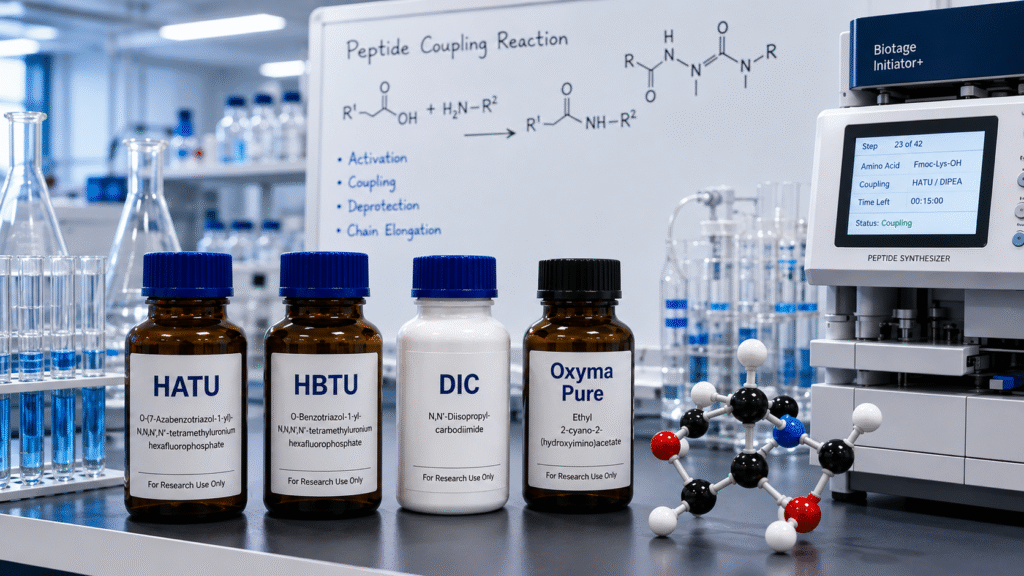
| Reagent Type | Example | Activation Step | Typical Helper Chemical |
| Uronium salt | HATU | HOAt active ester | DIPEA (a base) |
| Uronium salt | HBTU | HOBt active ester | DIPEA (a base) |
| Carbodiimide | DIC | O-acylisourea | Oxyma Pure or HOBt |
| Carbodiimide | DCC | O-acylisourea | HOBt |
What Does Coupling Efficiency Actually Measure?
Coupling efficiency is pretty simple. It is a measure of how many amine groups couple and react in one coupling step. It is expressed as a percentage.
99% sounds good to me . But peptides are long, It’s a tiny gap, but over 30 steps it adds up quickly. This can leave short or broken chains behind, called deletion peptides.
Hence the chemists check each step. They don’t just hope it worked. Some amino acids are more difficult to couple. They are either bulky ones or ones with an extra methyl group. The choice of reagent here is very important. Typical checks are:
- Kaiser Test It uses a colour change to locate unreacted amine groups.
- The chloranil test. It works for amines that the Kaiser test might miss.
- UV-monitoring. It monitors a step called Fmoc removal.
- HPLC test. It checks the final peptide after it has been cleaved from the resin.
Racemization Control: The Hidden Coupling Risk
Racemization control is the prevention of an amino acid from changing conformation during coupling. Each amino acid has one correct version. If it flips then it becomes the wrong mirror image form. This can destroy the peptide.
This flip can occur when the active acid forms a ring called an oxazolone. Histidine and cysteine are the two amino acids most at risk. Their side chains allow for easy formation of this ring.
Such is the importance of helper chemicals. Fast reagents like HOBt, HOAt and Oxyma Pure step in. They convert the acid to a stable active ester, so the ring can ‘t form. Some reagents are better at this than others. Thus racemization control becomes a key factor in the selection of the appropriate peptide coupling reagents.
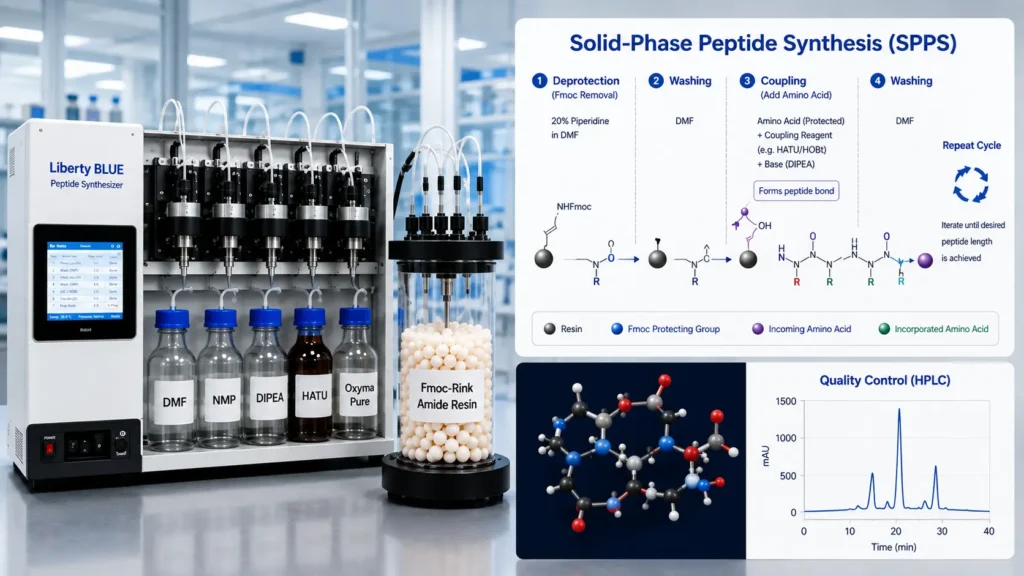
HATU vs. HBTU: What’s the Real Difference?
HATU and HBTU are similar in one way. Both use a small extra part, called a triazole group. But the helper part is not the same on each one.
HATU employs a moiety called HOAt. HBTU uses a component known as HOBt. This one small change makes a difference. The reagents were developed in the 1990s by chemist Louis A. Carpino. His work made hard couplings quicker and cleaner. Thus HATU is faster. It also better controls racemization at difficult steps.
HBTU is still a good choice for most peptides. It’s cheaper. It is a reliable everyday coupling reagent. HATU is often reserved for tough spots. These include amino acids with an extra methyl group or steps that link two big pieces of peptides together. Most labs start with HBTU. They only switch to HATU when some step gives trouble.
DIC and Carbodiimide-Based Coupling Reagents
DIC – diisopropylcarbodiimide. Another type of reagent, a carbodiimide. It works on the acid in a different way. It forms an O-acylisourea rather than the active ester used by HATU and HBTU.
Carbodiimides are among the oldest peptide synthesis coupling reagents. Today DIC remains popular. It is cheaper. It also produces a by-product which is soluble in a solvent. This makes it easier to filter-out than the older reagent DCC.
DIC is seldom used alone. It is coupled with Oxyma Pure or HOBt: These helpers avoid the same racemization problem that is seen with other reagents. DIC + Oxyma is a popular choice for large batches. It is cheaper. It is also safer to ship and store them than it is to ship and store HOBt or HOAt alone.
How Do the Main Peptide Coupling Reagents Compare?
| Reagent | Racemization Risk | Relative Cost | Typical Use Case | Scale Suitability |
| HATU | Low | High | Hard or blocked residues, joining large peptide pieces | Research scale |
| HBTU | Low–Moderate | Moderate | Standard, everyday coupling | Research scale |
| DIC + Oxyma | Low | Low | General use, cost-sensitive runs | Pilot to large scale |
| DIC + HOBt | Moderate | Low | Older, standard protocols | Large scale |
Does Coupling Reagent Order Matter?
Yes. Order of addition of reagents is important, both for speed and risk of racemization. Many labs use a pre-activation step. First they mix the amino acid, the reagent and a base. They wait a minute to five minutes. This allows the active form to fully build before adding the resin.
If the resin is added too early, the free amine can react with the starting material instead. This wastes reagents and slows the entire step down. With DIC the helper chemical has to go in simultaneously, not after. This keeps the racemization low. The peptide coupling order of reagents is a small point. But it has a big impact on the final purity of the peptide.
How Should You Choose the Right Reagent?
- Hard sequences: Bulky or sterically hindered amino acids often require HATU or DIC + Oxyma.
- Scale: Small research batches can afford to use expensive reagents like HATU. Large lots often shift to DIC based chemistry.
- Purity needs: Use a stronger reagent if the racemisation must be very low.
- Budget and supply: The final answer often depends on cost and availability of reagents.
No one peptide coupling reagent is the best choice for all jobs. Choose the best peptide coupling order of reagents that fits your sequence, your scale and your purity objective.
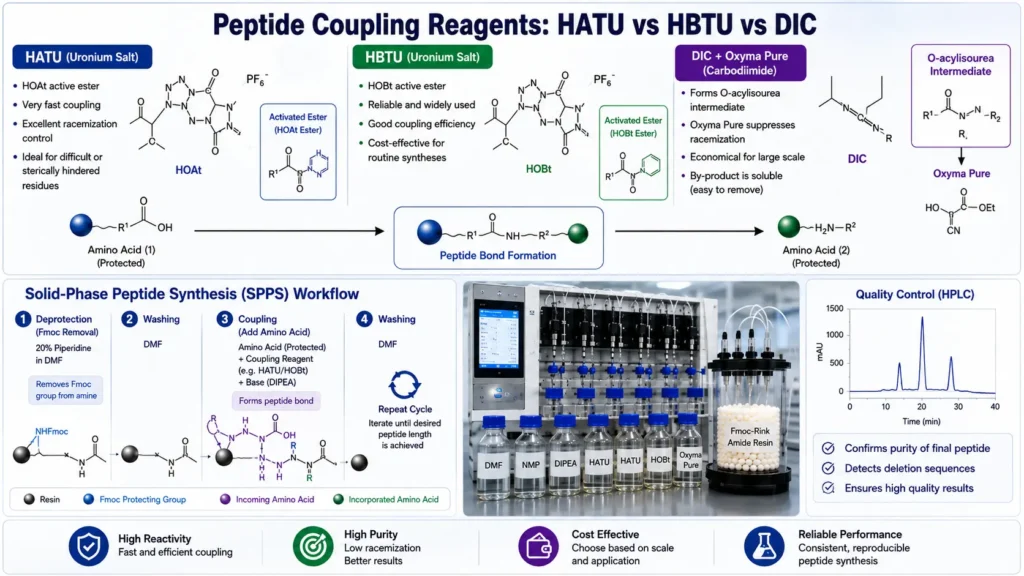
A Quick Peptide Coupling Reagents Review: Pros and Cons
- HATU– Good control of racemization. Fast steps are heavy. More costly. Needs dry storage.
- HBTU– Reliable and consistent. Less expensive than HATU. Doesn’t have the best on hardest steps.
- DDIC + Oxyma– Cheap. Safer in shipment and storage. Works well on a big scale. A little slower to come on.
- DIC + HOBt- History of long-term use. HOBt must be carefully stored for safety reasons.
This review of peptide coupling reagents is not a ranking. A quick glance at trade-offs. In most active labs there is more than one reagent available.
Frequently Asked Questions
What is a coupling reagent in peptide synthesis?
In peptide synthesis, a coupling reagent is a chemical that helps the joining of an amino acid to a growing peptide chain.
- This makes the reaction go fast, at normal room temperature.
- Typical examples are HATU, HBTU, and DIC.
- Most are used along with a helper chemical, like HOBt or Oxyma.
What is the difference between HATU and HBTU?
HATU part is HOAt, HBTU part is HOBt. This makes HATU more powerful and quicker.
- HATU is more expensive. It is often used for hard steps.
- HBTU is cheaper. This works well for most peptides.
How coupling reagents influence racemization?
Racemization is affected by the speed of the coupling reagents to lock the amino acid in a safe, stable form.
- The risk is slowed down by helper chemicals such as HOAt, HOBt and Oxyma.
- The most susceptible amino acids are histidine and cysteine.
Does the order of addition of reagent matter in peptide coupling?
Yes, peptide coupling is sensitive to the order in which reagents are added. It impacts the step performance.
- Most labs wait one to five minutes to add the resin.
- For DIC the helper chemical should be added at the same time, not later.
Best coupling reagent for difficult sequences?
HATU is often the method of choice for difficult sequences e.g. with additional methyl groups.
- DIC plus Oxyma is a cheaper alternative for the same hard steps on a large scale.
- “The last one is cost and purity needs.
Where can I find a PDF reference guide for peptide coupling reagents?
Many suppliers and research groups have a peptide coupling reagents pdf coupling-reagents online.
- A good starting point is a supplier’s certificate of analysis.
- Always confirm with a trusted, published lab method.
Conclusion
There is no “best” peptide coupling reagent for all jobs. The right one depends on your sequence, scale and what level of racemisation risk you can live with. HATU, HBTU and DIC each solve a different facet of this problem. Most active laboratories have more than one. See the guides on SPPS vs LPPS difference (solid-phase peptide synthesis (SPPS) and liquid-phase peptide synthesis (LPPS) for more on this topic).
Sichuan Pengting Technology Co., Ltd. can provide you with research-use-only (RUO) peptide coupling reagents and related raw materials for your bulk raw materials needs. They cater to institutional and industrial buyers. Their batch records and ISO/GMP-aligned quality checks help buyers verify quality before they scale up a synthesis.