One decision makes the whole synthesis. Before you start a coupling cycle you have to choose Fmoc or Boc. This choice determines your reagents, your equipment, and your risk for every step to come. Both strategies have been employed for decades in solid-phase peptide synthesis. They each do well in their respective settings. In this article we compare Fmoc vs Boc peptide synthesis from a chemical, safety and practical point of view.
The goal is a choice, not old habits, based on your sequence and your lab. We will also explain how each deprotection step works. We will see where the risks lie. We’ll also show when Boc still makes sense. By the end you will know exactly how to choose between them.
What Are Protecting Groups in Peptide Synthesis?
Protecting groups are small chemical moieties, They block the amino end of a growing peptide chain on coupling. This prevents side reactions that you don’t want to happen as the chain gets longer.
The protecting group is then cleaved after the coupling step. This is called deprotecting. It makes way for the next amino acid to attach. In Fmoc vs Boc peptide synthesis Fmoc chemistry differs from Boc chemistry in the type of protecting group like SPPS vs LPPS difference. One choice influences the type of resin, the protection of side chains, and the steps of final cleavage to follow.
Key Facts on Protecting Groups
| Attribute | Specification |
| Role | Protects amine group during coupling |
| Removed by | Base (Fmoc) or acid (Boc) depending on tactic |
| Used in | Solid phase synthesis and sometimes in liquid phase synthesis |
| Side-chain groups | Chosen to match the main strategy used |
Fmoc Peptide Synthesis: How It Works
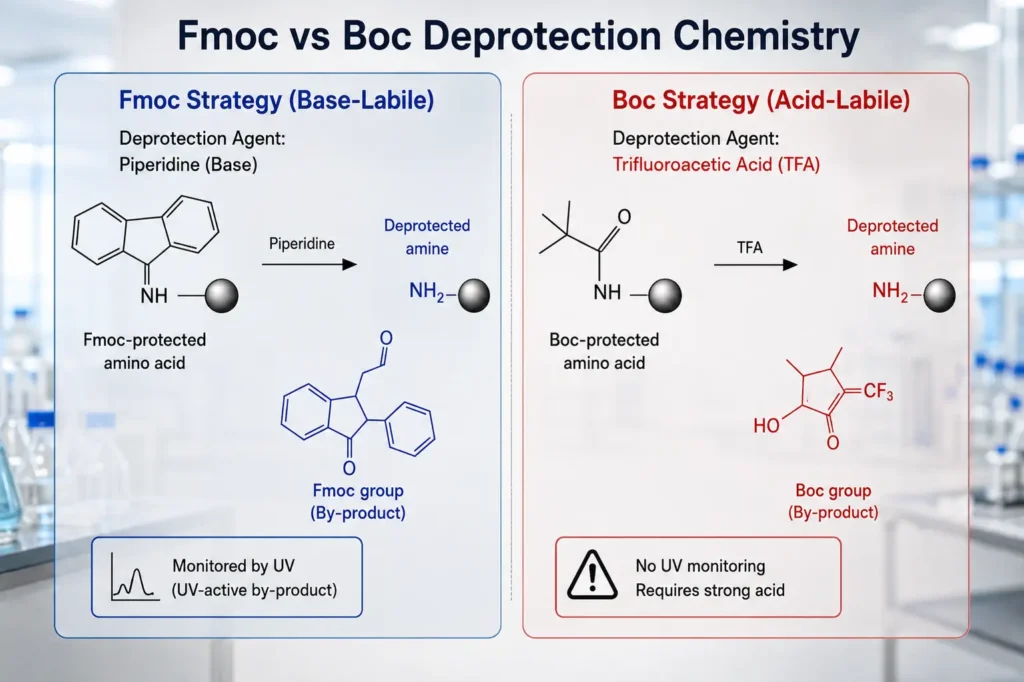
In Fmoc peptide synthesis, 9-fluorenylmethoxycarbonyl is used as protecting group. It comes on with a base, not an acid. Labs remove it by means of a piperidine solution, generally in dimethylformamide. The heart of the method is this mild Fmoc deprotection step.
The by-product of this step absorbs UV light. For this reason many labs monitor each deprotection cycle in real time. Part of the reason why fmoc solid phase peptide synthesis is the method of choice in most labs today is this built-in check.
Side-chain protecting groups used with Fmoc are generally acid labile. This means they remain fixed during the base step. Later they all come off, all at once, in one gentle final cleanup. This is a large part of the reason why fmoc based solid phase peptide synthesis works well for long or complex chains.
Boc Peptide Synthesis: How It Works
Synthesis of Boc-peptides. tert-Butyloxycarbonyl. This group is acidic, and not basic. In each cycle it is stripped by trifluoroacetic acid in the labs. All the steps here are acid mediated, unlike Fmoc.
The very first method used was Boc solid phase peptide synthesis. It was built by Bruce Merrifield in the 1960s. It is still a significant part of the history of peptide chemistry. But the final clean-up step requires a much stronger acid. This is often anhydrous hydrogen fluoride or some other strong acid.
That final step is hardest on the Boc work. It requires special equipment, good ventilation and strict safety precautions. You don’t need any of this for Fmoc work.
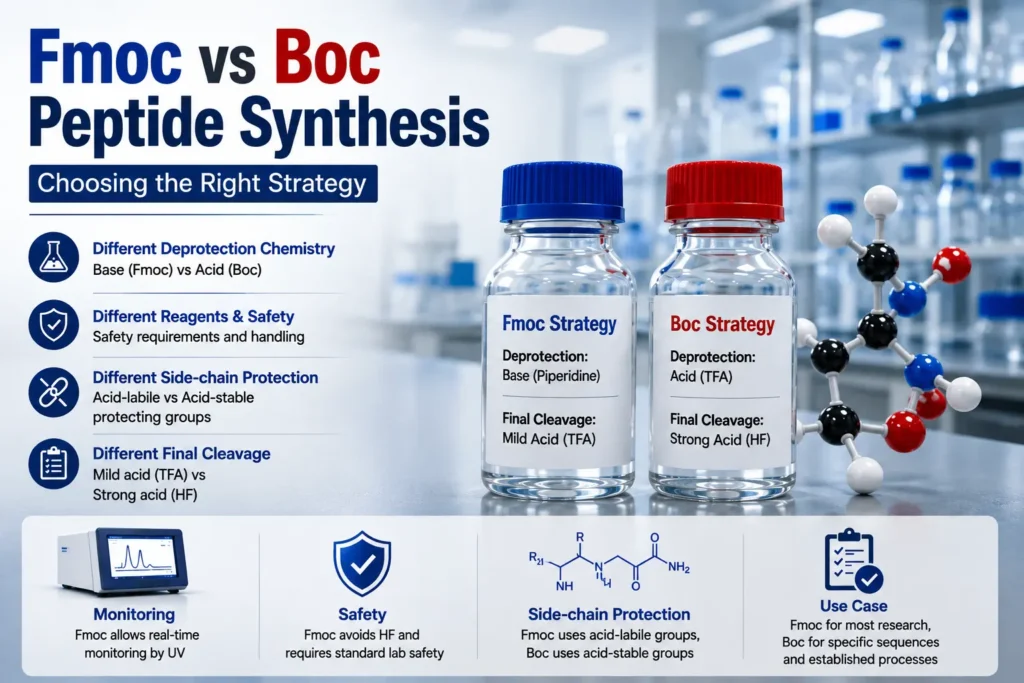
Fmoc vs Boc Deprotection Chemistry: The Core Difference
The basic difference is easy to state. A basic reagent is used to remove Fmoc. Boc is removed with acid. Here begins every other difference between the two.
Fmoc uses piperidine so side chain groups can be acid labile. They go through the whole build and come off in one mild step at the end. Boc involves repeated acid steps, so side-chain groups must be acid resistant throughout. That is the reason why Boc work needs stronger side-chain groups and more rigorous final clean-up. Resin choice, side-chain protection, and lab safety are dictated by one chemical fact from start to finish.
Fmoc vs. Boc: Full Strategy Comparison
We compare the two strategies side by side in the table below. Use that to figure out the most important things to think about when planning a synthesis.
Strategy Comparison Table
| Factorisation | Fmoc Approach | Strategy Boc |
| Deprotection Agent | base: Piperidine | Trifluoroacetic acid (acide) |
| Reagent for final cleaning | TFA based mild acid | Strong acid (usually anhydrous HF) |
| Equipment/Safety requirements | Conventional fume hoods | Special HF handling kit |
| Surveillance | Deprotection can be followed by UV light | No native UV check |
| Side reaction hazard primary | Aspartimide formation | tert-Butylation of labile residues |
| Now in common use | Most work and research | Ancient processes, tough sequences |
Why Most Labs Now Default to Fmoc Chemistry
The majority of labs today use Fmoc, mainly because it does not involve the use of hydrogen fluoride. This is a big part of how labs weigh Fmoc vs Boc peptide synthesis for day to day work. No HF also means no special gas handling equipment, and a lower safety burden overall.
UV light can be used by labs to track each deprotection step when using Fmoc chemistry to synthesise peptides. This allows a direct check that each cycle worked. Boc work doesn’t give you this same cheque. Fmoc is also compatible with many acid-labile side chain groups. This provides a good baseline for most new projects.
This does not mean that Boc is a bad method. It shows which trade-offs fit the tools and pace most labs use today.
When Boc Strategy Still Makes Sense
This is not one sided in a fair comparison of Boc strategies. There are still some sequences and labs that do better with the old way. Hard and sticky sequences can better respond to the acid stable groups Boc all the way.
Some side-chain requirements also point to Boc:
- Sequences that are less responsive to repeated base exposure
- Existing manufacturing lines built and proven around Boc
- Projects where the last HF step produces cleaner results for one target
- Labs already established and trained for acid-based, HF work
This does not make Boc the new default. Which is why the technique is still used today, in real, serious work.
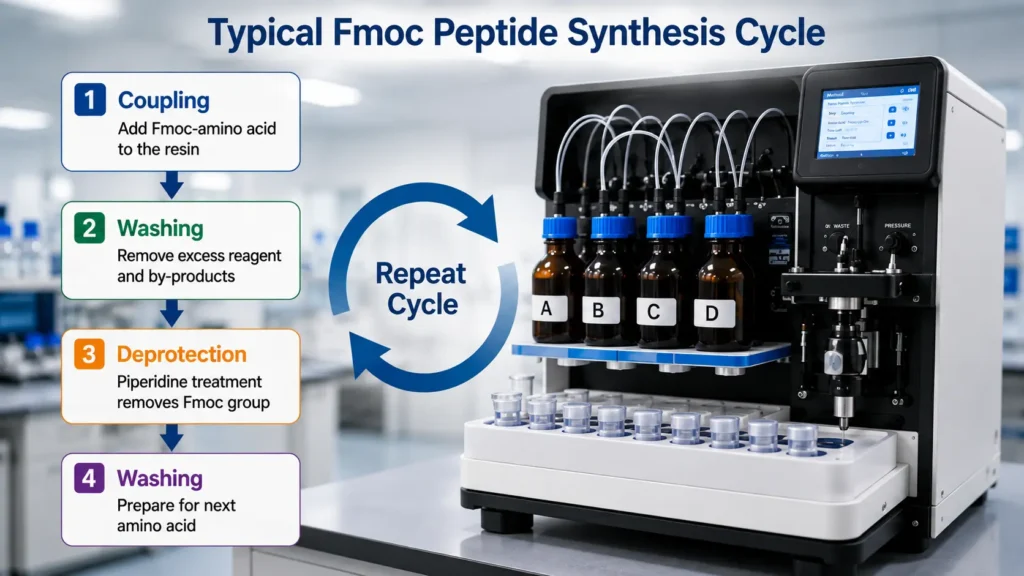
Fmoc Peptide Synthesis Protocol: What a Typical Cycle Looks Like
A typical Fmoc peptide synthesis protocol is a repeating cycle, not a single step. Each round adds one protected amino acid, deprotects it and washes the resin before the next round begins.
That cycle’s general shape is here:
- Add the next Fmoc-amino acid to the chain on resin
- Remove excess reagent and leftover byproducts
- Treat with piperidine to remove the Fmoc group.
- Wash again and repeat for the next amino acid.
This is a general outline, not a recipe step-by-step. Actual conditions, amounts and timing will vary by sequence and equipment used.
Side Reactions and Risks: What Each Strategy Must Watch For
The safety story is not the entire story of Fmoc vs Boc peptide synthesis. Neither is without risk. Each has its own main side reaction to plan for. The big risk with Fmoc is aspartimide formation. This is most evident in sequences containing an Asp-Gly pair, repeatedly exposed to base.
Boc has a different risk, related to its acid-based cycles. Tert-butylation on sensitive amino acids can be achieved by repeated exposure to acid. The longer the chain, the higher the risk.” An important part of any Fmoc vs Boc peptide synthesis buying decision is knowing which risk applies to your sequence before you begin. It’s a call from your sequence, not a hard and fast rule.
Frequently Asked Questions
What’s the difference between Fmoc and Boc peptide synthesis?
Fmoc and Boc peptide synthesis differ in the way they remove their protecting group. Base piperidine is used in Fmoc . Boc uses acid, TFA. This single fact is the gear, the choice of side chains and the final cleanup for the whole build.
- Fmoc: base labile, mild final deprotection
- Boc: Final deprotection by strong acid, acid-labile group
Why do we use Fmoc today instead of Boc?
More common is Fmoc. It does not employ hydrogen fluoride and laboratories can follow each step of deprotection by UV light. Most labs prefer the wider fit and lower safety load with acid sensitive side chain groups.
- No special HF equipment needed
- Progress can be followed in real time
What are protecting groups in peptide synthesis ?
Protecting groups are small chemical groups that block the amino end of a chain during coupling. This precludes any undesired side reactions. After each round of coupling they are stripped in a controlled step.
Special equipment for Boc peptide synthesis?
Yes, special equipment is needed for Boc peptide synthesis, especially for the last step of purification. Anhydrous hydrogen fluoride or an acid of similar strength requires special equipment and ventilation not required for Fmoc work.
Can you mix Fmoc and Boc ?
In some cases a build can be a combination of both strategies. That’s not normal, normal work. Most projects apply one strategy throughout the project to ensure consistency in resin, side chain groups and cleanup steps.
Which strategy is better for peptide synthesis, Fmoc?
Today, Fmoc-based methods are the easy default for most routine peptide synthesis. They require less protective equipment and are easier to inspect on the move. Boc chemistry still fits best for some difficult sequences or labs already set up for acid-based cleanup.
Conclusion
Fmoc vs Boc peptide synthesis- there is no clear winner. The right one depends on your sequence, your equipment and what risks your lab can handle. Fmoc chemistry is used for most standard work and has less safety load. Boc chemistry still has its place for select hard sequences and proven acid-based lines.
For laboratories that require the raw peptide material for such work, Sichuan Pengting Technology Co., Ltd. offers Research Use Only peptide APIs backed by sound analytical data. This is a good fit for institutional and bulk buyers running either strategy at scale.